By FIZA BAKSHI
My legs remembered the climb before I did. That particular ache up the calves, the old reflex of leaning into the turn by the tuck shop. I graduated from Woodstock in 2019, and for seven years I’ve told people, half-jokingly, that this school’s first real lesson was cardiovascular endurance. Walking back up that same incline last month, I felt closer to disbelief than nostalgia. I wasn’t visiting anymore. I was climbing up to interview the man now sitting in the oldest, most storied office on this hillside, the latest custodian of a legacy that stretches back 170 years.
Woodstock’s story began in 1854, when three women arrived in Landour and started a school for girls. What they built has since outlasted the East India Company, two World Wars, Partition, and enough political upheaval to fill a nation’s history books, always finding its way back to ordinary mornings on the mountain. By 1959, it had become the first school in Asia, and only the third outside the United States, to gain American accreditation.
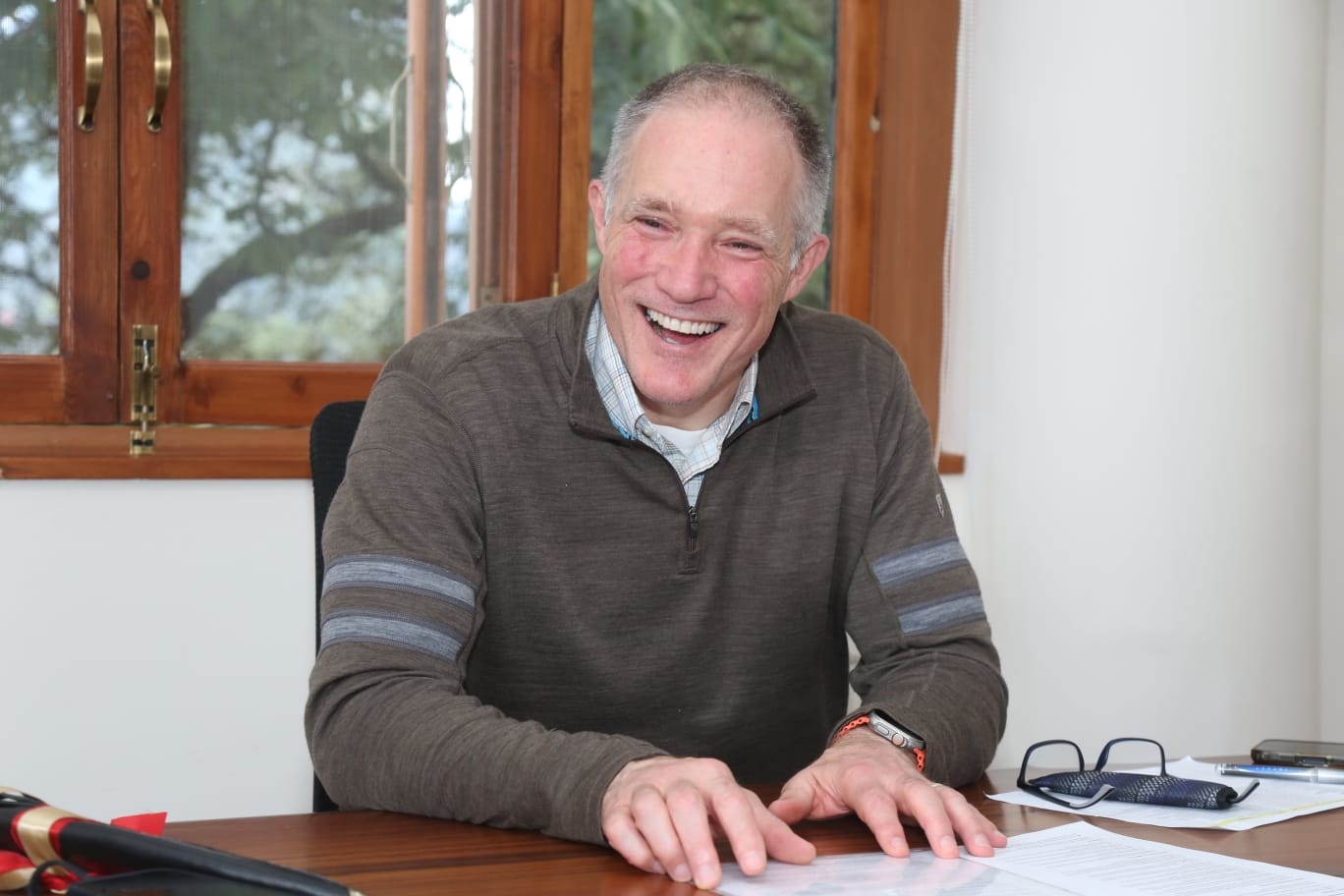
This is the legacy Dr. Blair Lee stepped into two months ago. His office still carries its history with it, dark wood panelling worn smooth by decades of hands, tall windows, a fireplace that has warmed generations of principals before him. It feels less like an office and more like a warm and familiar room inside the school’s own memory. And sitting there with him, it became clear. He knows exactly what has been placed in his care.
The afternoon carries that familiar mountain chill, the kind of mountain cold that feels almost comforting once you’re indoors, sunlight pooling softly across his desk as he walks me through a career that reads like a well-worn atlas. Twenty-five years in international education have taken him from Kuwait to a mining camp in Indonesia, to Seoul, to China, to Jeju, before finally bringing him here. For him, schooling has always been fundamentally a people business. Every subject taught here is ultimately in service of one larger goal, raising people capable of building a kinder, more peaceful world.
That philosophy reveals itself in unexpected little ways. He has two tattoos, both marking mountains he climbed with his sons, Kilimanjaro on one calf and Everest on the other, offered up cheerfully as the least principal-like thing about him, and, as it turns out, entirely in keeping with a man running a school built into a mountainside. When it comes to punctuality, however, he is clear about what he values. He wants to keep punctuality, but would happily do away with the bells. He believes people should learn to own their sense of time, rather than rely on a bell to tell them when to move. As an alumna myself, I couldn’t agree more. The real world doesn’t run on bells, and punctuality, like most things worth keeping, only means something once it becomes instinct rather than instruction.
On artificial intelligence, arguably the most contested subject in education anywhere right now, he has a position that feels less like policy and more like philosophy. Instead of resisting it or simply following its lead, he wants Woodstock to shape how it is used, doubling down deliberately on what he calls Human Intelligence. Character, intuition, emotional intelligence and relationships. Knowledge, he points out, has never been more accessible. What remains scarce, and worth protecting fiercely in a classroom, is humility, compassion and grace. Those are the things no machine can manufacture on command.
What struck me most, though, was how thoughtful he is about what he wants to build on in this place. He’s generous about what Woodstock gets right, the traditions that tie an alumnus in Seoul to one sitting across from him in Mussoorie, the sense of belonging this hillside slowly builds in anyone who stays long enough. But he’s equally clear-eyed about where there is room to grow.
A boarding school, he pointed out, has its students seven days a week, not five, and he doesn’t think Woodstock has fully used that. The learning happening in a Tuesday classroom, in his mind, shouldn’t live in a separate world from whatever a student is doing on a Saturday afternoon on that same campus. It’s less a criticism than an invitation to build further on strong foundations.
You can already see some of that on campus. A visiting MIT professor is in residence right now, working directly with students, and Lee spoke about it with real delight, as he did about the Centre for Imagination, which has been bringing that kind of learning out of its own building and into the classroom.
And perhaps that is what I found most interesting about his vision for Woodstock. It isn’t about turning the school into something unrecognisable. If anything, much of what he is talking about feels like a return to what the school has always understood instinctively. Woodstock has never been only about what happened inside a classroom. When I was here, some of the most important parts of growing up happened on the walks between places, in dormitories, on the playing fields, during evening activities, on expeditions and in the ordinary business of living alongside other people. The mountain itself was part of the education.
Lee seems to want to make that idea more deliberate. He talks about a place-based curriculum rooted in the Himalaya and about students developing a genuine relationship with the environment around them. As I heard it, he wants them to understand that they are not simply living in these hills for a few years, but are part of a place with its own history, culture, people and responsibilities. And as someone who spent some of my own most formative years here, that idea feels less like a new direction than a reminder of what has always made Woodstock special.
That sense of rootedness also extends beyond the school gates. Lee is candid about the ways Woodstock has become somewhat insulated from Mussoorie and Dehradun, shaped by Covid, traffic, tourism and concerns about safety. His instinct is to find more authentic ways for the school to learn from the community around it and give something back. That is refreshing. He isn’t talking about community engagement as a glossy new initiative. He seems to see it as a relationship that needs to be rebuilt properly.
Then he told me a story from his time in India so far that seemed to capture that philosophy better than any formal vision statement could. A tailor in the bazaar invited him for tea. Over tea, the tailor told him that his years of work for Woodstock had enabled him to send his daughter to school. She went on to become a teacher, and now works with UWC. On the surface, it is a simple story. It was a small encounter, but one that seemed to reveal just how closely Woodstock’s story can become intertwined with the lives of the people around it.
Perhaps that is why Lee speaks so naturally about relationships. He describes India as warm, relationship-centred and spiritual, and this is his first real experience of the country. For now, his priority is simply to listen, build relationships and get to know the people who make up this community.
That belief in relationships also shapes how he thinks about the families and alumni who surround the school. He sees parents as a child’s first and best teachers, and believes Woodstock’s alumni network has the potential to become one of the school’s greatest strengths. The opportunity, as he sees it, is to turn that network into a real source of guidance for students as they navigate the decisions that come after school, from choosing universities to finding their first footholds in the working world. The school’s alumni are scattered across the world, connected by a shared experience that many of us understand almost immediately when we meet one another. He sees a chance to bring that network closer to the students who will eventually join it.
When I asked what success would look like to him at the end of his career, his answer had very little to do with rankings, university placements or anything that could be neatly measured. He returned instead to a line he once heard from another head of school, that a school should not be judged by where its students go at eighteen, but by the lives they have touched by the time they are eighty.
It is the kind of measure that shifts the entire idea of what a school is supposed to leave behind.
So I asked him to imagine a former student running into him ten years from now, at a coffee shop, perhaps somewhere thousands of miles from this mountain. What would he want that student to say about Woodstock?
His answer came without hesitation. He hoped they’d say the school believed in them. That the people here helped them become bigger than they thought they could be. That they felt genuinely cared for, and that somewhere along the way, they learned to carry that same care into the world and into the way they treated other people.
That answer moved me, particularly because it strips the idea of a successful school down to its simplest form. Not the university a child gets into. Not the job they eventually land. Not the title beside their name. But decades later, they can look back and remember that someone believed in them when they were still figuring out who they were.
For a parent, that is one of the most reassuring things a principal can promise.
For an alumna, it sounded remarkably familiar.
Walking back down that ramp, I wasn’t thinking about gravity or cardio endurance anymore. I was thinking about how full my heart felt, how unexpectedly overwhelmed and nostalgic the whole afternoon had left me. This mountain, this school, exactly as I’d left it and completely new all at once.
But more than that, I kept thinking about Lee’s vision for the school. About a Woodstock that, as I understood it, can embrace AI without losing its humanity, that can use its seven-day boarding life more meaningfully, that can teach children to belong to the Himalayas rather than simply live in it, and that can open itself back up to the community beyond its gates.
What moved me most was that none of it felt like a rejection of the Woodstock I knew.
It felt like an attempt to understand what was worth preserving about it, and then carry those things forward.
I came back to the mountain as an alumna expecting nostalgia. I left with a feeling that was more complicated and, in many ways, more hopeful. The school I knew is still here, in the ramps and the bells and the children racing up the hillside. But there is someone new sitting in that old office, thinking hard about what those children will carry with them when they leave.
And if his answer about the coffee shop is anything to go by, he isn’t simply thinking about where they will go.
He’s thinking about who they will become.