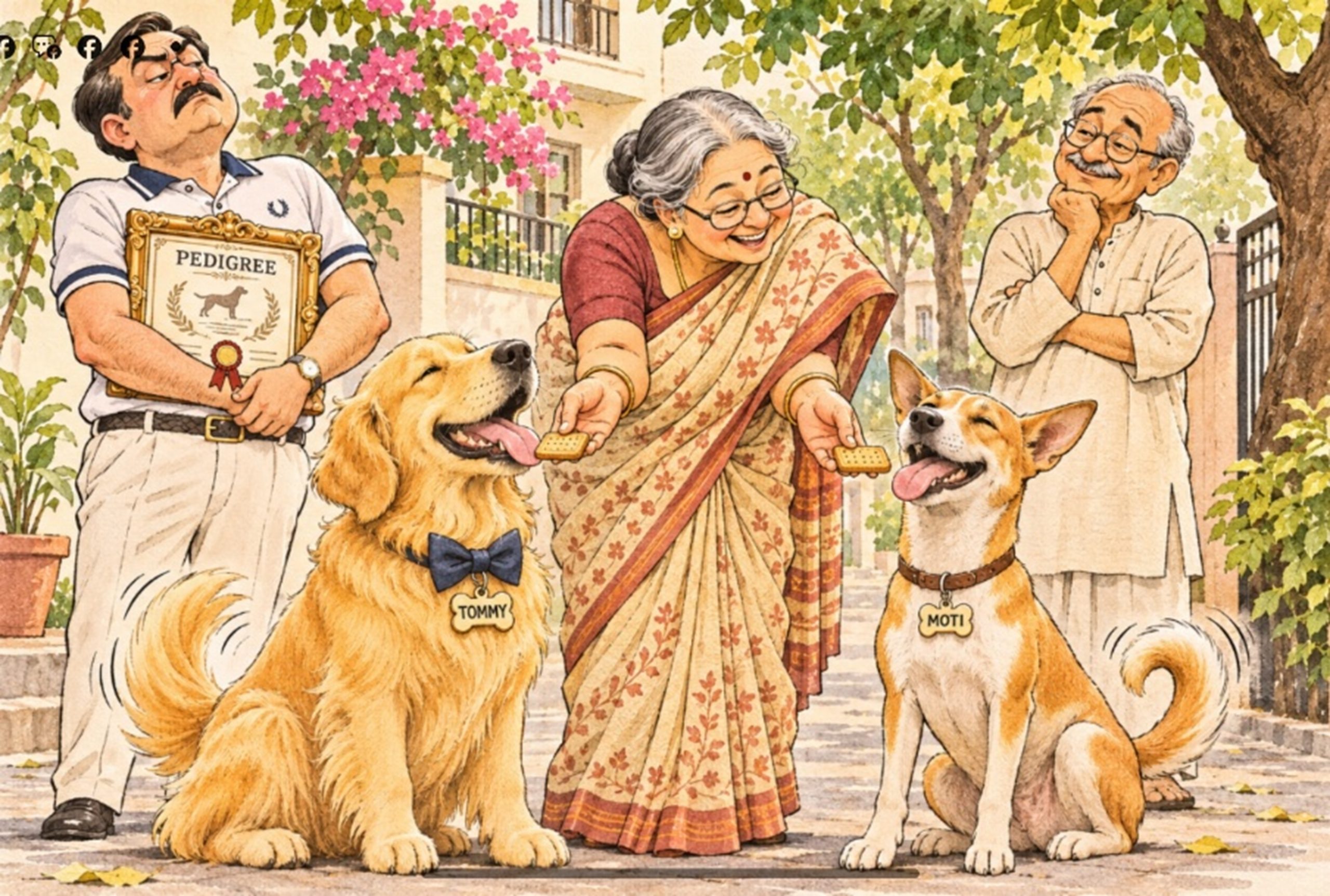
Oliver and Moti
 By Aloke Lal
The first time my neighbour’s dog bit someone, we were told that the ‘furry baby’ had “boundary issues”. When my dog barked at the same man, the Residents’ Welfare Association discussed whether animals like him should be allowed inside the colony. This was when I realised that class struggle had acquired a tail.
My neighbour, Mr Kapoor, owns Oliver, a dog whose ancestry occupies more pages than my service record. I own Moti, whose mother I knew by sight and whose father maintained the discretion customary among men with complicated personal lives.
Oliver came with certificates. Moti came with a tick. We dealt with the tick. The certificates continue to be discussed.
“Oliver is a purebred,” Kapoor informed me.
“Moti is also pure,” I replied. “He has never accepted a bribe.” Kapoor gave me the patient smile reserved for people who have failed to understand an investment.
“You don’t understand. His grandfather was a champion.”
“Mine was a schoolteacher. We must both learn to live without inherited glory.”
Oliver was purchased after extensive research, several telephone calls and a payment that could have financed a modest wedding. Moti followed me home from the vegetable market. Initially, I thought he had mistaken my kindness for an invitation. Later, I realised he had correctly identified the weaker party in a future domestic arrangement. Within three days, he occupied the verandah. Within a week, he had a bowl. Within a fortnight, my wife was asking why I had disturbed him while he was sleeping. I had lived in that house for thirty years without acquiring comparable rights.
Oliver eats imported food described on the packet as “ancestral nutrition”. Apparently, his ancestors hunted salmon, sweet potatoes and blueberries. Moti eats what his veterinarian recommends, supplemented by whatever he can persuade my wife the veterinarian has overlooked.
Oliver has a sensitive stomach. Moti has a persuasive face.
“He cannot tolerate ordinary food,” Kapoor explained.
“Neither can I,” I said. “But my wife says the cook is already doing her best.”
Oliver’s meals are measured in grams. Moti’s are measured in accusations.
“Look at him,” my wife says. “You haven’t fed him.”
“I fed him ten minutes ago.”
“Then why is he looking like that?”
Because he has discovered that famine can be performed.
The naming issue began bothering me at the colony’s annual pet gathering. There were three Brunos, two Bellas, a Duke, a Coco and a creature called Sir Winston who was eating a paper plate.
Then the organiser reached us, “And this is?”
“Moti.”
Her expression suggested I had brought a pressure cooker.
“Oh. An Indian dog.”
“Yes. He has decided to stay despite everything.”
“What breed?”
“Dog.”
She waited. I waited. She seemed to be wondering if merely ‘dog’ was enough to describe Moti or would an additional Latin or Greek word needed to be appended. I thought of adding the word Bharatiya.
Unaware of the cerebral exercise going on in two human heads, Moti scratched himself, contributing corroboration to the information about the training school he had been to: none at all.
Kapoor, who was hovering around, intervened.
“He means an Indie.” The face had an expression of a person who had seen a dead rat in a drain.
Immediately, the organiser brightened. “Oh, an Indie! How lovely!” I looked at Moti. Without moving a paw, he had been upgraded. I even thought of giving him a ribbon bearing the colours of our beloved tricolour to be tied in a bow between his ears. For the record: Moti’s ears stand up like those of a German shepherd!
That evening I raised the matter at home. “Padosi ka kutta Oliver hai to mera kutta Moti kyun?” “Because you named him,” my wife said. This was technically accurate and therefore deeply unhelpful. That quip, however, missed the essence of my question. A question which had pathos and resignation written all over it.
I considered changing his name to Mozart. For two days, I called out, “Mozart! Mozart!” He ignored me. Apparently, he had grown deaf like the legendary musician himself. I started feeling responsible for the loss when on the third day, the vegetable seller shouted, “Moti!” He arrived at a speed suggesting that it was European classical music that had been holding him back. I felt the relief of being free of guilt, and the satisfaction that Moti had his desi credentials unharmed. We abandoned the experiment and saved our best friend from acquiring anything foreign.
Oliver understands commands in English. “Sit.” “Stay.” “Leave.” Kapoor demonstrates these whenever visitors come. Oliver sits occasionally, stays selectively and leaves only after taking the cushion. Like all beings high-bred, he has a mind of his own.
“He’s very intelligent,” Kapoor explains. “He questions authority.”
Moti understands Hindi, gestures, the refrigerator door and the precise sound of a biscuit packet being opened behind a closed bedroom door.
He also understands “Chalo, naha lo.” At those words, he disappears so completely that I have considered recommending him for witness protection.
Yet Oliver is described as “highly trainable”. Moti is described as “stubborn”. I have noticed that expensive disobedience attracts better vocabulary.
Oliver attends a grooming salon. His appointment includes shampooing, conditioning, nail care and something called a blueberry facial.
I have never had a blueberry facial. I mentioned this to my wife.
“That’s because Oliver doesn’t complain about the household expenses,” she said.
Moti’s grooming takes place in the courtyard, where three adults negotiate with one wet defendant. Afterwards, he rolls in the flowerbed. My wife calls this disgusting.
Kapoor says Oliver enjoys “sensory enrichment”. The toys that he gets to play with must address this requirement. They cost a pile of cash, yet Oliver has the choice to reject with disdain every three out of four he is offered.
I am beginning to think we need a public relations consultant. Moti makes me feel socially insecure at times. The real test came during a colony security meeting. A series of thefts had alarmed residents.
Kapoor spoke proudly about Oliver’s protective instincts. “He comes from a guarding line.” Moti, who had accompanied me, slept through this claim. At that moment, a delivery boy entered. Oliver rushed towards him. Excellent, we thought. Then he rolled over to have his stomach rubbed.
“He’s assessing the threat,” Kapoor explained.
Meanwhile, Moti woke, walked to the gate and barked at a man attempting to wheel away the secretary’s bicycle. The man abandoned it and fled.
There was a brief, uncomfortable silence.
“Of course,” Kapoor said, “street exposure does develop certain survival skills.”
The secretary recovered his bicycle. Oliver recovered his belly rub. Moti went back to sleep. Since then, people have become warmer towards Moti. Someone called him “our indigenous security asset”. Another suggested a certificate of appreciation. I declined. One dog in the neighbourhood with paperwork was enough.
Yesterday, Kapoor and I met outside our gates. Oliver was wearing a bow tie. Moti was carrying one of my slippers. “You must admit,” Kapoor said, “pedigree does make a difference.” Before I could reply, Oliver spotted Moti and bounded over. They sniffed, wagged and set off together towards a promising smell near the hedge. Neither asked about the other’s grandfather. Kapoor hurried after them, calling, “Oliver! Come back!” I called, “Moti!” Both ignored us. At last, equality.
A week later, Kapoor informed me that Oliver’s tail had been praised by a visiting breed expert. “Perfect carriage,” he said. “Exactly what the bloodline demands.” Until then, I had assumed a tail was something a dog brought along without professional supervision. I looked at Moti’s. It curved upwards, with no apparent concern for the family’s reputation.
“Has his ever been assessed?” Kapoor asked.
“Regularly. By my wife. If it knocks over a flowerpot, she assesses it quite severely.”
Just then, my wife appeared with treats. Both tails began wagging. Oliver’s moved in accordance with generations of distinguished breeding. Moti’s moved without supporting documents.
Both received a biscuit.
Kapoor looked faintly disappointed.
Apparently, my wife had introduced equal pay for equal wag.
Kapoor bothered over the sugar content in the biscuit. I adored the way Oliver was drooling over the treat.
(Aloke Lal is a former DGP, author of six bestselling books, painter and TEDx speaker. He is the festival director of the Crime Literature Festival of India.)