World Heritage Week concludes at DLRC
Garhwal Post Bureau
Dehradun, 25 Nov: At the conclusion of World Heritage Week, a programme on heritage conservation was organised at the Doon Library and Research Centre on Wednesday, jointly by the Archaeological Survey of India (ASI), Dehradun Circle, Doon Library & Research Centre and INTACH, Uttarakhand State Chapter.
The programme featured a photographic exhibition and a public awareness lecture on the theme, ‘Emergency Measures for the Protection of Living Heritage in Situations of Disaster and Conflict’. The discussions highlighted the need to safeguard historical monuments, archaeological sites, cultural heritage and the collective memories associated with them during natural disasters, conflicts and other crisis situations.
The Chief Guest, N Ravi Shanker, former Chief Secretary, and Honorary Director of the Doon Library and Research Centre and Chairman of the INTACH Uttarakhand State Chapter, said that heritage is not merely a legacy of the past but a living foundation of society’s identity, knowledge and collective experience. He emphasised the need to encourage greater public participation in conservation efforts and to integrate heritage sensitively into the development process. He observed that, in the face of natural disasters and changing circumstances, institutional initiatives must be complemented by awareness and active participation of local communities to prevent damage to heritage assets.
Dr. M. C. Joshi, Superintending Archaeologist (In-Charge), Archaeological Survey of India, Dehradun Circle, spoke about the relevance of World Heritage Week and the role of the ASI. He explained that World Heritage Week is observed every year from 19 to 25 November. Its objective is to create awareness, particularly among young people and students, about the country’s historical, cultural and archaeological heritage. He also highlighted the work being undertaken by the Dehradun Circle in the conservation of monuments, scientific excavations, documentation, dissemination of public information and maintenance of heritage sites.
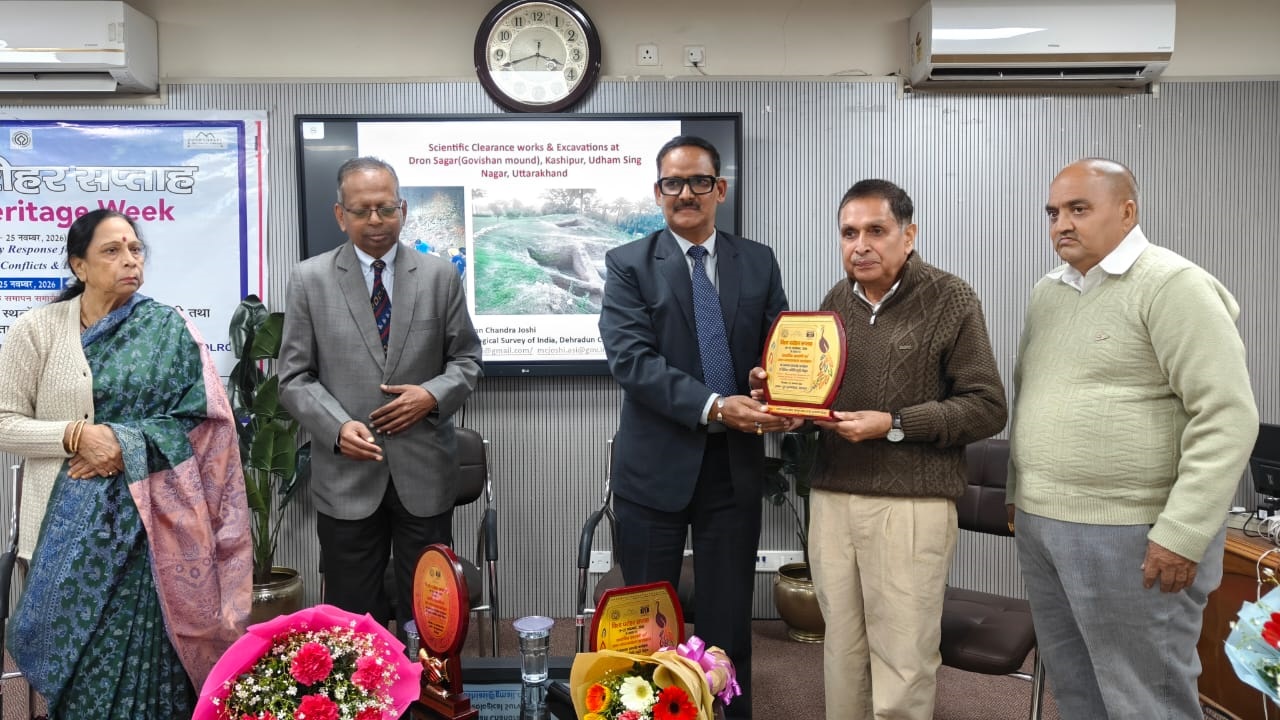
On the occasion, Dr M. C. Joshi delivered an illustrated presentation on the scientific clearance and archaeological excavation at Drona Sagar (Govishan Mound) in Kashipur, Udham Singh Nagar district of Uttarakhand. Through photographs and visual documentation, he elaborated on the excavation site, archaeological remains, scientific procedures and the historical indications emerging from the findings. His presentation proved highly informative for the audience, familiarising them with the local archaeological heritage, its historical significance and the scientific methods involved in archaeological excavation.
He further informed the gathering that the ASI Dehradun Circle is responsible for the conservation and management of 42 centrally protected monuments and archaeological sites in Uttarakhand. These include the Ashokan Rock Edict at Kalsi, Katarmal Sun Temple, Jageshwar Temple Group and Khalanga War Memorial. Archaeological excavations undertaken by the Circle at Govishan (Kashipur), Purola, Veerbhadra (Rishikesh) and Jagatgram have also made significant contributions to understanding the history of the state. He also referred to initiatives aimed at improving accessibility, such as Braille booklets, a talking website and the ‘Monuments of Uttarakhand’ mobile application, which are helping make heritage-related information accessible to a wider audience.
Dr. Lalata Prasad, Honorary Museum Adviser to the Doon Library, observed that museums, libraries and historical monuments are important institutions that preserve the collective memory of society. They enable younger generations to understand their history, traditions, art and cultural evolution. He emphasised that heritage conservation should not remain confined to experts but should become an integral part of the lives and everyday practices of ordinary citizens.
At the outset, Chandra Shekhar Tewari, Programme and Research Officer at the Centre, welcomed the dignitaries on the dais. He said that heritage conservation is not limited to protecting old buildings, sculptures or archival records; it is also an endeavour to preserve the values, knowledge, traditions and historical experiences that connect society with its roots. He emphasised that timely preparedness, a scientific approach, documentation and collective responsibility are essential for safeguarding heritage during disasters and conflicts. Such programmes, he added, generate historical curiosity among students and young readers and help nurture citizens who are sensitive to the importance of conservation.
The programme was successfully conducted by Dr. Pal Singh Rana, Assistant Archaeologist (Technical), Archaeological Survey of India, Dehradun Circle.
The photographs displayed during the programme illustrated various aspects of heritage conservation, measures to be adopted during emergencies and the vulnerability of archaeological assets. The speakers unanimously emphasised that sustained cooperation among government institutions, experts, local communities and young people is essential for protecting cultural heritage.
Mementoes were also presented to the dignitaries on the dais by the Archaeological Survey of India, Dehradun Circle.
Among those present were officials of the Archaeological Survey of India, Dehradun Circle, including ASI staff, Dr. Sudha Rani Pandey, Pankaj Naithani, Dr. Yogesh Dhasmana, Sundar Singh Bisht, Rakesh Kumar and Avtar Singh, along with young readers, students, history enthusiasts and other distinguished members of the community.