All Around the World with the Most Travelled Indian
 By Nitin Gairola
Did you know that ship breaking is actually a thing? Have you ever wondered what happens to these massive sea monsters when they get old, which is around the age of 30? Are they sunk into the sea? Well not really because you don’t want a lot of rusted metal lying below the waters and impacting marine ecosystems. And in this day and age we are not talking about wooden vessels which sunk quite often during the voyages of discovery from the 1400s to 1700s but didn’t destroy marine life. These modern day ships are giants and there are many such giants from the booming merchant navy days of the 1980s and 1990s that just can’t just be left out in the open to rust. It would be an environmental disaster of epic proportions, wouldn’t it? Well it is still an environmental disaster though not in the waters of developed nations that made them, but somewhere else.
So yes, ship-breaking is more than just a thing, it’s a full brown industry. Sometimes called ship graveyards, it is the place where sea faring monsters are dismantled, disassembled (but not demolished) so that they can be turned into raw material for other industries such as steel, aluminum etc. Basically there are private yards which purchase junk ships at a bargain price and via their labour turn the ‘cheap’ raw material into something more valuable in the secondary market (I write ‘cheap’ with caution as we are talking about millions of dollars). So it is a very profitable business and it pays some of the highest unskilled worker wages but that is only one side of the story. This is also one of the most dangerous jobs on Earth besides its severe impact on the environment.
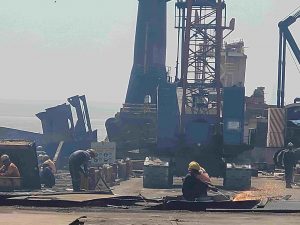
I had read a National Geographic article from their May 2014 edition on ship-breaking industry of Bangladesh and was horrified by the realities which were captured by photographer Mike Hettwer at a yard near Chittagong in Bangladesh. Basically photography was not allowed there, so instead of coming in from the land, he paid a fisherman and entered from the sea and hid in the shadows of the vessels to capture his story that was penned by Peter Gwin. It is then that I got to know that Bangladesh leads in shipbreaking (at Chittagong), followed by India (Alang), China (Xinhui & Jiangyin), Pakistan (Gadani) and Turkiye (Aliaga) and the working conditions in Bangladesh are particularly appalling.
Matter of chance, on 6th April The Economic Times came out with an article on Alang too, very aptly named ‘Breaking Bad’ and highlighted the dwindling ship breaking numbers in India, from around 400 in FY 2011-12 to only 113 in FY 2024-25 (Note – FY stands for Financial Year in India, and is from April to March, not January to December). This volume is only 25% of the capacity at Alang which means looming unemployment. In this recent piece I also got to know that China has discontinued the industry and the Pakistani one gets only 5% of the global volumes now with 46% coming to Bangladesh and 33% to India and the rest going primarily to Turkiye which caters to European vessels. Both National Geographic and Economic Times have acknowledged that the working conditions in India are far more humane and with the private ship breaking factories meeting safety standards. The reporter in me wanted to find out first hand. Besides as always, we wanted to visit a unique destination.
This was April of 2023 and sort of like a birthday holiday (mine falls on 5th April). While many were quite dumbfounded when they heard how I wanted to celebrate my birthday, I knew this trip would give me a kick (since chances were high that I would be kicked out of the private yards).
As I said, photography here is a big no-no, so you really need to keep your DSLR or mirrorless out of sight. But going back a bit, we had taken the RORO ferry (Roll-in, Roll-out for cars I guess) from Surat’s Hazira port to Ghogha port near the town of Bhavnagar in Gujarat at the Gulf of Khambhat. From there Alang was not too far. But we first rested in Bhavnagar, which is a peaceful residential town where a lot of merchant navy officer’s families live. One of those merchant navy families was that of my aunt and uncle (Ava & Dinesh Thapliyal) way back in the late 1980s and they are now living a peaceful life in good old Doon. In fact the merchant ships which my uncle used to captain back then would be coming to Alang pretty much now. I was a tiny tot when I had first visited Bhavnagar in 1988 and 35 years later, there I was again, definitely a bit nostalgic.
Now during the RORO ferry ride, by chance we struck a conversation with a person who knew someone who worked at one of the private yards. He understood that we wanted to see the yards through our own eyes and actually told us to refer the name of the person, who incidentally was somewhere in Rajasthan at that time. In any case he told us that if we took his name we were likely to get access. That’s the benefit of not being shy to pick up conversations with strangers.
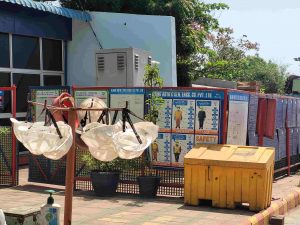
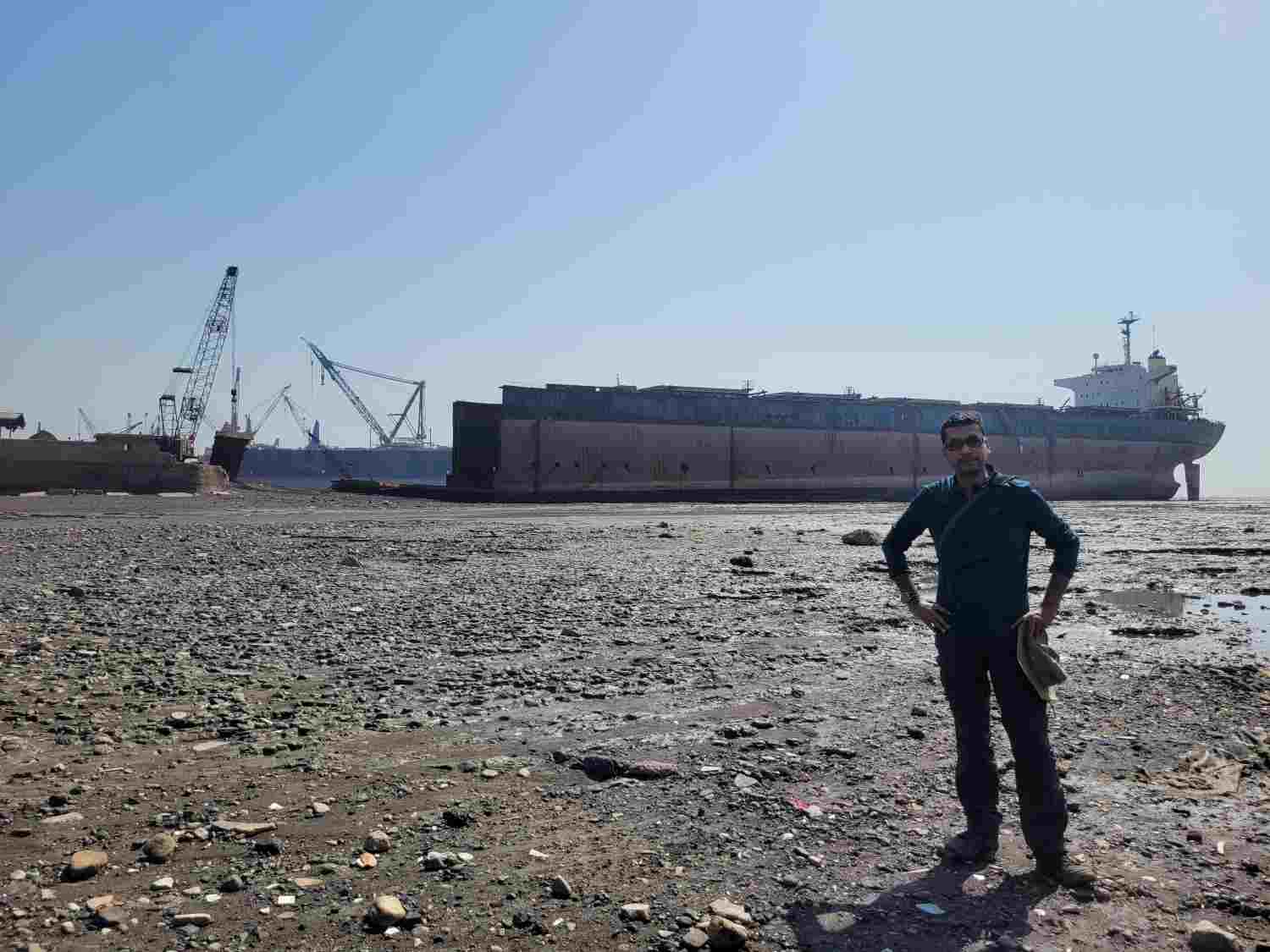
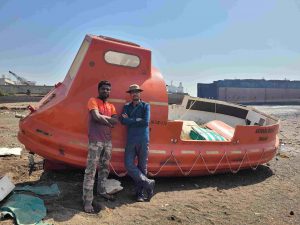
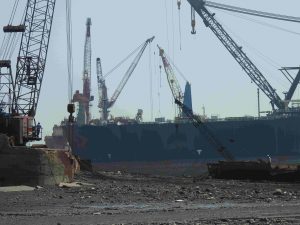
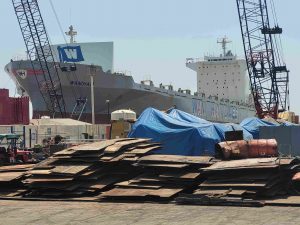
So we were super excited as we entered Alang since we now had a ‘contact’ in our pocket. Once there, we saw huge ships breached in the murky black sands, basking in the mid-day sun. All these could be photographed since labourers were not around. There we met an interesting character who said he was buying an old bright orange rescue boat taken from a dismantled ship. He had cut this fully covered rescue boat from the top and was planning to take it from Alang to Mumbai. It almost sounded as if he was involved in some fishy business but we didn’t probe any further and moved on.
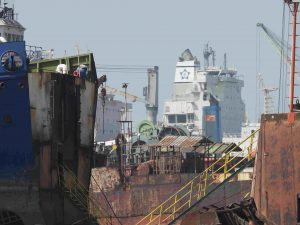
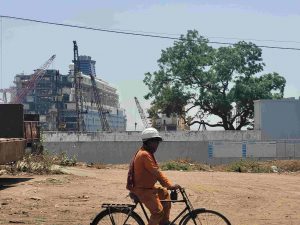
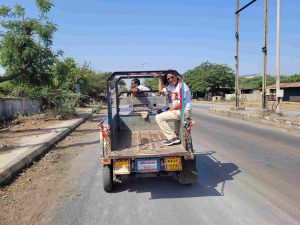
Later we hired a rickety rickshaw and started going up and down the only street where all the private yards were – one adjacent to the other in a single row. All seemed heavily guarded with typical light blue industrial metal gates and all had an access to the dirty black beach and the sea. Then we heard a siren which signaled lunch hour for the labrours and we had hundreds of them coming out of the gates in their orange overalls and white hard hats. We actually ended up eating lunch with them and to be honest, we were quite aghast at their oily meal choices, that too in the afternoon heat. They also must have been wondering who these two misfits were. For some reason we avoided conversations this time.
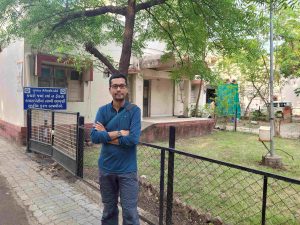
Post lunch we starting walking down the street looking for open gates. We reached the factory that man on the ferry had mentioned and took our ‘contact’s’ name. To our sheer astonishment, the guard actually let us in. We then looked around and started chatting with the foreman. Appearing like decent people, he gave us permission to take a few quick snaps from the mobile phone and thereby making our day, week and month not to mention my birthday. In the end, not only this particular factory, we ended up entering three of them, all though some genuine conversations and an honest look on our faces. I scanned for safety equipment and found them in almost every compound and while this is dangerous work for sure, I didn’t see workers in the mud and grime unlike how it is in Bangladesh. In Alang the workers were also wearing proper gas masks to protect themselves from asbestos, dioxins and other harmful substances.
Another major attraction of Alang is the second hand goods market that has sprung up on the road to the town. Here you can find anything and everything inside these giants such as furniture, decorative items, crockery, glassware, towels and even the kitchen sink. They also have imports from China should the shops not have enough stock from the ships and everything is sold at bargain basement prices. ET says the next big ship that is expected to arrive at the black beaches in the coming two months is MV True Confidence. This was the ship that was struck by missiles from the Houthi rebels of Yemen when the ship was passing through the narrow Red Sea corridor between Eritrea and Yemen. The workers are looking forward to it as it means gainful employment and I am looking forward to it too since it means I can witness something special which I can’t sitting snug at home.
Nitin Gairola is from Dehradun and has travelled the natural world more than almost any Indian ever. He has set world travel records certified by India Book of Records, has written for Lonely Planet, and holds National Geographic conservation certifications. He is also a senior corporate executive in an MNC and in his early days, used to be a published poet as well. More than anything else, he loves his Himalayan home. Reach him at: www.facebook.com/nitingairola/; www.facebook.com/MostTravelledIndian/