 By Kulbhushan Kain
Uttar Pradesh is very close to my heart. And for good reason. I grew up in Dehradun in the 1960s when it was a part of UP. All my childhood memories still revolve around it. I studied in school, college, university, married, had my only child as a resident of UP. My mother and father were cremated in UP. In the year 2000, my umbilical cord with UP got cut, when Uttarakhand was created. As luck would have it, at that time I was the Principal of DPS about 80 kms away from the capital of UP, Lucknow. Dehradun became the capital of the newly carved state of Uttarakhand. With one stroke of the pen, I became a resident of Uttarakhand. But too much of UP flows in my blood. And hence my love for it.
I am a part of the rich history of Uttar Pradesh. Unfortunately, our written history by and large ignores the role that women played in resisting foreign rule. This article is about a woman who fought the British during the 1857 revolt in UP. And no – I am not writing about Rani of Jhansi.
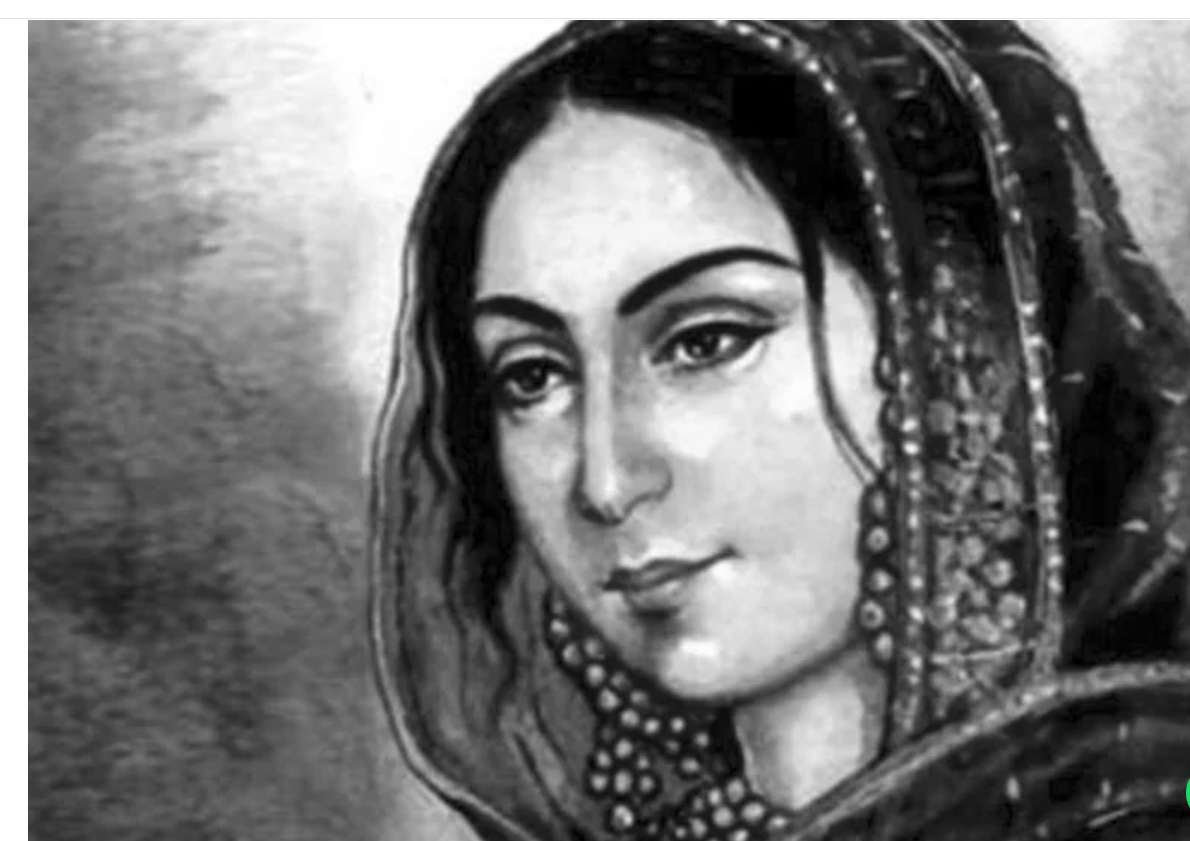
I am writing about the Begum of Awadh.
Awadh was a province of India. Its rulers claimed descent from Khorasan, in Iran. With the decline of the Mughals in Delhi, Awadh became more or less independent and a major source of literary, artistic, religious, and architectural patronage in northern India under the rule of its eleven rulers, called Nawabs. From 1720 to 1856, the Nawabs presided over it, with Ayodhya and Faizabad serving as the region’s initial capitals. Later, the capital was relocated to Lucknow, which till the present day is the capital of Uttar Pradesh.
The British conquered Awadh in 1856 on grounds of misgovernance and the Doctrine of Lapse. This infuriated the rulers and subjects of Awadh and was recognised as one of the major factors causing the Indian Rebellion (1857-58) – the biggest Indian uprising against British rule in most parts of Northern and Central India. In the forefront of the revolt in Awadh was a brave lady – Hazrat Mahal. Who was she?
Unfortunately, only scattered details are available about her early life. Through my research I have found that she was born to an African slave in Faizabad. Does African slave surprise you? If yes, then let me inform you that a significant number of African slaves, largely from East Africa, had been traditionally imported into India for centuries. The Nawabs of Awadh even had a platoon of “Hubshiyan Pulton” or ‘Black Platoon’. Hazrat Begum, whose name at birth was Muhammadi, was possibly born into one such family. At a very young age she was sold into a royal harem as an “khawasin” or attendant. She was strikingly good looking and soon got into the good books of the ruling Nawab – Wajid Ali Shah. She was temporarily married under a contract known as “nikah mu’tah” in 1845 to him and was elevated to the status of a “Begum” or official wife. She gave birth to Wajid Ali Shah’s son named Birjis Qadr. She became the apple of the eye of the Nawab and was rechristened “Begum Hazrat Mahal”.
However, her equation with the Nawab was to change. Intrigue and jealousy of the other wives of the Nawab (yes, he had several wives), and the Nawab’s mother, Janab-i-Aliyah’s hate for her, led to the Nawab divorcing her. This was in the year 1850. Hazrat Mahal must have felt very ignored.
By 1856, the British who had always coveted Lucknow, deposed Wajid Ali Shah and on 13 March 1856 decided to exile him to Calcutta. He was a much-loved man, a human being steeped in poetry, songs, and surrounded by artists and beautiful women. He was the first Urdu drama writer and director. He wrote ‘Kissa Radha Kanhaiya Ka’ in 1842-43. He also got it staged at Rahas Manzil, the first drama theatre made in Qaiserbagh, which was destroyed during the siege of 1857. This shows his passion for art. He was also trained in Sitar and Kathak by masters of those times. The Nawab himself composed two timeless thumris – “Babul Mora Naihar Chhuto Hi Jaye”, and “Jab Chhor Chale Lucknow”. It is said that when his entourage was leaving Lucknow, people voluntarily followed him all the way to Kanpur.
The ill treatment meted out to Wajid Ali Shah was a spark that lit the gunpowder of the 1857 revolt. The fire quickly spread to Sitapur, Faizabad, Gonda, Bahraich, Sultanpur, and Salon. The rebels needed a leader, and they found one in Hazrat Mahal. Her 12- year-old son was provisionally made king, and she became the Regent and power behind the throne. Destiny holds many unlocked mysteries. Having been consigned to oblivion and desertion after divorce, fortune once again smiled on its favourite child! In 1850, little did she and her haters know that through a strange quirk of faith she was going to be propelled back right in the midst of a huge storm and a rebellion that would enshrine her name in the annals of history.
Begum Hazrat Mahal played a key role in the 1857 Indian Rebellion, particularly in Awadh, and was involved in several battles. She led the rebellion against the British East India Company, including in the Battle of Alambagh and the Battle of Musa Bagh.
She was a key figure in defending Lucknow against the British siege, even riding an elephant during the battles. Hazrat Mahal worked in association with Nana Saheb, and later joined the Maulavi of Faizabad in the attack on Shahjahanpur. She was a fierce fighter. One of the principal complaints of Begum Hazrat Mahal was that the East India Company had casually demolished temples and mosques just to make way for roads. In a proclamation issued during the final days of the revolt, she mocked the British claim to allow freedom of worship: “To eat pigs and drink wine, to bite greased cartridges and to mix pig’s fat with sweetmeats, to destroy Hindu and Mussalman temples and mosques on the pretence of making roads, how can people believe that religion will not be interfered with?”
One must keep in mind that she was a divorced woman in 19th century India.
However, when the forces under the command of the British re-captured Lucknow and most of Awadh, she was forced to retreat to Nepal.
She died there in 1879 and was buried in a nameless grave in the grounds of Kathmandu‘s Jama Masjid.
No greater tribute can be paid to her as the one given by VD Savarker who in his book, “The Indian War of Independence” (page 260), wrote, “The Begum of Awadh, though not quite another Lakshmi Bai, was undoubtedly a great organiser, full of liberty, and the spirit of daring. Every day a Durbar was held to discuss political affairs and there the Begum exercised authority in the name of the Nawab.”
History must never ignore the bravery of women!
(Kulbhushan Kain is an award winning educationist with more than 4 decades of working in schools in India and abroad. He is a prolific writer who loves cricket, travelling and cooking. He can be reached at kulbhushan.kain@gmail.com)