 By Ganesh Saili
‘Vijay!’ said his father, tearing up the new currency notes like confetti. ‘Now I understand why that rascal of a cashier at the bank was smiling at me. He gave me these fake notes.’
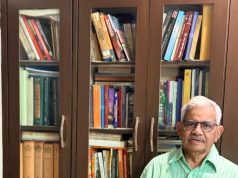
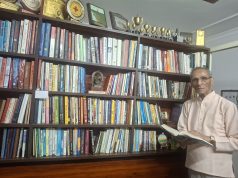
‘Don’t worry, Ganesh. Nothing wrong with the currency. My father is slowly losing his marbles! He imagines all kinds of things!’ assured his son, Professor Vijay Krishna Uniyal (pronounced Onial), who taught us English at the Mussoorie postgraduate college.
The family had its roots in the Ghuttu-Ghansali valley, and the father had taught Sanskrit at a college in the plains. When I met him, he was spending his days in retirement, living with his son at Inverneal Cottage; he seemed to have occasional lapses of memory with big and small things.
Though this story is about his son V. K. Uniyal, whom I remember for his rare mastery over literature in three languages: Hindi, English and Sanskrit. It was a gift that made his lectures a pleasure as he effortlessly wove Keats’ melodious nightingale into the harmony of Kalidas’ clouds, bunched elephants trumpeting across the sky.
But our luck would run out very soon when he was offered a teaching assignment in Ethiopia. There he met the beautiful Abyssinian Imu, fell in love and soon after they were married. The trouble was, she was half his age, a fact that seemed to bother him no end. He had taken to constantly looking over his shoulder, almost furtively, to ensure no one ran off with his wife. The couple had two beautiful daughters: Archana and Neeti, who, to me, represent that rare blend of Garhwal and Ethiopian DNA!
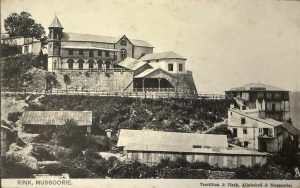
To get back to those early days when he left for Africa, and our loss ended up being Ethiopia’s gain. Yet, he loved this hill station and kept coming back, again and again. When he retired, this was the only place he could call home, and this is where he came back. With his savings from his stint abroad, he bought Wolfsburn, a rambling old ruin spread over six acres in Landour. That is a whole other story waiting to be told another day.
Coming home late one evening, I saw him standing on the roadside and offered him a lift. He jumped onto my rickety motorcycle as if settling into a car, oblivious that this contraption had no backrest. I drove very slowly, the road was bumpy, we arrived at the cottage, and I waited for him to get off. But there was no one getting off for the simple reason that there was no one to get off! He had slid off the seat barely a few minutes into the ride!
In sheer panic, I turned around and went looking for him. The Gods were kind and merciful, and I found him unhurt; he was sitting on the parapet wall. He knew that in a one-horse town, when I discovered him missing, I would turn around to fetch him.
‘This time around, hold on to me. Grab my shoulders!’ I suggested.
He did, and this time, I dropped him home safely.
We bumped into each other during the heady days of the Uttarakhand Movement. The Sanyukt Sangharsh Samiti had nominated me to a committee tasked with collecting funds for the movement. We went from house to house, cottage to cottage, trying to raise funds. We were desperately short of funds, what with hospital bills for those who had been wounded in the shoot-out; there were pamphlets and posters to print.
At Wolfsburn, I found my old teacher sitting under a chestnut tree. He smiled and asked: ‘Would you like some tea?
‘Yes, please!’ said I.
‘Four cups of tea!’ he called. A while later, the curtain parted, and Imu brought out a tray full of teacups.
After putting down the tray, it was obvious that she was unsure of what to do next.
In his best male chauvinist manner, he dismissed her, saying: ‘Now you go!’
Today, the expression has become a part of our lexicon. And we use it whenever it’s late and it’s time to pack up and go home.
Ganesh Saili, born and raised in the hills, is one of the select few whose words are illustrated by their pictures. As the author of two dozen books, some of which have been translated into twenty languages, his work has gained recognition worldwide.