By: Ganesh Saili
‘Better means! (sic) Saili. You will fail!’ said Mr. Gupta, our mathematics teacher, glumly.
Henceforth, we started calling him ‘Better means’, behind his back, of course! Luckily for me, he was no soothsayer, for I still squeaked through, as if to prove him wrong. However, in my heart, I knew that the fun and games of calculus and slide rules were not meant for me!
In the school, a story of doubtful authenticity is widely believed to be true, which involves three service Chiefs, all Manorites: General Shankar Rai Chaudhuri, Air Chief Marshal Dennis Anthony La Fontaine, and the Chief of Naval Staff, Ronald Lyndale Pereira. They were guests at the school’s sports day. I have tried several times but have been unable to find any evidence related to this event in the old school magazines or the souvenir shop.
Pic: Author’s Collection
Among the other invitees was their old teacher, Mr J.N. Dey. The chiefs snapped to attention and saluted their old teacher, greeting him with well-deserved warmth and respect. Chitchatting with them, time slipped by, and soon it was time for Mr Dey to nap. He got up to leave, and the chiefs stood up again to bid him farewell. As was expected of someone with his garrulous manner, he remembered something he had not yet mentioned, resumed chit-chatting and sat down again. This charade of getting up and sitting down played out several times until the old schoolmaster finally left for Spring View, his home in Bhatta village!
St. George’s College gave this hill station its first clock, imported from England in 1938. It strikes every fifteen minutes and produces the unexpected but desirable side effect of scaring away the wildlife that prowls the school’s four-hundred-acre campus.
‘Look how the school shines today! We were able to do it without adding zeroes to the balance sheet. Instead, we used the old timber, polished the door frames, buffed the ancient door handles,’ he said, his chest swelling with pride.

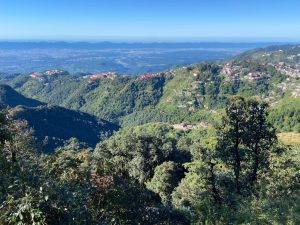
At night, northwards, the lights of Mussoorie look like a pearl-encrusted carpet, while southwards, down below, the lights of the Doon valley blink at you. In a homecoming of sorts, I have walked up the steep incline, going past the trainer jet – a gift from the IAF in appreciation of the contribution of the school’s alumni in the armed forces. I finally arrived at the station’s largest playing field, which encourages excellence in sports. The school’s four houses are named after old boys, Tapsells, Gateleys, Cullens and Marthns, who etched their names into history as part of the Indian Hockey team that struck gold in the Amsterdam Olympics in 1924.
Virtus et labour (character and hard work) are the twin anvils that make the sparks fly.
I bumped into Brother Caroll again and he told me: ‘Our seven flats could park some 2000 cars!’
Arrived at the witching hour, I hear the familiar hum of students during study hour, and it to be like the throb or hum of a powerhouse. Below Fox Hill rises a school built for those not born to the Manor. Only two schools – Convent of Jesus and Mary, Waverley (est. 1845) and St. George’s College – have tried to give back to the town by creating two new schools – Nirmala and St. Lawrence – for local children.
Almost two hundred years ago, in 1853, the brown-hooded Capuchin Fathers acquired the estate of the old Manor House to create St George’s. It is the second-oldest school that exists in Mussoorie. Ten years later, St. Fidelis shifted from Shimla to Whytbank Castle. There was an old suspension bridge between the main school and the place where the parlour-boarders once lived, along with their domestic help.
‘There’s our plant hospital. Every autumn, we scour the nearby mountains for dried-up deodar cones. We break them and nurture them to sprout two thousand deodar saplings. We plant some in the valley down below and give away the rest,’ green-fingered Bro. Carroll tells me with pride.
On St. George’s fields, try as much as you may, you will find no half-measures. Manorites know how to walk the talk.
Ganesh Saili, born and home-grown in the hills, belongs to those select few whose words are illustrated by their pictures. Author of two dozen books, some translated into twenty languages, his work has garnered recognition worldwide.