Garhwal Post Bureau
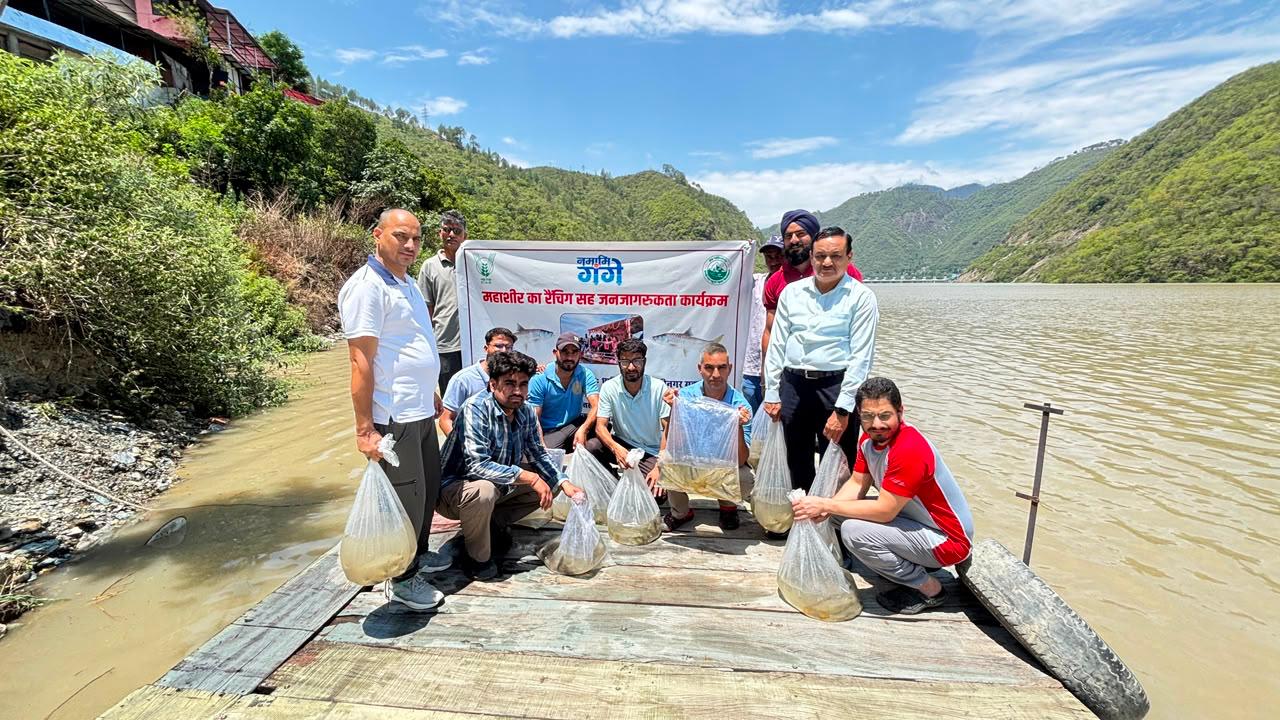
Srinagar, (Garhwal), 14 Jun: Under the Namami Gange project, 7,000 Mahseer fish fingerlings were released into the Alaknanda River near Dhari Devi on Friday to strengthen the biodiversity of the Alaknanda River and conserve the riverine ecosystem. This important initiative was carried out in collaboration with the Central Inland Fisheries Research Institute (CIFRI), Barrackpore, Kolkata, the Department of Zoology, Garhwal University, and the Fisheries Department, Tehri Garhwal. During the event, emphasis was placed on river conservation, aquatic life conservation, and raising awareness about biodiversity conservation.
Professor Deepak Singh Bhandari, Coordinator of the Fish Hatchery at Garhwal University, stated that the Mahseer is the state fish of Uttarakhand and plays a vital role in the ecology of the Himalayan rivers. He explained that, due to various reasons, the Mahseer population in the state’s rivers is continuously declining. The International Union for Conservation of Nature has also classified it as endangered, making its conservation a pressing need. It was reported that the fish hatchery located on the Zoology Department’s campus in Chaaras was developed in collaboration with the Alaknanda Hydropower Company. Seven thousand fingerlings of the Mahseer species, developed at this hatchery and the Fisheries Department’s hatchery in Tehri Garhwal, were released into the Alaknanda River. Both hatcheries are also receiving partial financial support from CIFRI, Barrackpore, under the Namami Gange project.
It was reported that the Mahseer fish have been considered a major source of protein and omega fatty acids since ancient times. It is also renowned as a game fish, attracting tourists and visitors. Its taste is considered superior to other fish found in the region, and its market value is higher than that of the region’s main fish, the Asella (Schizothorax species), also known as Snow Trout. While the snow trout has a maximum lifespan of 4-5 years, the Golden Mahseer (Tor putitora) has a lifespan of 20 to 25 years. The Snow Trout has a maximum weight of 3 kg (normally 1.5-2 kg), but the Golden Mahseer can reach a maximum weight of 40 to 50 kg. Therefore, this fish is considered excellent for food security in every way. It was reported that various anthropogenic causes, including overexploitation, illegal exploitation, unscientific exploitation (using electric current for fishing, dynamiting, poisoning of water bodies, etc.), water pollution, habitat destruction (due to the extraction of building materials from the river), the introduction of various exotic species into the area, and the construction of dams for hydroelectric projects, have adversely affected the Mahseer population. Consequently, its numbers are continuously declining. Due to the declining global population of this fish, the IUCN has declared it an endangered species. This local species has been given the status of state fish by Uttarakhand, Himachal Pradesh and Arunachal Pradesh so that it can be conserved.
In the programme, project scientists Dr Upendra Singh, Dr Jitendra Singh Rana and Dr Ranjit Singh associated with the Namami Gange project highlighted the conservation of Mahseer fish and its environmental utility. On this occasion, a pledge was also taken to keep Ganga and its tributaries clean, pure and rich in biodiversity.
Head of Zoology Department Prof Manju Prakash Gusain, DSW Prof OP Gusain, Pushkar Singh Nayal from Fisheries Department Tehri Garhwal, Sanjay Singh along with researchers Sachin, Rahul, Ajay, Ayush, Rakesh, etc., were present.