 By: Ganesh Saili
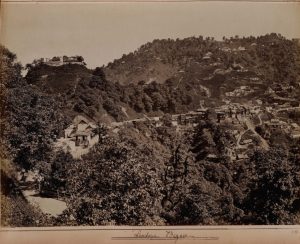
Walk down the narrow strip of Landour bazaar and you will find buildings huddled together. They seem to lean on each other as if for comfort. While some of our younger ones grow up to leave for distant shores, take a peek inside some of the shops to find many, many like me who stayed on. We are but slaves to destiny.
Our first businessman was a certain Mr. Lawrence, who set up the first shop in 1829 on Camel’s Back Road to sell household goods. A year later, the German Mr. Bohle started our first brewery to slake parched throats, and we seem to have never looked back.

Pic courtesy: The author.
On a walk through Landour bazaar, Fanny Parkes found, ‘Everything is to be had. From patee foie gras, truffles, shola hats covered with the skin of pelican, champagne, Bareilly couches, shoes, Chinese books, pickles, long poles for climbing mountains, and various incongruous articles.’
By 1860, there were three European establishments, as Northam’s Guide (1884) informs us: ‘The large native merchant’s shops, the cloth merchants, and the native grain merchants. Europeans frequently crowd this bazaar in the evening, and a good deal of business is done … Many of the native merchants purchase their goods direct from agents in England, France, America, and other countries.’
Pic courtesy: The author.
At the turn of the twentieth century, there were still many European-run shops. In the slump created by the Great War around the mid-1930s these establishments changed hands, with Indian traders (of all shapes and sizes) stepping into the boots of those winding up their affairs to go home. To this day, in Kulri, you find Hamers, James & Co., and Pioneer Chemists. They carry on the good work well into the hands of third or fourth generations.
Long may they prosper!
Believe it or not, the crumbling hulk of Railway Out Agency once housed Fitch & Co. Ltd. (established in 1862), Mussoorie’s largest business house, which imported merchandise from around the world and exported Indian medicinal drugs worldwide. As chemists they dealt in wine and spirits, as well as general goods, like hardware, silver goods, cigars, cigarettes, pipes and tobacco. This is where my father and Gopal Dutt Dimri found their first employ as store salesmen.
But the nineteenth century was the age of the specialist. How else can one explain the existence of J.C. Bechtler Son & Co. and Dill & Co., dealers in fine jewellery, or H. Clark & Co. (1879), drapers, and Trevillion & Clark (1896)m which employed European assistants to manage their millinery and clothes outfit departments.
Mrs. Draper’s advertised the owner’s training in millinery, with hats imported directly from Europe. Further down the Mall lived Mrs. Hakman, with a shop named after her. What was her specialty? She dabbled in wigs and perfumes that suited all pockets.
For the musically inclined, my fact-o-file tells me our pianos were stamped ‘Made in Mussoorie.’ At the Library end, long before the Criterion Restaurant came up, Fitch & Co set up in 1899 under a Mr A. Liebehen, a piano tuner and maker. Eight years later, he shifted to Kulri, and dealt in ‘all kinds of musical instruments. Imported pianos made by first class makers only. As a specialty, pianos are also made on the premises.’ The Armenian run Godin & Co. carried the many-pronged musical baton forward before winding up affairs in the 1960s to emigrate to Australia.
Up until the 1970s, anything or everything was delivered right to your door. The 1970s will be referred to by future historians as the ‘Age of the wala’: milkwala, andaywala, meatwala, breadwala, sabziwala, kapdaywala, ping-ping wala (or the flufffer) and the kabariwala. They would go from home to home, selling their wares.
Looking around, I find that even as a scribbler of trivia, I am most at home with the kabariwala. We are both survivors, the last remnants of those who trawl this hill station with an eternal battle-cry of, ‘Teen–bottal!’
Maybe we are soul brothers, for wherever human beings live, there shall always be a trail of junk: old newspapers, discarded cans and empty bottles.
It might not be much, but it’s enough to keep body and soul together.
Ganesh Saili, born and home-grown in the hills, belongs to those select few whose words are illustrated by their pictures. Author of two dozen books, some translated into twenty languages, his work has found renown worldwide.