On adopting her native village Bhatwari in Rudraprayag:
By ARUN PRATAP SINGH
Garhwal Post Bureau
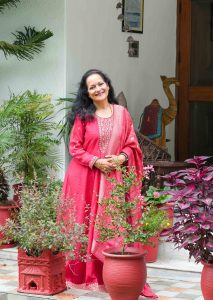
Dehradun, 30 July: Known for her endearing on-screen characters and a distinguished acting career spanning decades, Bollywood actor Himani Shivpuri is now also channelling her energies into social work, quietly but purposefully to bring meaningful change to the land of her roots. In an exclusive and heartfelt conversation with this correspondent, veteran film and theatre actor Himani Shivpuri opened up about her recent initiative of adopting her native village Bhatwari, nestled in the serene hills of Rudraprayag district and about her plans for its development. She shared that she had recently visited Bhatwari to get a feel of the requirements and what can be done towards its development.
Adopting your native village is a substantial step. What inspired you to take this decision?
I have always felt a deep connection to my roots. Recently, I visited Bhatwari to understand the current situation and to interact with the local residents about their needs and aspirations. I wanted to see personally how I could help improve the quality of life there.
What did you observe regarding the current state of the village?
There are only 33 families left which are still living there because most people have migrated for better opportunities. In summer months, more families are seen. As is common in the hills across Uttarakhand, employment opportunities are scarce. However, I need to point out that those who remain there are not extremely poor. In fact, many of them are working or retired teachers or government officials. Despite the challenges, there is a sense of dignity and resilience among the villagers.
What are the main needs expressed by the villagers?
One of the major demands is for an English medium school. Many families feel strongly that this is essential for the future of their children. This issue is close to my heart because my own father studied in this village as a child.
What is the potential of Bhatwari in agriculture and horticulture. What are your thoughts on the village’s potential?
I believe the village and the neighbouring villages have great potential in agriculture. The soil in Bhatwari is highly fertile. I got it tested through an agrarian society from Kotdwar of which I am also a member. The results were very encouraging. There is adequate availability of water for irrigation as there are several natural water springs and sources. Earlier, the village had a large number of Kinnow trees, but unfortunately, most have been destroyed by monkeys and wild boars. There are plenty of natural springs and water sources, but there is acute shortage of locally available labour for agriculture besides a huge challenge posed by the monkey and wild boars, which discourages the people from taking up agriculture on a large scale there despite the huge potential.
How can the monkey and wild boars menace be tackled?
It is huge challenge across Uttarakhand and there is no immediate solution. The villagers have demanded fencing, and a good idea is to grow ground crops which do not attract monkeys and wild boars.
What steps do you plan to take up to support agriculture in Bhatwari?
I have helped the villagers by providing turmeric and ginger seeds. These crops are less prone to damage by wildlife and have good market value, as they are cash crops and they can help generate income for the farmers. Besides this, I am very keen on promoting organic cultivation of millets like Mandua and Jhingora, etc., which have high demand and can be sold or marketed online too.
What about healthcare in the village?
There is a real lack of basic medical facilities. I remember one woman telling me she had to go all the way to Dehradun to get treated for a minor fever. Then I approached the Hans Foundation, and I am glad to share that they now send a well-equipped ambulance to the village regularly. This should bring essential healthcare closer to the villagers. Of course, much more needs to be done to improve healthcare infrastructure and manpower in the hills. The ambulance is just a beginning.
You are a National School of Drama graduate and you have spoken about preserving Uttarakhand’s traditional culture. What are the plans?
It concerns me that young people are not learning our traditional instruments like the Dhol, Damau, and Hurki any longer. I feel deeply attached and committed to preserving our culture and traditions. Once, I even had to reach out to a Hurki player associated with All India Radio for a cultural programme. We wish to do something serious towards reviving local music and folk traditions. We must support and conserve our heritage so that it can be passed on to future generations.
Such initiatives have e lot of financial implications. What about funding such initiatives?
Frankly, I don’t have the resources that very big stars like Salman Khan have. My means are rather modest, but I seek help of organisations, well-wishers and friends who are willing to collaborate. Major celebrities do. We have just set up a trust for this purpose and my aim is to include visionaries from various fields who can give ideas and, also, help with resources to carry our projects forward. My commitment is long term. The trust and I will keep working on finding practical, sustainable solutions in education, healthcare, agriculture, and cultural preservation. I truly hope our collective efforts will help bring about positive change in Bhatwari.