
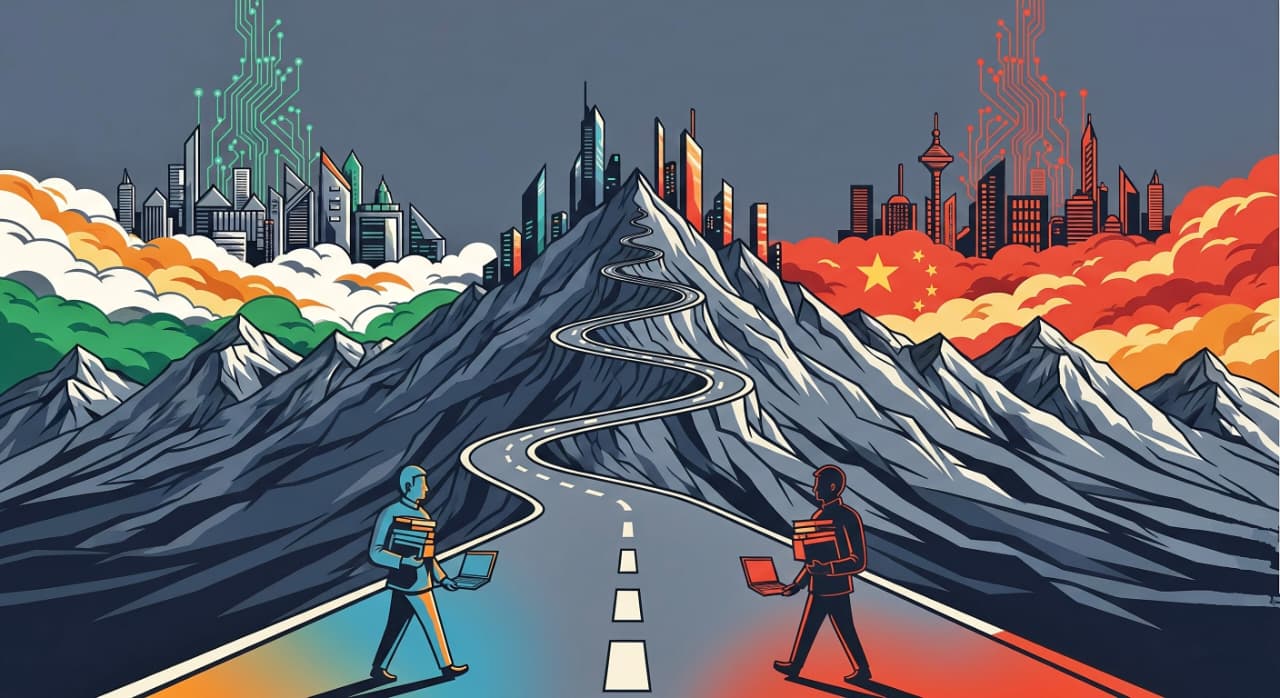
India & China After Tianjin: Between Rivalry and Renaissance
 By Rajat Aikant Sharma
A New Meeting in an Old Neighbourhood
When Prime Minister Narendra Modi and President Xi Jinping met on the sidelines of the Shanghai Cooperation Organisation (SCO) summit in Tianjin, the optics were deliberately restrained. There were no grand declarations, no sweeping announcements that might suggest a sudden thaw after years of distrust. And yet, hidden within the modest agreements on direct flights, resumed pilgrimages, and renewed border trade was the outline of something larger: an attempt to re-imagine the India–China relationship in an era when the world itself is shifting eastwards.
The Weight of History, the Pull of Geography
The two countries share more than a border; they share civilisational depth, a billion-plus people each, and the prospect of shaping the 21st century. But the shadow of wars and incursions hangs heavy. Every conversation about cooperation is haunted by the memory of 1962 and the skirmishes of the last decade.
Yet to look only through the prism of conflict is to ignore reality. The world order itself is tilting. The West’s once-uncontested dominance is giving way to multipolarity, with Asia at the centre. The rise of artificial intelligence, the green economy, and digital trade are opening new fault lines—but also new corridors of cooperation.
India and China cannot erase their differences, but they can choose to quarantine disputes and focus on domains where both stand to gain. The Tianjin summit was one such effort to compartmentalise rivalry from cooperation.
Travel, Tourism and the People Factor
Perhaps the most tangible breakthrough has been the resumption of direct flights and the restoration of tourist visas, suspended since the pandemic and border tensions. Pilgrims are once again trekking towards Kailash Mansarovar. Border passes at Lipulekh, Shipki La and Nathu La are reopening for controlled trade.
It may seem mundane, but these small bridges matter. Tourism and student exchanges do more than economics; they humanise relationships that geopolitics strains. An Indian student in Beijing or a Chinese tourist in Varanasi creates a buffer of empathy, a reminder that societies are larger than soldiers.
Both governments are also planning a 2026 People-to-People Exchange Forum, which could institutionalise cultural, educational, and academic ties. If handled well, this channel could become a shock-absorber in times of crisis.
Technology: The Delicate Dance
Technology is where rivalry burns hottest and yet where cooperation is most necessary.
- Electronics and manufacturing: India has signaled willingness to allow Chinese companies in—but only through joint ventures with technology transfer. Gone are the days of simple assembly lines; what New Delhi seeks is skill-building and self-reliance.
- Rare earths and critical inputs: Beijing has promised to address India’s pressing needs in rare earth supplies and machinery, crucial for semiconductors and clean energy.
- Artificial Intelligence: A subtler dialogue is underway. India is considering cautious support for China’s call for a global AI governance framework, though it prefers a broader “Global South AI Forum”. Either way both nations recognise that those who write the standards for AI safety, data use, and ethics will shape the future global economy.
This is a delicate dance: cooperate enough to benefit, compete enough to retain autonomy. It is less about trust, more about structured reciprocity.
Education, Employment, and the AI Shock
The real storm gathering on the horizon is AI’s disruption of jobs. India and China, with their vast labour forces, cannot afford complacency. Manufacturing, back-office services, even white-collar professions will face automation pressures.
The only insulation is education redesigned for the AI age:
- Micro-credentials and short apprenticeships in fields like robotics maintenance, AI safety evaluation, healthcare support, and EV servicing.
- Teaching human-AI collaboration across all universities and vocational institutes.
- Massive apprenticeship programmes that tie companies to colleges, ensuring students graduate into jobs, not unemployment lines.
- Investing in care, wellness, tourism, and green infrastructure—sectors resilient to automation but uplifted by technology.
Here, India and China could either retreat into suspicion or collaborate on shared curricula, mutual recognition of skills, and research partnerships insulated from sensitive data. The world’s two largest education systems, if retooled for the AI century, could stabilise not only their societies but also global labour markets.
Guardrails Before Grand Visions
It would be naïve to imagine that a few flights and visas can erase deep strategic mistrust. Border flashpoints remain the ultimate tripwire. Any flare-up in Ladakh or Arunachal could freeze cooperation overnight.
That is why both sides are now talking about “guardrails” rather than breakthroughs: 24×7 hotlines, disengagement protocols, drone-free zones. The goal is not to solve the dispute—perhaps unsolvable in the short term—but to prevent incidents from spiralling.
In parallel, they are creating off-ramps: pre-agreed steps if tensions rise, ranging from pulling back troops a set distance to coordinated public statements. These mechanisms may appear bureaucratic, but they are vital in a relationship where trust is thin and tempers can escalate quickly.
The Shape of a Multipolar Future
Look beyond immediate agreements, and the larger picture is stark. The centre of global gravity is shifting eastwards. Demography, energy, digital economies, and climate vulnerabilities ensure Asia will be the decisive theatre of the 21st century.
For India and China, the choice is not between love and hate, but between rivalry that burns everything, and competition tempered by selective cooperation.
The best way forward is what analysts call “competitive interdependence”. Each side builds strength, hedges its bets with other partners, but also recognises that total decoupling is impossible. Trade, climate, pandemics, and AI regulation are transnational by nature; neither country can tackle them alone.
Three Tracks, Always On
To make this balance work, three tracks must run simultaneously:
- Deterrence & De-risking: Maintain strong defences, diversify supply chains, protect critical technology.
- Selective Cooperation: Tourism, climate science, public health, academic exchange—areas where joint gains are clear.
- Hedging: Work with other powers—Japan, Russia, ASEAN, the West—ensuring no single relationship becomes overbearing.
Why This Matters Globally
The new world order will not be shaped in Washington or Brussels alone. It will emerge in the choices made in Delhi and Beijing—whether to quarrel over passes and patrols or to jointly set AI standards, whether to blockade pilgrims or to reopen circuits of culture.
For the West, this is both a challenge and an opportunity. A cooperative India–China axis could stabilise global trade and climate efforts. A hostile one could fragment the system irreparably.
For the Global South, the example set by Asia’s giants will be decisive. If they can rise without destroying one another, they offer a template of multipolar coexistence. If they cannot, the ripple effects will destabilise regions far beyond the Himalayas.
The Road Ahead
The Tianjin summit should not be over-interpreted. It is a reset of tone, not of trust. But it signals that both sides, chastened by economic pressures and wary of overdependence on the West, are willing to test a new framework.
In practice, the future will likely look like this:
- A Cold Peace, where borders are tense but managed.
- A Shallow Thaw, where flights, students, pilgrims, and limited trade resume.
- Persistent competition in technology, military power, and influence—but bounded by guardrails and offset by cooperation on climate and AI governance.
A Closing Thought
For too long, India–China relations have been read as a zero-sum game. Perhaps it is time to see them as a paradox to be managed, not a problem to be solved.
Wars and incursions cannot be wished away. But neither can the geography of being neighbours or the imperatives of a shifting world order. The best way forward is neither embrace nor estrangement, but a disciplined mix of rivalry and collaboration.
If India and China can master this paradox, they will not only stabilise their own futures but also help steady the world at a time when AI, climate change, and economic shocks threaten to unmoor everyone.
(Rajat Aikant Sharma is a writer, columnist, and photojournalist whose work spans culture, history, philosophy, and human narratives across the world.)


