The Villages We Carry Within Us
 By Rajat Aikant Sharma
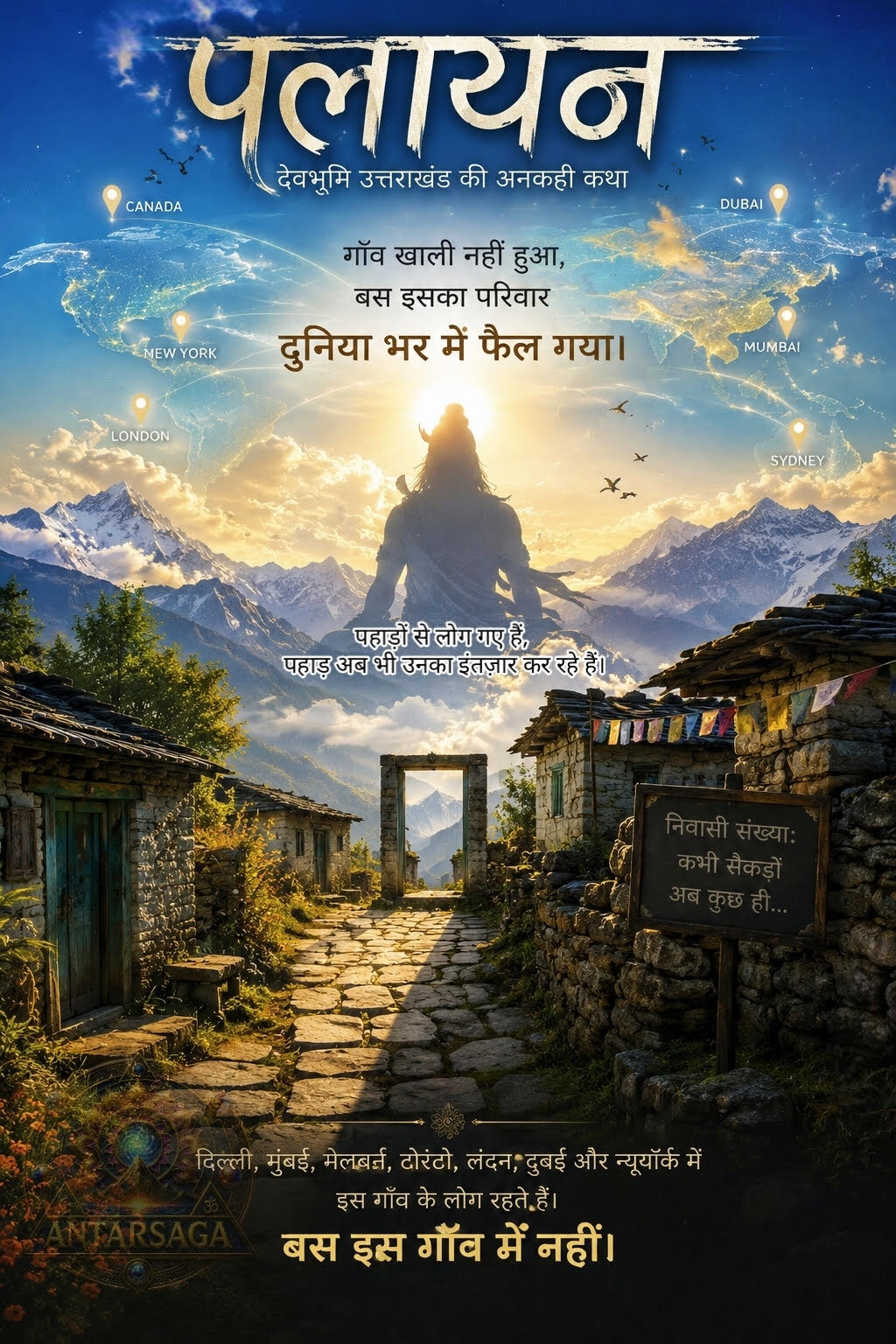
There is a village in Uttarakhand where only four or five families remain. A few decades ago, hundreds lived there. Children ran along stone pathways, women gathered at the village spring, cattle bells echoed across terraced fields, and every festival belonged to the entire community. Today many of those houses stand locked, their wooden doors still facing the mountains while the people who once opened them each morning are scattered across India and the world. And yet, perhaps, the village is not empty at all. Perhaps its population now lives in Delhi, Mumbai, Bengaluru, Dubai, London, Toronto, Melbourne, and New York.
This is the paradox of ‘palayan’ in Uttarakhand. The village shrinks, but the family grows. The ancestral house falls silent, but the bloodline flourishes. Census records show decline, while descendants multiply across continents. So what exactly are we mourning? The loss of people, or the loss of belonging?
The debate around migration in Uttarakhand is often framed as a story of abandonment. Empty villages, locked homes, overgrown fields, forgotten pathways. The images are real, but the story is more complicated than it first appears. During a recent discussion on the subject, educationist Nidhi Bahuguna made a distinction worth considering. Migration, she observed, can be both positive and negative. It is positive when it brings education, opportunity, prosperity, and growth. It becomes negative when it severs people from their ancestral roots, memories, and cultural anchors.
That distinction forces us to confront an uncomfortable truth. If migration were inherently bad, modern Uttarakhand itself would not exist.
My own family history reflects this contradiction. My grandfather left his native village in Pauri Garhwal and came to Mussoorie nearly a century ago. My maternal grandfather journeyed from Almora to the Queen of the Hills, where he became a respected artist and photographer. My paternal grandfather worked as an estate agent during the British era and ran a hardware business near Landour. Like thousands of others, they left their villages in search of opportunity. Their journeys helped build a new town. They were migrants.
We mourn what our grandparents made possible.
This irony lies at the heart of Uttarakhand’s story. Mussoorie, Dehradun, Nainital, and Haldwani did not emerge from stillness. They were shaped by generations of movement. Teachers, soldiers, traders, artists, civil servants, and entrepreneurs descended from villages and helped create the towns we now call home. The mountains have always produced travellers. Migration is not an exception in Himalayan history. It may well be the rule.
Nidhi Bahuguna offered the example of her own village, Bugani. From it emerged Hemvati Nandan Bahuguna, one of the most influential political figures of his era — and also professors, pilots, administrators, and professionals whose lives spread across India and beyond. Bugani may have lost residents, but it gained reach. The village became smaller on paper even as it expanded into the world. This is the paradox of migration: a place can become emptier and larger at the same time.
The real problem, then, is not migration itself. The real problem is forgetting.
For generations, young men left the hills for military service, education, or employment, but their families remained behind. Fields were cultivated. Homes remained occupied. Festivals continued. The bond between migrant and village stretched, but it rarely broke. Today’s migration is different. Entire families relocate. Children are born in cities, educated there, married there, and eventually raise children of their own there. By the third generation, the ancestral village often survives only as a name mentioned during weddings or funerals. A place that once formed the centre of life becomes a fading memory. And memory, unlike stone, can disappear.
Yet not all migration is voluntary. Some departures are acts of aspiration. Others are acts of survival — or worse, rupture. When Nidhi Bahuguna’s paternal family was forced to leave Sialkot during Partition, they did not migrate in pursuit of opportunity. They were displaced. A wound that does not fully close. The distinction matters: aspiration and displacement are not the same grief.
Perhaps this is why traditions such as Pitr Kuda remain so important in Uttarakhand. To an outsider, they may appear as simple religious rituals. In reality, they are acts of remembrance — bridges stretched across time, connecting scattered families to a common origin. They remind people living in distant cities and countries that their story began somewhere specific: a village, a hillside, a spring, a temple, a patch of earth where their ancestors once stood beneath the same Himalayan sky. Without such anchors, identity becomes strangely weightless.
Yet when we step back further, another mystery emerges. Human history itself is the history of migration. Every civilisation was founded by wanderers. Every city is the result of arrivals and departures. The shepherd crossing Himalayan passes, the trader walking ancient routes, the Garhwali youth joining the army, the engineer boarding a flight to Canada — these are not separate stories. They are chapters of the same story. The story of human movement.
Perhaps every generation makes the same mistake. It believes it has found a permanent home.
Our ancestors thought the village was permanent. Their children believed the town was permanent. We imagine the city is permanent. Yet permanence keeps retreating like the horizon. Houses remain for a while, then families change. Families remain for a while, then generations change. Even nations and borders shift. What remains is not the house, nor the village, nor even the family in its original form. What remains is the longing itself.
Advaita Vedanta asks a question that cuts through the entire debate: Who exactly migrates?
The body moves. The address changes. Languages change. Occupations change. Entire identities are rebuilt. Yet the witnessing consciousness remains untouched. The same awareness that once looked upon terraced fields in a Garhwali village now gazes through apartment windows in Delhi, London, or Melbourne. From the perspective of the Self, perhaps nothing has migrated at all. The witness remains where it has always been; only the scenery changes.
This may explain why empty houses evoke such powerful emotions. We are not mourning stone walls. We are mourning continuity. We fear that a spring will lose its name, that a temple will lose its stories, that a pathway walked by generations will disappear beneath grass. The anxiety is not really about geography. It is about memory.
Today the same story is unfolding in Mussoorie itself. Families whose grandparents arrived from Pauri, Tehri, Almora, or Jaunsar a century ago are moving to Dehradun, Chandigarh, Delhi, and beyond. Meanwhile, families from nearby villages are buying homes in Mussoorie and building their own futures. The villages flow into Mussoorie. Mussoorie flows into the plains. The plains flow into megacities. The current never stops; only its direction changes.
Perhaps the Himalayas have understood something that we have not. Rivers move. Clouds move. Birds migrate. Seasons travel across the mountains. Even stars drift through space. Why should human beings be any different? The tragedy is not that we leave. The tragedy is forgetting where we came from.
A century ago our grandparents left their villages to build Mussoorie. Today many leave Mussoorie to build lives elsewhere. Tomorrow their children may leave those places too. The cycle will continue because movement is woven into life itself. Perhaps we are not meant to choose between roots and wings. Perhaps we are meant to carry both.
And perhaps that is the final secret of palayan. We think we carry our villages in old photographs, rituals, and memories. In truth, the villages carry us. Long after we have gone, they continue to live quietly within our surnames, our stories, our festivals, and our longing.
We spend our lives searching for a permanent address in a temporary world.
The mountains know better.
We are all, in some ancient and enduring sense, wanderers.
(Rajat Aikant Sharma is a writer and photojournalist exploring culture, history, and human stories. Beyond print, he creates digital content, posters, and social campaigns that extend his editorial voice into the world of influencer engagement and brand storytelling.)