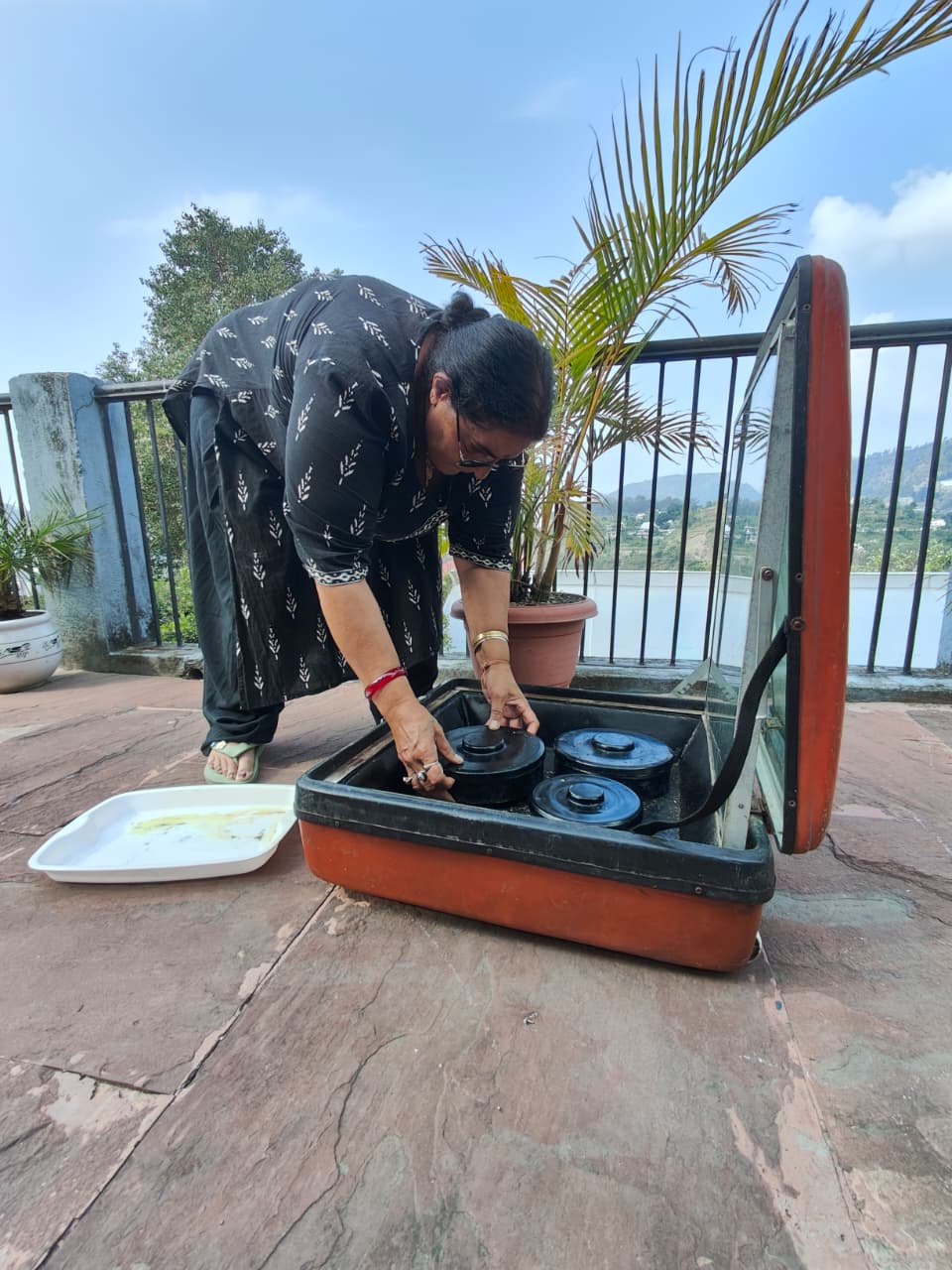
(His family, during a period of LPG scarcity, rediscovers a solar cooker purchased in the early 1980s and finds that it can reduce household gas consumption by more than 50 percent. The experience prompts a broader reflection on the untapped potential of solar cooking in India, particularly in the Central Himalayan hills where sunshine is plentiful but fuel supplies can be uncertain. A lived experience is shared)
 By Rajshekhar Pant
The recent difficulty in obtaining regular LPG supplies in many parts of the country has brought an unexpected guest back into our kitchen—a solar cooker.
Like many families of our generation, we had purchased one sometime in the early 1980s at the subsidised cost of Rs 250, if I recall it correctly. It was part of a nationwide enthusiasm for alternative energy that briefly flourished before fading into the background. For decades, the cooker lay forgotten in a corner, gathering dust and memories in equal measure.
Then came the present uncertainty over cooking gas supplies.
One sunny morning, we pulled the old box-type solar cooker out of storage, cleaned it, repaired a few loose fittings, and decided to give it another chance. To our pleasant surprise, it worked almost as efficiently as we remembered. Within a few days it had become a regular feature of our household routine. Rice, pulses, vegetables, potatoes, stew for the pets and even some slow-cooked dishes began finding their way into the solar cooker.
A few weeks later, we realised that our LPG consumption had fallen by more than half.
What began as a temporary response to a shortage soon revealed itself as a practical lesson in energy resilience.
India receives abundant sunshine for most of the year. Yet solar cooking remains a neglected technology. While rooftop solar panels have gained visibility, solar cookers continue to be seen as curiosities rather than serious household appliances.
This is unfortunate because solar cookers are particularly suited to many parts of India, including the Central Himalayan region. Contrary to popular assumptions, hill districts often enjoy bright sunshine for long stretches, especially during the post-monsoon, winter, summer and spring months. At the same time, transporting LPG cylinders to remote villages is costly, logistically challenging, and vulnerable to disruptions caused by landslides, road closures, or supply bottlenecks. At times those from the villages away from the main road have to spend the entire day in carrying the empty cylinder to the gas godown and the refill back home. In such circumstances, every meal cooked by sunlight reduces drudgery besides the dependence on fuel brought from hundreds of kilometres away.
When people hear the term “solar cooker”, most imagine the traditional box cooker familiar from school science exhibitions. These do remain useful and affordable, but technology has moved ahead. Today, a wide range of solar cookers is available. Box solar cookers are inexpensive, simple to operate, and ideal for slow cooking. Parabolic solar cookers are capable of producing much higher temperatures suitable for frying and faster cooking. Panel cookers are lightweight and relatively inexpensive. Community solar cookers are designed for schools, hostels, temples, and community kitchens. At the higher end Solar-electric hybrid systems are there which combine photovoltaic panels with electric cooking devices and can function even when sunlight fluctuates.
Different regions and income groups may require different solutions. There is no single model that fits all households.
For many families, particularly in rural and hill areas, the initial cost remains the biggest obstacle. A solar cooker often pays for itself over time through fuel savings, but the upfront investment can discourage adoption. This is where public policy can play a transformative role. Governments at both the central and state levels could consider subsidising household solar cookers, much as LPG connections were once promoted. Some other steps could be -supporting local manufacturing units in hill states; making solar cookers available through cooperative societies, self-help groups or even through the LPG gas godowns, frequented quite regularly in hills by the villagers for collecting refills. Offering easy financing through rural banks; demonstrating their use through schools, agricultural extension centres, and village development programmes and including solar cooking within broader renewable-energy missions may also be helpful in due course. Such measures would not merely promote a green technology; they would strengthen household energy security.
Perhaps the greatest challenge is not technological but psychological. Many of us have become accustomed to instant cooking and on-demand energy. Solar cooking requires a little planning. Food is prepared during the sunny part of the day rather than at the press of a button. Yet the rewards are considerable. Food cooks gently, fuel costs decline, and dependence on external energy sources is reduced. In an age increasingly concerned about sustainability, climate change, and energy security, solar cookers definitely deserve another look.
As we watch our old solar cooker quietly doing its work under the Himalayan sun, it is difficult not to wonder whether we abandoned a useful idea too quickly. The cooker that entered our home more than four decades ago as a symbol of an alternative future may still have something valuable to teach us. Sometimes innovation does not arrive in the form of a new invention, it waits patiently in a storeroom, reminding us that solutions to present challenges may already be within our reach.
(The author is an amateur filmmaker, a photographer, and a writer, who has written over a thousand write-ups, reports, etc., published in the leading newspapers and magazines of the country. He can be reached at pant.rajshekhar@gmail.com)