 By Ganesh Saili
‘Civilisations are known by their drainage systems!’ My wise friend Vinod’s remark was drier than us, soaked as we were to our knees by the sudden downpour.
Trouble comes when every drop of water that falls anywhere on this ridge makes its way down the hill to Mullingar gate. Those drops, in turn, come together to become a raging torrent, a river in spate. At times like these, life seems a little bleak.
To cope with this, our pioneers had built strategically placed culverts to drain the water. Every single one of them, and there are over a dozen, from the top of the hill to the very bottom, has been in a state of abject neglect for the past few years. Choked with garbage. Useless. With nowhere else to go, the water turns the road into a river.
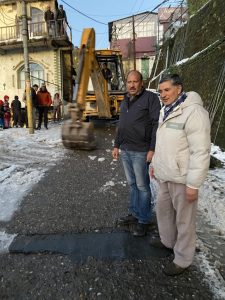
Pic courtrsy: Nikarika Bakshi.
Why are the culverts choked? Well! We haven’t had a health officer or sanitary inspector for the last ten years. It’s all a part of a money-saving measure. Tragically, used in the wrong place at the wrong time.
Elsewhere, you will see NRIs – not our Non-Resident Indians but the come-to-town-lately Newly Rich Indians. They turn their backs to the majestic sweep of the Himalaya, preferring the mundane bun-n-omelette or noodles under their noses.
Meanwhile, Landour’s distended octopus is spreading its tentacles. Its slimy presence is felt in the old Landour Cantonment, which is home to celebrities like Ruskin Bond, Vishal Bharadwaj, Victor Banerjee, Stephen Alter and Prannoy Roy. A clutch of shops near St. Peter’s Church is referred to as Char Dukan, literally ‘four shops’, opposite a ten-year-old car park. This is where the rowdies gather to glug sundowners from mobile car bars, leaving behind a trail of paper cups and smashed bottles. How long can the place survive this reckless onslaught? The jury is out. My guess is as good as yours.
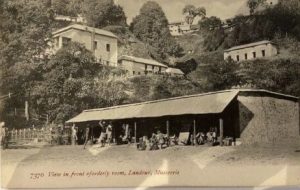
Pic courtesy: Author’s Collection.
Ten years ago, the authorities built a spindly three-storeyed structure for car parking. Instead of an architect, the office clerks designed it, and they forgot to include a way to get in and a way to get out. Unusable except for five measly parking slots, it was auctioned off and became yet another café. The next owner did away with the five-car parking, too.
Further afield, a hundred rental scooters ring in the sunset. They gather at Lal Tibba, outside St. Asaph, the home of my friend, the publisher, Pramod Kapoor. Poor fellow, he cannot enter his house because of the crowds that clog his gate. Fully fed up, he has abandoned his lovely home and has shifted to an apartment in Dehradun.
Recently, some enterprising local boys, as part of their ‘Make in India’ effort, pooled their resources and purchased electric vehicles to provide rides to the elderly and infirm around Upper Chakkar. It was a win-win model. Sadly, it was too good to last – the authorities banned it too.
Mercifully, Landour’s lost charm gives me more tales! In the interests of full disclosure, I admit to being in love with this place for a lifetime, and have been associated with a few books on this hill station. More by happenstance than by deliberate design, I have been a photographer and chronicler, and stand guilty of aspiring to be an author. The last is like treading on glass, if not on thin ice!
This summer, having taken eight hours to travel 31 kilometres, visitors are fuming by the time they arrive at the station.
‘The light at the end of the tunnel,’ warns Professor Sudhakar Misra, my friend, ‘ could well be an incoming freight train.’
And he’s spot on.
Around this erstwhile pristine promenade, you risk getting run over by vehicles driven by greenhorns who have never before driven in the hills. Seemingly, everyone, rich and poor alike, illegally parks on the side of public roads with impunity, forcing hapless pedestrians into the path of speeding traffic.
For folks living in a seismic zone, we are much too blasé. Over a hundred years ago, on April 4th 1905, the Kangra Earthquake struck, causing widespread destruction. When will the next big one strike? We’re way past due.
Ganesh Saili, born and home-grown in the hills, belongs to those select few whose words are illustrated by their pictures. Author of two dozen books, some translated into twenty languages, his work has garnered worldwide renown.