 By Roli S
As we look around us today, we can sense that the winds of change are blowing across Bharat’s educational landscape. The world is shifting at a rapid pace – new technologies, changing economies, and emerging global challenges are transforming how societies function. In such a dynamic environment, what is the true role of education? Is it only to prepare students to clear examinations, memorise information, and secure jobs? Or is it also to prepare them to become resilient, creative, and innovative citizens who can thrive in a competitive world?
I believe, with all my heart, that the time has come for us as teachers to rethink how we nurture our middle school students. Middle school is not just a stage in education – it is the foundation where curiosity is alive, imagination runs wild, and a sense of identity begins to form. If we, as teachers, can encourage an entrepreneurial mindset during these years, we will be preparing our children not just for jobs, but for life.
Entrepreneurship does not mean that every child must grow up to start a company. Rather, it is about cultivating life skills—resilience, creativity, collaboration, problem-solving, and adaptability. These are the very qualities that our students will need to succeed in the future. And in today’s Bharat, where “Make in India” has become both a call and a vision, instilling entrepreneurial skills in classrooms is not just an option—it is a necessity.
Why does entrepreneurship matter in today’s Bharat? Let us first reflect on the reality around us. Bharat is home to well over a billion people. Our youth population is one of the largest in the world, and this is our greatest strength—but also our greatest responsibility. The traditional job market is shrinking. Many careers that exist today may not even exist tomorrow. At the same time, new careers and industries are emerging that demand creativity, flexibility, and innovation.
This is why self-reliance and self-sufficiency are the need of the hour. We cannot raise a generation that only looks outwards for opportunities. We must empower them to create opportunities, to innovate, and to contribute solutions not only for Bharat but for the entire world.
Who will shape this future? Not politicians, not policymakers alone – it is we, the teachers, who will shape it in our classrooms, one student at a time.
An entrepreneurial mindset consists of resilience, the ability to face challenges, overcome setbacks, and keep trying until one succeeds. Creativity is the ability to think differently, to come up with new ideas and possibilities. Collaboration, the willingness to work in teams, to listen, share, and co-create. Problem-Solving, the skill of identifying problems and actively working towards practical solutions. Adaptability, the capacity to change with changing times, technologies, and environments. An entrepreneurial mindset is not confined to commerce alone. Whether a student grows up to be a doctor, engineer, artist, scientist, or farmer, these skills will make them effective, confident, and future-ready.
Teachers, you might be wondering: How do we bring entrepreneurship into middle school classrooms where curriculum demands, and time pressures already exist? The answer is simple: we integrate entrepreneurial experiences into what we already do. We do not need separate classrooms or huge budgets; what we need is a shift in mindset.
Encourage students to research different professions. They can interview local shopkeepers, artisans, or professionals in their neighborhoods. Invite parents or community members to speak about their work. Some schools can organise career-shadowing days where students observe someone at work. This exposure makes students curious and gives them a sense of what skills different careers demand.
Let students engage in small community service activities – helping at a library, assisting a local NGO, or organising a cleanliness drive. These experiences build empathy, teamwork, and problem-solving while helping them see themselves as contributors to society.
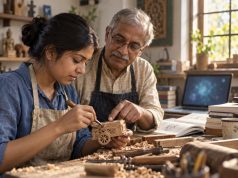
Encourage students to create something with their hands. It could be painting, calligraphy, crocheting, making clay figurines, or woodworking. Students can present their creations in a school exhibition or even sell them in a small “student market day”. Such activities combine creativity with real-world application.
Ask students to imagine a business idea and create a logo, slogan, and simple branding strategy for it. This taps into their design skills, language skills, and imagination. They can also work in teams to prepare a short pitch, presenting their business to classmates.
Today’s children are natural digital creators. Why not channel this energy? Students can create a short podcast, blog, or video where they explain their business idea; or interview a local entrepreneur. This strengthens communication, critical thinking, and technical skills.
Schools can reach out to local businesses to organise field trips, career fairs, or small workshops. This bridges the gap between classroom learning and real-world practice. Students get a first-hand look at how businesses operate and how teamwork drives success.
Some of you may ask, why middle school? Why not wait until higher secondary or college years? I think If we wait until later, students may already be conditioned to think narrowly about success as “marks and degrees”. By then, risk-taking and creativity may have been replaced by fear of failure. Middle school is the time to build the foundation for lifelong resilience and innovation.
Fellow teachers, let us recognise the power we hold. We are not just instructors – we are nation-builders. When we nurture entrepreneurial thinking in our classrooms, we are directly contributing to Bharat’s dream of self-reliance.
Think of it: each child who learns to innovate and solve problems is a potential changemaker. Each group project that builds collaboration is training future leaders. Each art piece, logo, or podcast is a step towards creativity and confidence.
We do not need to revolutionise the system overnight. Small steps will make big differences. A single project a term, a single workshop a year, or a single career day can plant seeds that will grow into forests of innovation. I know many teachers and educators are already working in the same direction.
By promoting entrepreneurship in schools, we are not only preparing individuals for personal success but also strengthening Bharat’s collective future. Imagine a generation of confident, resilient, creative, and adaptable young people—ready not just to take jobs but to create them.
My dear colleagues, this is my heartfelt appeal: let us rise to the challenge. Let us shift our perspective from “teaching lessons” to “nurturing creators”. Let us embrace project-based learning, hands-on experiences, and real-world connections.
We owe it to our students to prepare them not just for exams, but for life. We owe it to our nation to raise a generation that is self-reliant, confident, and future-ready. And we owe it to ourselves, as teachers, to take pride in knowing that the entrepreneurs, leaders, and innovators of tomorrow once sat in our classrooms, and we gave them wings to fly.
The future of Bharat is sitting before us, today, in the form of middle school students. Let us give them the tools to build not only their own futures but the future of our nation. Together, let us make our classrooms the birthplace of Bharat’s next wave of innovators.
(Roli S is an Educator, Teacher Trainer, Author, and School Reviewer based in Thane.)