 By Rajat Aikant Sharma
There are moments in history when the world does not collapse—it quietly rearranges itself. We are living in such a moment. The wars in Ukraine, the escalating tensions involving Iran, the United States, and Israel, and the slow but visible cracks in the dollar-dominated financial system are not isolated events. They are signals. Signals that the old order is tiring, and a new one is searching for form.
And in this shifting landscape stand two ancient civilisations—India and China—facing each other not just across the Himalayas, but across history itself.
For decades, we have been taught to see this relationship through the lens of conflict: borders, incursions, strategic rivalry. But what if that lens, itself, is outdated? What if the real question is not whether India and China will compete—but whether they can afford not to collaborate?
Because the world outside is already changing.
The Iran conflict has shaken the foundations of global energy trade. Nearly 20% of the world’s oil flows through the Strait of Hormuz, and sustained disruptions there have sent shockwaves through supply chains and markets worldwide. But amid the turbulence, something subtler and more consequential is unfolding: the slow retreat of the dollar from the centre of global commerce. Iran has begun accepting Chinese Yuan for oil payments, a quiet but deliberate step away from the petrodollar architecture that has governed energy trade for half a century.
Russia has moved even further. Under the weight of Western sanctions, a significant portion of Russia–China trade is now settled in rubles and Yuan. The Yuan has become a functional reserve currency in Eurasian energy settlements, and Indian refiners purchasing discounted Russian crude have, on occasion, been asked to transact in Yuan rather than dollars. Taken together, these are not random disruptions—they are the early grammar of a new financial language being written in real time.
This is not yet a revolution. But it is undeniably a direction.
What makes this shift even more intriguing is the quiet emergence of a deeper question—if trade is slowly moving beyond the dollar, what comes next?
One possibility, still distant but increasingly discussed, is the idea of a regional Asian currency framework. Not necessarily a single unified currency overnight, but a system where major Asian economies—India, China, and others—settle trade through a shared financial mechanism, reducing dependence on external systems.
For India, the implications of such a shift could be profound.
A common or coordinated Asian currency system could reduce exchange volatility, lower transaction costs in trade, and strengthen regional supply chains. It could give India greater leverage in energy imports, especially in times of global crisis, and reduce vulnerability to sanctions or currency fluctuations originating outside the region. More importantly, it could allow India to participate not as a follower, but as a co-architect of a new financial order.
Yet such a possibility cannot be built on economics alone. Currency follows trust. And trust, in the case of India and China, remains the missing foundation.
This is why the future may not begin with a shared currency—but with smaller steps: bilateral trade settlements, digital currency bridges, and regional payment systems. Over time, these could evolve into something larger, more stable, and more representative of Asia’s growing economic weight.
The question, therefore, is not whether a common currency is immediately possible. The question is whether India and China can create the conditions where such an idea no longer feels impossible.
The question is: where does India stand in this emerging financial geography?
India is still catching up in manufacturing, supply chains, and industrial depth—areas where China holds a commanding lead built over decades. But India brings something equally significant to this moment: demographic energy, democratic flexibility, and a civilisational philosophy that has long understood unity beneath apparent opposition.
And this is where the conversation must move beyond economics into something deeper.
In Advaita Vedanta, the foundational idea is that separation is an illusion. The apparent boundary between self and other is not fundamental—both are expressions of the same underlying reality, Brahman, undivided and whole. Adi Shankaracharya did not argue that difference does not exist; he argued that difference is not the final truth. Applied to geopolitics, this becomes a radical and clarifying thought: perhaps nations too are not isolated entities locked in permanent opposition, but evolving expressions of shared human striving—for security, for prosperity, for continuity across generations.
India and China, in that sense, are not opposites. They are mirrors.
Both seek stability in a world growing less predictable. Both seek influence as the centre of gravity shifts eastward. Both seek dignity after centuries of colonial diminishment. And yet, both remain trapped in a narrative of mistrust that belongs more to the 20th century than the 21st—a narrative sustained more by institutional inertia than by genuine strategic necessity.
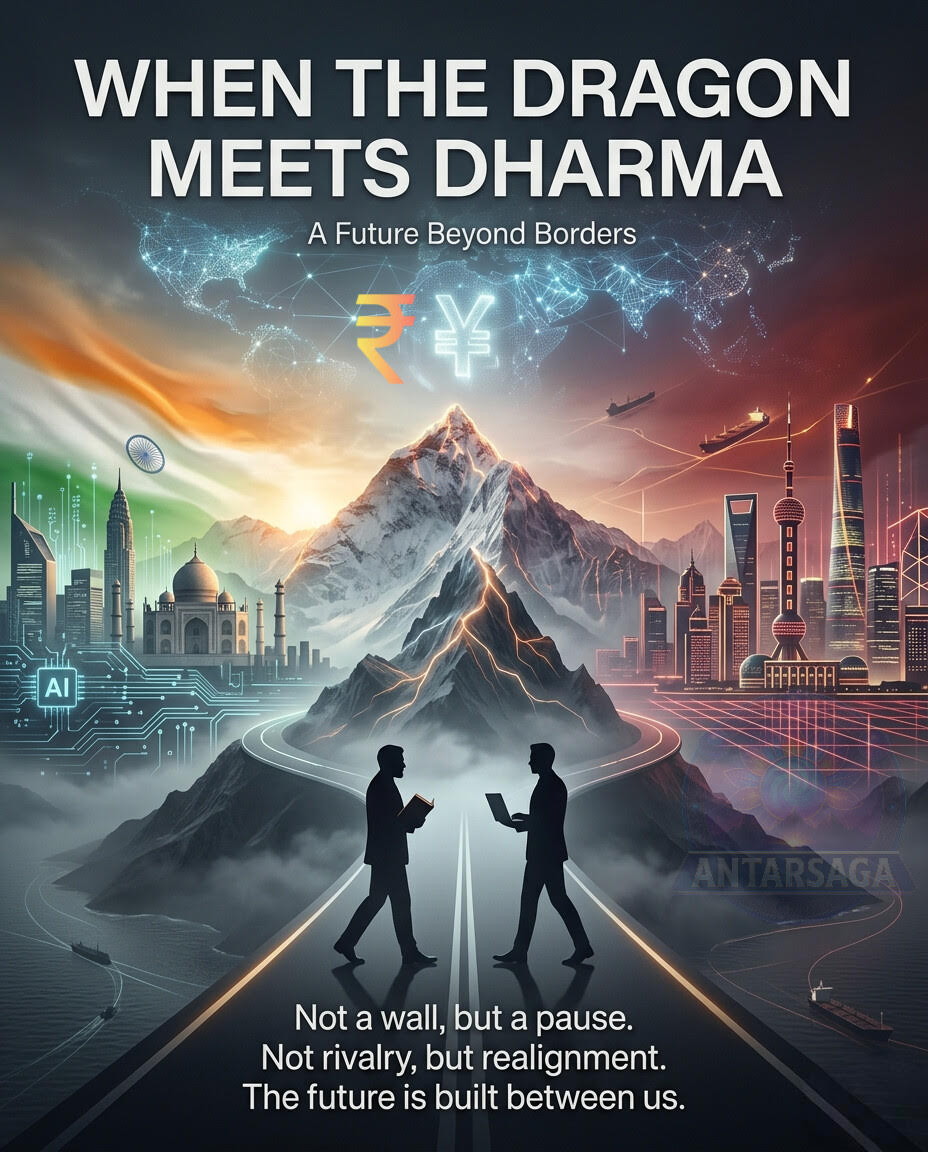
The Himalayas, so long cast as a boundary, could become something else entirely.
Instead of a contested line, imagine a shared civilisational corridor—a zone where sovereignty is not surrendered, but softened by shared interest. Economic regions jointly administered. Tourism circuits linking Kailash Mansarovar, Ladakh, and Tibet. Infrastructure built not as military assertion, but as economic lifeline. Roads that carry traders instead of tanks. It sounds idealistic. But history’s most enduring solutions are often those that redefine the problem rather than merely manage it.
The border dispute is not just costly—it is increasingly anachronistic. Maintaining high-altitude military deployments year after year drains billions from both economies—resources that could be redirected toward education, climate resilience, or the infrastructure of the future. Because the real contest of this century will not be over mountain passes. It will be over artificial intelligence.
AI is not merely a technological shift—it is a civilisational one. It will redefine work, learning, governance, and the meaning of productivity itself. In that world, traditional territorial rivalries begin to look not just costly but primitive. The competition that matters will be over intelligence systems, data ecosystems, and the capacity to adapt human capital at scale.
Here lies the most compelling case for India–China alignment—not alliance, not merger, but alignment. India’s software and services depth integrated with China’s manufacturing scale. Joint research platforms focused on climate, health, and automation. Supply chains redesigned as regional networks rather than globally fragmented dependencies. This is not friendship in any romantic sense. It is strategic maturity—the recognition that complementarity, pursued with clear eyes, outperforms rivalry.
The Yuan’s rise in global energy settlement points toward something broader: the future may not belong to any single dominant currency, but to a constellation of regional financial ecosystems. Digital currencies, multi-currency settlements, and bilateral trade arrangements are already reducing dependence on any one system. The petrodollar’s reign is not ending overnight—but its monopoly is quietly eroding, and both India and China have more to gain from shaping what replaces it than from remaining passive in its shadow.
But beneath all these possibilities lies a harder question: Can two ancient civilisations transcend their recent past?
Geopolitics, ultimately, is not just about power—it is about perception. If India sees China only as a threat, and China sees India only as a rival, even cooperation will remain brittle. But if both begin to understand each other as inevitable partners in a reorganising world, then even competition can become constructive.
Advaita does not ask us to deny difference. It asks us to see beyond it—to hold difference and unity simultaneously, without collapsing one into the other. India and China will never be identical. Their systems, values, and ambitions will differ. But difference need not mean division. It can mean complementarity. It can mean depth.
The dragon and the dharma do not have to clash.
The future will not be decided by who wins the next border standoff. It will be decided by who reads this moment with greater clarity—and has the courage to act on what they see.
Perhaps the Himalayas have been misunderstood all along.
Not as a wall.
But as a pause.
A pause between conflict and clarity. Between history and possibility.
The time has come to move beyond that pause.
(Rajat Aikant Sharma is a writer and photojournalist exploring culture, history, and human stories. Beyond print, he creates digital content, posters, and social campaigns that extend his editorial voice into the world of influencer engagement and brand storytelling.)