
 By Maria Wirth
In my first English book “Thank you India – a German woman’s journey to the wisdom of yoga”, I had written a chapter on a Sadhu whom I had met in Gangotri in 2001. His story is inspiring, so I shortened the chapter to fit it into a page of Garhwal Post:
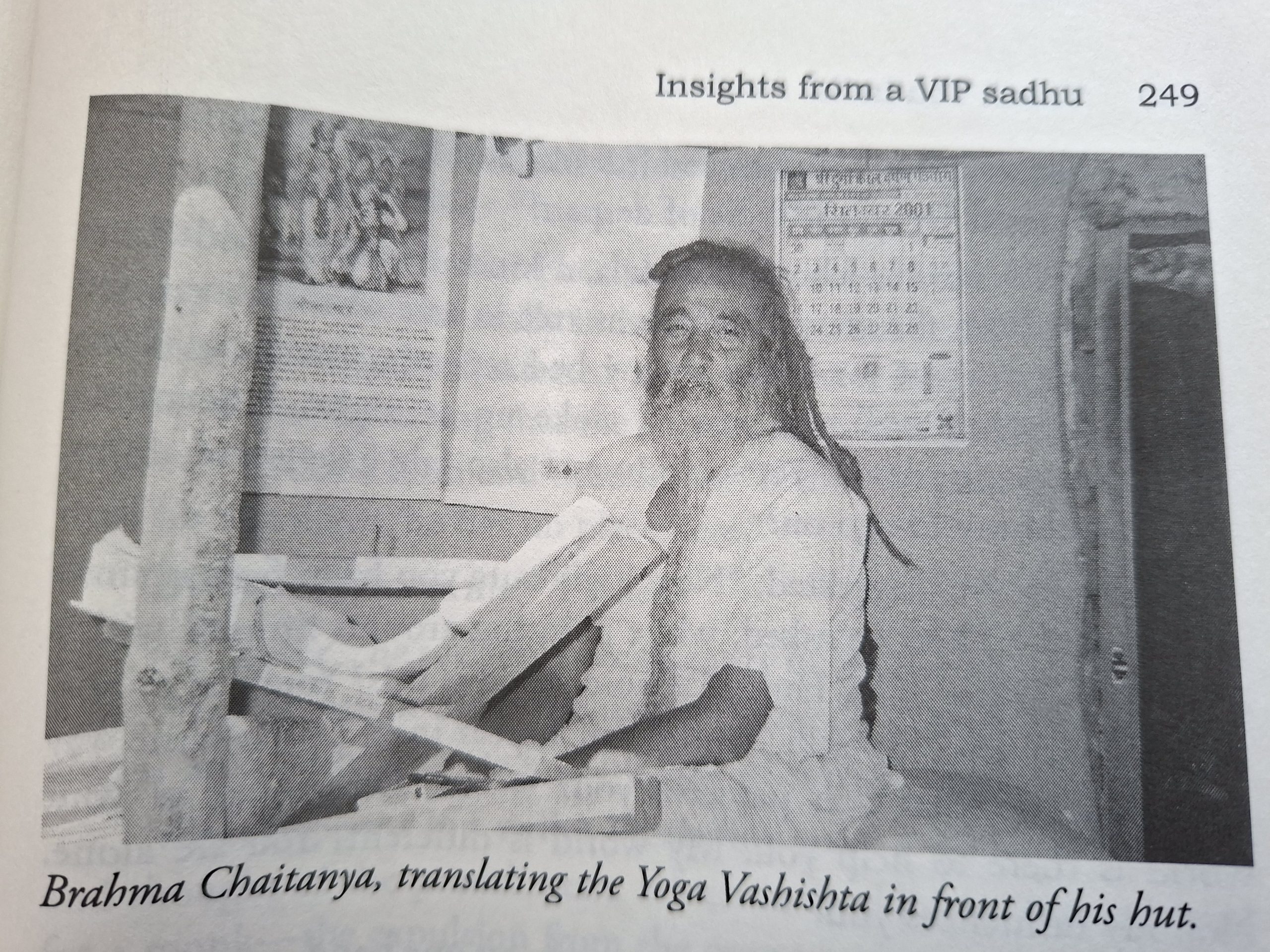
On the compound next to Yoga Niketan, right above the gorge of the Ganga, three sadhus lived in simple huts. One of those sadhus sat the whole day on his tiny veranda and scribbled into a big book placed on a wooden stand before him. Two more big books were spread out near him. He translated the Yoga Vasishtha into English, using the Hindi and Sanskrit versions for reference. The Yoga Vasishtha is an ancient teaching, which Guru Vasishtha imparted to Sri Ram, after the young prince came back from a pilgrimage and had lost all interest in worldly life.
Brahma Chaitanya or BC, as the sadhu was called was an impressive figure in his late fifties, tall and strong, his matted hair so long that he could use it as a cushion, his laughter louder than even the roar of the Ganga and his eyes sparkling with humour and charm. He was quite naturally a VIP among the sadhus and the president of the sadhu community in Gangotri. He came from a wealthy family and had been an engineer. So, commanding authority came easily to him and this self-assured conduct stayed with him as a sadhu.
Early in life, he became interested in spirituality, read a lot and practised pranayama. But he was young and did not want to be celibate. So, he married and had two children.
In his late thirties, however, he had had enough of family life and, one fine day, left his wife and teenaged sons. He thought about it for a long time and had tested himself, he explained. Then, he was sure. He wanted to become a sadhu.
However, his wife traced him in Uttarkashi and was adamant that he come back home with her to sort out an inheritance issue. He yielded. Yet soon after, he left his family for good. His wife discovered him in Gangotri, too, but now she respected his wish.
He told me what happened when he begged for the first time:
It was in Haridwar. He still had a few hundred rupees, but now wanted to start his new life – with full trust in providence. He stretched out his hand towards an elderly gentleman. As a reaction, he did not get any alms but a furious rebuke. “You should be ashamed, young man! Go to one of the ashrams which offer free food for sadhus!”
The newly baked sadhu was greatly annoyed, went straight into a restaurant and ordered a meal. Then he checked into a hotel. In the night, his conscience troubled him. “So quickly am I offended? Only because of a passing remark?”
Next morning, he gifted his travel case to a boy in the hotel and threw the rest of his money into the Ganga. “I now fully belong to you. You have to look after me now,” he told his Ganga Ma. From then on, he did not face any problems. He went to the centres, which served food to sadhus and joined the queue like everyone else.
The talks with him were highly interesting and he had, unexpectedly, an exquisite library in his hut – books by ancient and modern Indian and even Chinese masters.
Our conversations in the afternoon became routine and I looked forward to them. Afterwards he often dived into his hut and came back with a book in his hand. Books like “Shiva Sutras” or “Spanda Karika” about the philosophy of Kashmir Shaivism, which flourished in Kashmir in the 11th century, which I enjoyed studying in the beautiful surroundings at the height of over 3000 metres with snow-capped mountains standing guard.
On BC’s advice, I bought a japa mala fro, one of the shops near the temple and sat for hours on my bed repeating mantras. I was generally feeling well and when I woke up at night, I heard the mantra repeating itself.
Once I had brought a bar of chocolate for him. “Do you eat chocolate?” I asked. Because sometimes he looked very holy, for example said, that he does not like conversing on worldly topics, and I considered it possible that he had renounced such worldly pleasures. “Yes, of course I eat chocolate,” he immediately replied.
He told me that once an American accused him of wasting his talent. “You should give lectures in the West,” he had said. BC answered him, “I have here everything I need. I get daily two meals.”
“Meals okay. But if you want chocolate, you have to do something for it”, the American had replied.
“Look! I even get chocolate!” he exclaimed and once again burst into roaring laughter.
I sat either in front of my hut and studied ancient texts or inside and meditated. During the first few weeks in Gangotri, I made hardly any contact with others. It was an intense time, and it slowly became clearer to me what ‘pure awareness’ signifies.
“Look at those snow-capped peaks over there, but nevertheless stay with your awareness inside,” BC advised me. “Try to be aware of the unity behind the apparent duality – be aware of the white paper and also perceive the black print on it. Be attentive! Give your attention not mainly to the objects, but to attention itself,” he demanded. I tried it and got an idea what he meant.
Once he gave me the ‘Golden Letters’ by Garab Dorje, an ancient Tibetan master, after he had again dived into his hut. They were a treasure, like the Shiva Sutras, and I copied them by hand into my diary, because there was no copy machine in Gangotri.
The content of those letters is simple, yet very subtle. The main thing is to recognise that this fresh, immediate awareness of the present moment is the truth that is sought after. It is ever present – this ordinary, thought free awareness – now in this moment. Realise this ordinary awareness as your true nature and stay with it, because everything else, which means all appearances in this world, are only modifications of this basic awareness and therefore secondary.
BC shared my excitement regarding the Golden Letters. He suggested that during my next meditation I relax and then suddenly and loudly shout “Phat”. This would cause pure awareness to rise up. In the evening, I tried it and it had a tremendous effect. It felt so beautiful that I didn’t want to move. As if something had opened – an insight into my Self.
BC suffered since long from back pain. One morning the pain became unbearable and he could not get out of bed. A doctor from Amma’s ashram advised him to go to the hospital in Rishikesh for a check-up and accompanied him.
When he came back after a fortnight, he felt better and decided to stay in Gangotri for the winter as usual, even though everybody advised against it. It was only end of September and already ice-cold.
“Last year a Frenchman paid for my winter provisions,” he told me, and I knew why. I felt obliged.
“I will pay for it this year,” I offered. “How much is needed?”
“5000 Rupees are enough.”
I had not expected that much but money could not possibly compensate for what he had given me. Pure awareness as my own inner being had become more recognisable through the contact with him and his books.
Four years later, in August 2005, I went once again to Gangotri.
“Brahma Chaitanya is no more,” the manager of Yoga Niketan informed me, even before he unlocked a hut for me. “He died last month in Delhi.”
I really felt sorry. He had been so full of life. I did not understand how he could have gone to Delhi in the hottest season. He himself had told me that he would not leave Gangotri again. Only his ashes would be carried down into the plains by his Ganga Ma.
I heard two versions why he went to Delhi:
A ‘big’ Swami from Delhi had sent two of his followers to Gangotri to request him to come. BC declined. Yet, they came again and he yielded, maybe because the Swami had offered to arrange an Ayurvedic treatment for him.
The other version said that he wanted to go to Delhi on his own wish for Ayurvedic treatment and the Swami arranged it.
“Death called him to Delhi,” a sadhu neighbour of BC said and thus put any speculation that there might have been foul play into a different perspective. “His time had come.”
Brahma Chaitanya’s sons came to Gangotri and took the translation of the Yoga Vasishtha out of his hut. Their father had given his life to this work. His ashes were immersed in his beloved Ganga Ma – in Haridwar, where he had started his sadhu life. The circle had come full round – an inspiring life had ended…
(Maria Wirth is the author of ‘Thank You India’ which was released at the Dehradun Litfest.)


