 By Anil Raturi
Srinagar town in district Pauri Garhwal of Uttarakhand remained the capital of the Garhwal Kingdom for many centuries.
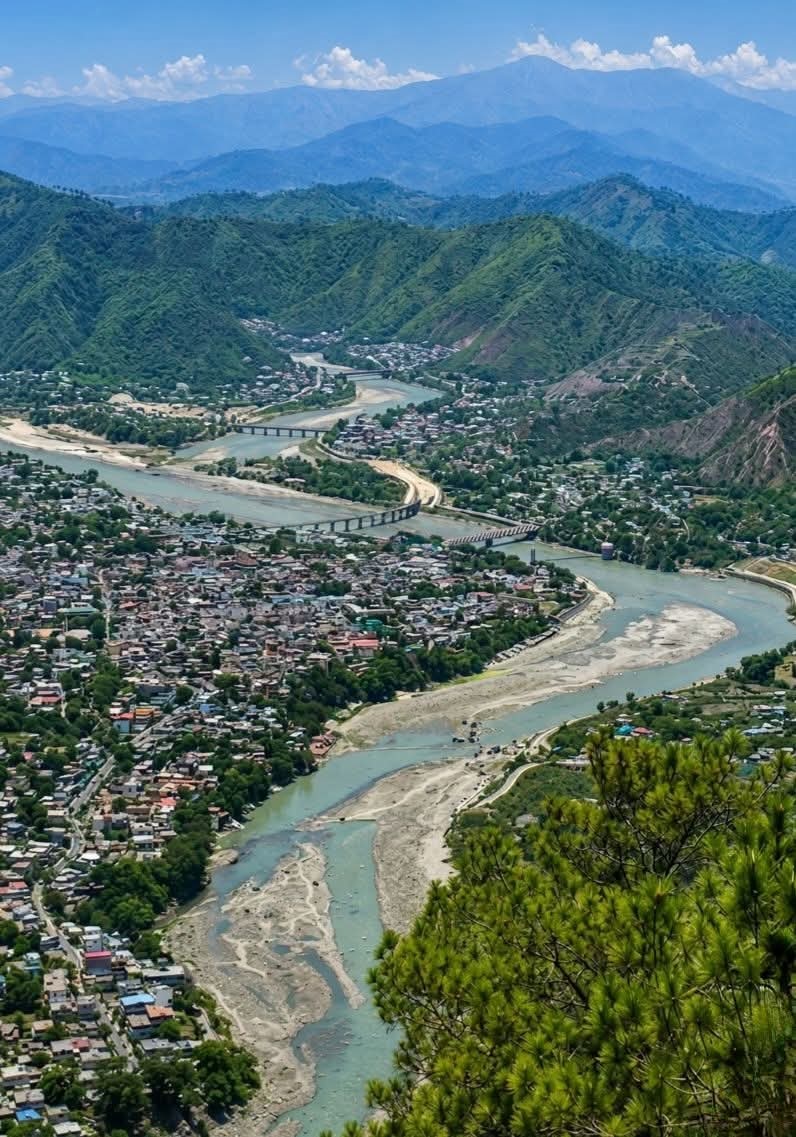
The panoramic town is situated on the banks of River Alaknanda at an altitude of about 1900 feet above sea level.
King Ajay Pal founded this town when in 1506 he shifted his capital from the higher mountains to come to Srinagar valley.
Hundred and five kilometres from Rishikesh, the road to Srinagar is a picturesque drive along the flowing clear blue and green icy waters of the Ganga River.
Between the 7th-11th centuries, the North and West of India was ravaged by various invasions.
It was during this period that the Garhwal Kingdom was founded by Raja Kanakpal, a scion of Rajput rulers of Dhar Malwa.
Initially the Kingdom was established in Chandpur Garhi near Adi Badri in district Chamoli Garhwal. At that time, it was a remote place in the Himalayas, which was far removed from the unpredictable happenings of the great Indian plains.
In the absence of modern roads and communications, it was a relatively safe place for the people who were fleeing the invaders.
King Ajay Pal unified the 52 factions (Garhs) of the hill chieftains into a single Kingdom, which in due course came to be known as Garhwal.
Centuries of immunity from invasions provided a stability to the Garhwali society which evolved a unique culture which is steeped both in the classical Vedic as well as the local Himalayan traditions.
The Panwar rulers of Garhwal patronised the iconic shrines of Badrinath, Kedarnath,Gangotri and Yamunotri.
During this period, the Garhwalis developed a rich culture of folk music, folk theatre, poetry and literature.
The Garhwal school of painting, led by the 19th century artist, Molaram, is known around the world today. The Garhwali cuisine, based on Himalayan plants is becoming popular by the day, just as is the region’s cultural signature cap, the “Brahma Kamal Topi”. The intellectuals of this Himalayan society were steeped in a literary tradition of centuries of learning in Sanskrit, Jyotish, Vedic Mathematics, Ayurveda and the study of ancient Indian classics.
It is remarkable how this remote Himalayan society was successful in preserving the ancient Indian knowledge for centuries and transmitting it from one generation to the other.
The traditional knowledge and culture of the hill society, distilled good values, such as frugality, simplicity and integrity, which it instilled within its people.
On the one hand, this contributed towards forging the character of the people, while on the other hand, it also helped in keeping the mind of the mountain folks intellectually fertile.
Centuries of habitation in the mountains has made the people hard working, physically tough and stoic.
An interesting facet of Garhwal Kingdom’s history is that, for many centuries, it was able to maintain its independence. The Mughals unsuccessfully tried to subjugate it on two occasions.
First was during Shah Jahan’s reign when his army under Najabat Khan invaded Garhwal.
At that time, young Mahipati, the ruler of Garhwal had died leaving behind his widow, Rani Karnavati and a seven year old son, Prithvipati.
Rani Karnavati was a shrewd lady.
Seeing the formidable army of the Mughals advancing and realising its strength, she cleverly ordered her military to withdraw from her Kingdom’s borders in the plains.
The Garhwali army drew the great Mughal army deep into the hills.
Finding themselves in the unfamiliar and inhospitable mountainous terrain with the military of the foe nowhere to be seen, the Mughal force, facing logistic challenges fell into disarray.
Compelled to turn back, the retreating Mughal army was attacked by the Garhwali military in the night.
The Garhwalis, being more familiar with the local terrain, efficiently used guerrilla tactics to devastate the fleeing enemy.
Rani Karnavati ordered her men to cut the noses of many fleeing Mughal soldiers.
Infuriated, Shah Jahan later referred to her as “Nak Katti Rani”!
The second time when the Garhwal King had to face the ire of the Mughal Emperor was during Aurangzeb’s reign. Dara Shikoh’s son, Prince Sulaiman Shikoh, fleeing Emperor Aurangzeb took refuge in the Srinagar court of Raja Prithvipati of Garhwal.
In 1790, the Nepalese subjugated the adjoining Kingdom of Kumaon. Then, they also attacked Garhwal.
The resilient Garhwalis were successful in keeping the Nepalese at bay for more than a decade.
However, in 1804 in the battle of Khurbura in Dehradun, the Gurkhas were finally successful in killing King Pradyuman and annexing the Kingdom of Garhwal into the Nepalese Empire.
Just as the Panwar dynasty ruled Garhwal, similarly the Chand Rajput Kings ruled the adjoining Kingdom of Kumaon for many centuries.
Before the advent of the Panwar and Chand dynasties, the people of both the Kingdoms had been ruled by a common Katyuri dynasty which had its capital at Joshimath.
The people of Garhwal and Kumaon have a shared history and culture.
In 1815, the British defeated the Nepalese in the Battle of Khalanga in Dehradun.
Subsequently, they annexed the region making it a Non Regulation District of the East India Company.
Interaction with the British administration made the people of the hills generally well versed in the English language, much before the rest of North Indians learnt it.
No wonder that the talented people of this small hill state (now known as Uttarakhand) have distinguished themselves in all walks of life within India as well as around the world.
(Anil Raturi is a retired IPS officer and former DGP, Uttarakhand.)