Garhwal Post Bureau
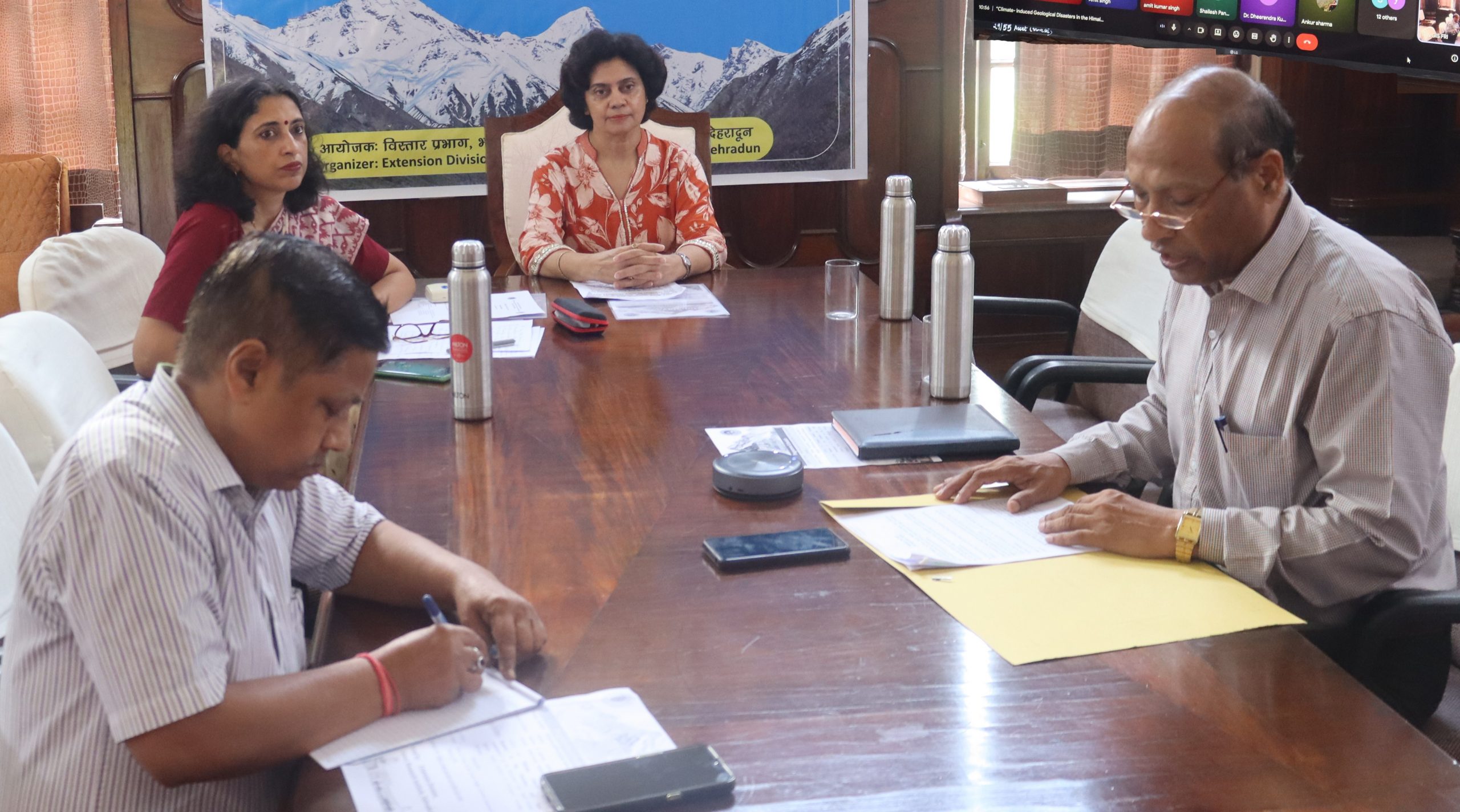
Dehradun, 10 Sep: As a part of celebration of Himalaya Day-2025, Extension Division, ICFRE-Forest Research Institute, Dehradun organised a webinar, today, at which an online presentation on “Climate- induced Geological Disasters in the Himalaya and their remediation” was made by Dr Kalachand Sain, former Director, Wadia Institute of Himalayan Geology, Dehradun.
At the outset, Richa Misra, IFS, Head, Extension Division, Forest Research Institute, welcomed all the participants. In her welcome address, she mentioned that Himalayas are the origin of many rivers like Indus, Ganga and Brahmaputra, the lifelines of people settled in the river basins. She said, “We are dependent on Himalayan Eco-point for our survival and livelihood. The over-exploitation of natural resources due to anthropological pressure has created an alarming situation. Different kinds of pressures on the mountain ranges are leading to earthquakes, floods and droughts.”
After the welcome address, she invited Dr Renu Singh, Director, ICFRE-Forest Research Institute, for the inaugural address. Dr Renu Singh spoke on the importance of the Himalayan ecosystem and asserted that the Himalayas are not only a source of strength but also a global heritage that demands preservation. She quoted the example of calamity in Dharali and other places in Uttarakhand as a result of flooding. She said that it is everyone’s moral duty to protect the Himalayan ecosystem for sustaining nature and human life.
During the technical session, Dr Kalachand Sain, in his presentation, mentioned that the Himalayan ecosystem becomes fragile due to global warming, climate change and disturbance by humans. Due to climate change, there are some visible indicators like glaciers melting, upward shifting of snowline and treeline. These indicators are making the ecosystem fragile, causing natural disasters such as floods, drought, landslides, etc. He suggested that there should be systematic planning and strategy with a strong monitoring system to protect the Himalayan ecosystem.
The programme concluded with the vote of thanks proposed by Dr Charan Singh, Scientist-F, Extension Division of the institute.
The programme was attended by about 70 participants including officers & Scientists of ICFRE-FRI, other sister organisations under ICFRE and other institutes and students of FRI Deemed to be University, Dehradun and other universities.
All team members including Rambir Singh, Scientist-E and supporting staff of Extension Division of the institute did a commendable work to make the programme a successful one.