 By Roli S
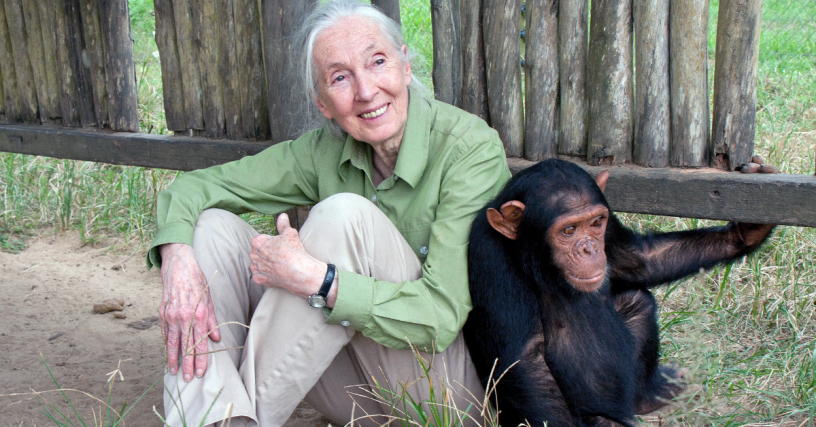
One of my all-time favourite images from the world of information has remained of Primatologist and Conservationist Jane Goodall playing and interacting with the chimpanzees in the forests of Africa. I have since followed her like people of my generation did by reading books and articles about her and watching a few documentaries on her life and work on television. What I most admired about was that her life shows us a rare alchemy of passion, persistence, humility, courage, science, art, hope and spirituality. It is very easy to see and understand her courage & boldness as she moved to a remote forested region in Gombe, Tanzania, to live among chimpanzees, in challenging conditions (disease risk, isolation, very little infrastructure). Persons like Louis Leakey believed in her, but she was breaking new ground. She was willing to risk comfort, status, convenience to follow her calling. The exemplary patience and observational discipline that she demonstrated required long hours, waiting, observing, often being ignored by the chimps, sometimes risking illness, etc. Many discoveries came because she persisted where others might give up. She had the ability to live simply, endure hardship, and commit long‐term. Although she came without formal credentials in the beginning, Jane Goodall adopted rigorous scientific observation. She had to convince skeptical scientists, for example, that chimpanzees use tools like we humans do. At the same time, she allowed herself to be surprised: she noticed behaviours that challenged prevailing scientific ideas. But for me, Jane Goodall, the person believed in the bright future of humanity, which has remained the most fascinating aspect of her personality. Despite the world experiencing most destructive natural calamities, floods and droughts persisting around the world and fires burning forests, across continents; increasing political division leading to hateful rhetoric, disillusionment and wars; despite the hardships that our world faced, Dr Jane Goodall, who had been a witness to the atrocities and destruction of the Second World War, still held a tremendous amount of hope for the future of this planet and its people. Why? I think it is because of her strong belief in spirituality.
“I had never been able to believe that God would give us poor frail humans only one chance at making it — that we would be assigned to some kind of hell because we failed during one experience of mortal life. … So, the concepts of karma and reincarnation made logical sense to me.” These words expressed by Jane Goodall confirm her spiritual leaning. In her ‘The Book of Hope: A Survival Guide for Trying Times’, Jane Goodall stated, “We are spiritual beings having a human experience.” Primatologist and conservationist Jane Goodall’s spiritual journey is rooted in her reverence for the natural world and a belief in a universal spiritual power. While not explicitly linked to Vedic or Indian thought, her ideas align very much with the key concepts from these traditions. Her experiences led her to a biocentric spirituality, the belief that every living thing possesses a soul or “spark of divine energy”. During her time in the forests of Gombe, Tanzania, studying chimpanzees, Goodall felt a strong spiritual connection to the natural world. This profound experience, where she felt very close to a great spiritual power, shaped her beliefs and became the bedrock of her spiritual identity. Goodall believed that, if humans possess a soul, then that same divine spark of energy is also present in chimpanzees, trees, and every other living thing. This perspective fosters a sense of unity and shared existence with all species. The Sanskrit concept of Mata Bhumi (Mother Earth) is not just a planet but a living, conscious being—a Devi or divine mother. Goodall’s idea was that all of nature is embodied with consciousness and a soul mirrors this reverence for the Earth as a divine entity. In the book, ‘Reason for Hope’, the spiritual autobiography, Goodall explores her deepest beliefs about spirituality and moral evolution. The book touches upon themes of faith, mysticism, and the existence of the soul, tracing her spiritual journey alongside her groundbreaking scientific work. The interconnectedness of all species, a concept Goodall learned while observing nature, is a central theme in ancient Indian thoughts as well. The idea that all life is part of a single, universal consciousness is a foundational aspect of Vedic and Advaita Vedanta philosophy. Her story provides a model for how one can find spiritual connection and purpose through nature rather than solely through religious institutions. The “Gospel of Jane”, as some have called it, is a personal story of spiritual connection to animals and habitats that inspires hope and action. And then the question that arises in my mind often is, “Is it hard to duplicate Jane Goodall’s feat in today’s environment?” To this the answer that I get is “Yes and No”. Well, these days social media, smartphones, constant information/digital stimulation tend to reduce the time and attention people can invest in deep observation and patience, which requires time and in person actions. There is often demand to produce visible results fast, to have public recognition, likes, and followers. That can push people away from slow, humble work of natural observation which is mainly done in isolation. The challenges facing nature are more intense, faster and more global. Climate change, habitat loss, species extinction, environmental degradation and, in some places, political instability, land rights issues, conflicts, make fieldwork like Jane Goodall did dangerous or more difficult. Also increasing emphasis on protecting wildlife from human disturbance means stricter protocols, which while good, make some kinds of observation harder. In the era of monetisation and visibility bias,
sometimes the quieter, less public work of long immersion and documentation may get overlooked or underfunded. There’s pressure to make impact measurable in short term, not always compatible with deep, long drawn naturalist work like Jane did. Historically, naturalists sometimes drew upon inherited or local knowledge. Today, local knowledge is sometimes undervalued or destroyed. Cultural connections to nature are weakened in many societies by rapid development, migration, and schooling disconnected from nature. In many academic or institutional settings, separating out the spiritual or emotive or artistic side is discouraged. Goodall’s willingness to speak about her spiritual reflections as part of her scientific life is unusual and not heard of often. Many people feel they must choose between being rigorous scientists OR being spiritual/empathetic/artistic, rather than integrating. So, it is tempting to think that such feats are no longer possible—but Jane Goodall’s life suggests otherwise. Her reasons for hope show that environment, youth, human intellect, resilience still offer fertile ground. But the path is steeper, more complicated, less glamorous in many ways now. The distractions, the difficulties, the speed of life, the regulatory and financial demands—all pose real challenges. But “over” I think is too strong a word. There are naturalists, researchers, conservationists working deeply and passionately today. Some of them may not be household names, but they are continuing Jane’s work in new ecosystems, new fields (e.g. climate science, digital monitoring, species restoration). The question is: will we cultivate enough of them, will society support them, will their work survive visibility, funding, recognition? To sum up I can say that being a Jane Goodall requires a rare combination: early passion. curiosity; courage, patience, willingness to live simply; scientific rigour combined with spiritual openness; empathy, humility; a storyteller’s heart; inner resilience; a hopeful mindset that acts. Still remaining hopeful as Jane Goodall was, I can say that in our time, duplicating her feat is harder—but not impossible. What is needed is intentional cultivation: of education, support systems, funding, cultural values, habitat protection, and above all, nurturing hope and moral purpose. If we can do those things, the world might produce not just one more Jane Goodall, but many people of her quality in many places — each with their own specialisation, but united by love for nature, for science, and the spirituality.
Goodall passed away on Maha Navami, the final day of the sacred Hindu festival of Navratri, which honours the Divine Feminine. In a tribute, we people of Bharat have described this as a fitting day for her passing, referencing the Goddess, Siddhidatri, who bestows spiritual powers and helps one transcend earthly desires.
(Roli S is an Educator and Author based in Thane.)