 By Ganesh Saili
On the grapevine, I hear that Pramode Sawhney is chugging along. After decades together on the Board of the Mussoorie Library, I find myself scrambling for a phrase to describe him. Perhaps, ‘Gentler than gentle,’ fits like a glove.
‘When did Art Press start?’ I ask him.
‘My father’s family came here from Lahore in 1933. Analogue printing meant running out of ‘e’s!’ he rues. With his two children settled overseas, it is time to draw the shutters on the press, so I put it up for rent.’
‘This is all I carried away as I walked away from a place where I’d spent a lifetime,’ he said, pointing at a sheaf of pink papers wedged between his books on his shelf.
Pic courtesy: Pramode Sawhney.
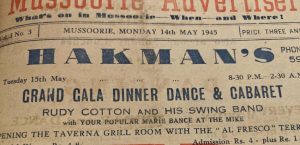
Rummaging through early copies of The Mussoorie Advertiser, I find the saxophonist Rudy Cotton announced his show at Hakman’s Grand Hotel in the summer of 1945, and the Savoy Hotel listed its celebrations on Independence Day 1947.
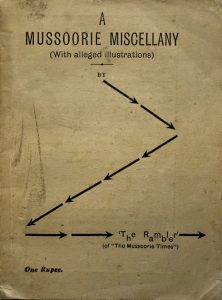
‘To the memory of those who have contributed to the history of Mussoorie, this publication is humbly dedicated,’ began Charles Wilson with the pseudonym ‘the Rambler’. Priced at one rupee, only a few copies survive.
‘Drat the Beast! The printer’s devil ran amok and left you these corrections.’ Nine corrections were listed in the second publication.
However, I had never seen one till Rahul Kohli sent me an image.
‘The artwork is way ahead of its time,’ observes Rahul Kohli wisely. He adds, ‘Very minimalist and clean.’
True that, considering that thus far, I have had to rely on coverless Xerox copies.
Pic courtesy: Rahul Kohli.
‘Lest the melancholy maid be robbed of her slumber after that wade through the mire of Mussoorie, the miscellany that follows is proffered as an unguent to her megrims,’ says author Alan Sealy, when I last met him over lunch at Wildflower Hall. It turns out that he hates a line quoted by a reviewer.
‘Too long-winded and too convoluted a sentence!’ he grumbles.
Yes! I couldn’t agree more.
John Northam’s ‘Masuri’ was the first guide to these hills, published in 1884. Next came Frederick Bodycot’s Guide to Mussoorie in 1935. Almost sixty years later, Ruskin Bond and I were commissioned by Roli Books to do a book on our home in the hills. I admit to being a novice. I had no clue where to begin. But I think I made a good start by learning the art of keeping my mouth shut. Ruskin was the first off the block, marking with a pencil a few lines in Bodycot’s Guide, which he gave to Maya Banerjee, who most generously typed the manuscript at the oval dining table, on her manual Olivetti typewriter.
Victor was helpful; he took me under his wing to guide me with pictures, which marked the end of my siestas. Henceforth, our afternoons were spent haring to places like my old school, to see my teacher, Miss Edith Garlah, and her friends, Dagma Houghton and Dorothy Nestor. We saw Prithvi Bir Kaur, the Rajmata of Jind, residing in Oakless; we also met General Ram, retired from the army’s nursing services, at her home, and met Rajah Dinraj Pratap Singh of Kasmanda at Bassett Hall.
Sundown saw us gathered at our publisher, Pramod & Kiran Kapoor’s home in St Asaph’s, to write captions, where elbow exercise intervened. I blame the single malt for making all the pictures look good. Sober, they were the good, the bad and the ugly, the latter dominating.
At this point, a round of thanks is in order: Victor, for not tearing my clothes when my pictures did not turn out well; to Maya, for her typing, which helped the book get printed without a single typo; to the team at Roli Books for their efforts in designing the book, and to Pramod, who watched it come off the old drum rollers in Singapore. When I look back over thirty years, the book has had so many reprints that we lost count. Together they testify to the book’s resilience.
Meanwhile, at Albany Cottage, Pramode Sawhney gently waves a freshly chugging along bound copy of The Mussoorie Advertiser, saying: ‘It’ll probably outlast us both, Ganesh.’
Ganesh Saili, born and home-grown in the hills, belongs to those select few whose words are illustrated by their own pictures. Author of two dozen books, some translated into twenty languages, his work has found him renown worldwide.