 By Roli S
For the veterans of the 12th Naval Academy Course (NAVAC), of the Indian Navy, the reunion of the course to celebrate the Golden Jubilee (50 years) of the course, which was arranged between 16 and 23 January 2026 at Kochi and Ezhimala in the state of Kerala, returning to Cochin, now Kochi, was not just a journey across geography—it was a voyage across time. As their aircraft descended and the familiar humid breeze of the Malabar Coast wrapped around them, many felt a quiet tightening in the chest. This was Cochin, their alma mater, the place where they had first arrived fifty years ago as wide-eyed young boys from all corners of India, carrying large black trunks, lofty dreams, and an unspoken sense of uncertainty about the life they had chosen.
Their reunion began symbolically at Cochin Harbour Terminus; a place etched deeply into their collective memory. Decades ago, this was where many of them had first stepped into the world of the Navy—some after days of train travel from the Northern and Eastern and Western states of India, rest from states much closer like Tamil Nadu, Karnataka, Andhra Pradesh, Kerala, etc. At that time, the terminus looked enormous and intimidating. Now, as veterans with silver hair, unsteady gait, they stood there again smiling, pointing, laughing softly.
“Yahin se sab shuru hua tha,” one of them murmured. Another joked, “Tab yeh jagah badi lagti thi, aaj toh chhoti ho gayi… ya shayad hum buddhe ho gaye hain.”
Meeting old colleagues face to face after decades was perhaps the most emotionally charged moment of the reunion. There were sudden shouts of recognition, double takes, hesitant steps forward followed by tight hugs. Names were called out with nicknames long forgotten by the rest of the world. Behind the humour lay deep affection. These were men who had shared drills, punishments, fears, ambitions, and countless cups of strong naval tea and beer breaks. Time had scattered them across ships, commands, and civilian lives, but here, in Kochi, they slipped effortlessly back into the camaraderie of youth. There were a few course mates who fate had taken away from them too soon. Their void was felt by everyone, but their representation by their better halves brought a spark of hope and cheer to the whole group.
The visit to their old cabins and bunks was a deeply sentimental chapter of the reunion. Walking through corridors that once echoed with hurried footsteps and shouted commands, many paused silently. Some rooms looked different as they had turned into offices with a totally new interior and furniture—but the invisible bunks seemed to whisper stories to them “Yeh cabin mera tha,” one veteran said softly.
Their memories spilled out freely—late-night gossip, whispered jokes after lights-out, the fear of inspections, and the rare luxury of a Sunday afternoon nap. Old pranks resurfaced too. Laughter rang out, echoing against walls that had witnessed the making of naval officers.
For the benefit of ladies and families, a guided visit to the training establishments—CELABS, Signal, Navigation, Anti-Submarine Warfare, Gunnery School (INS Dronacharya) at Fort Kochi, and Aviation School was both nostalgic and awe-inspiring. The veterans walked slowly, eyes darting between familiar layouts and unfamiliar technology. The establishments now bore new names, sleek buildings, and advanced simulators. Large screens, digital consoles, and automated systems stood where once there had been chalkboards, paper charts, and manual calculators.
They remembered plotting courses by hand, calculating fixes with sextants, and learning gunnery on systems that demanded physical strength as much as technical knowledge. Aviation training, once limited and awe-inducing, now looked futuristic. Yet there was no envy—only pride. Pride that the Indian Navy they had served had evolved so magnificently.
Their conversations often drifted to life onboard ships in those early years—ships with old technology, analog dials, and equipment that demanded ingenuity.
“GPS toh door ki baat hai,” one veteran said, “hum toh stars se baat karke rasta poochhte thae.”
Meeting old serving hands and instructors, some now retired and others still in uniform, stirred deep emotions. There was genuine respect on both sides. Younger officers listened attentively as veterans shared experiences from earlier eras. One of the veterans summed it up beautifully: “Uniform wahi hai, discipline wahi hai, bas technology nayi hai. Navy ka dil abhi bhi wahi dhadakta hai.”
Visiting old living quarters brought back quieter memories—loneliness, homesickness, and personal growth. Many recalled their first nights away from home, the strict routine, and the gradual transformation from boys to officers. “Navy ne sirf naukri nahi di,” one veteran reflected, “Navy ne zindagi banana sikhaya.”
An excursion trip visiting old lanes and by lanes of Fort Kochi, museums, art cafes, and a synagogue combined with a bit of street shopping helped the ladies satisfy their varied interests. A backwater cruise in a houseboat followed by a typical Kerala meal on banana leaves was an experience that will be narrated by the old heads for a long time to come.
Amid all this nostalgia and flurry of activities, what stood out strongly was the immense pride they felt seeing today’s Indian Navy—well-equipped with the latest technical systems, professionally organised, and supported by world-class infrastructure. The bases were cleaner, greener, and more efficient. Training was sharper, more scientific, and better resourced.
“Hum foundation thae,” someone said thoughtfully, “aur yeh log imaarat hain. Aur imaarat bahut khoobsurat bani hai.”
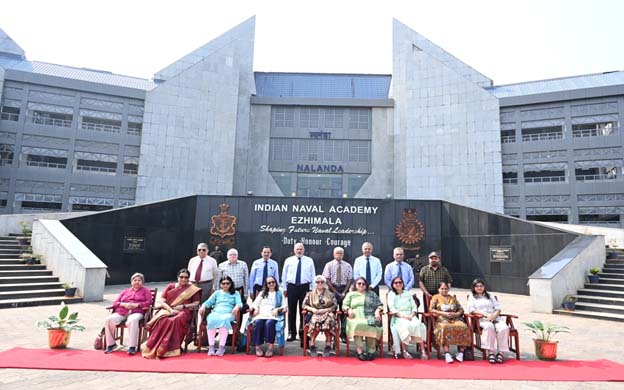
Visits to the Cadet’s squadron, Cadet’s mess, Panini Library, Herbal garden, Horse stable, a boat ride, dining by the sea, walking by the beach and a golf game, etc., kept the veterans fully occupied during their stay at the Indian Naval Academy at Ezhimala, where they reached after a not so incident free ride on ‘Vande Bharat’ train when some luggage was left behind on the station because the automatic doors of the train closed despite all the huffing, puffing, running and pushing done by the veterans. Luckily, the luggage was reloaded as the train was stopped by a few helping hands at the station of Ernakulam.
The reunion evenings were filled with shared meals, gentle music and dance, and endless conversations. Stories overlapped, jokes repeated themselves, and laughter came easily.
As the reunion drew to a close, hearts were full. There was contentment, gratitude, and a quiet promise hanging in the air. They knew time was relentless, but bonds forged in youth, discipline, and shared purpose were timeless.
The Reunion of the 12th NAVAC Course ended not with sadness, but with hope. They parted with firm handshakes, warm embraces, and assurances of meeting again.
“Next time jaldi milenge,” someone said confidently. “Haan, bas tab tak knees aur hearing aid ka maintenance ho jana chahiye,” came the inevitable joke, followed by roaring laughter.
They left Cochin carrying more than souvenirs—they carried sympathetic memories, renewed friendships, and a deep sense of pride in having been part of the Indian Navy something larger than themselves. Anchored in the past, inspired by the present, and hopeful for the future, the veterans sailed away with happy hearts—already counting down, in their own quiet way, to the next reunion.
(Roli S is an Educator, Teacher Trainer, Author and School Reviewer based in Thane)