By: Ganesh Saili
Gentle Reader, please don’t ask me what I am doing; I am collecting a nosegay of memories. After all, they do say, ‘The creation of a thousand forests lies hidden in one acorn.’
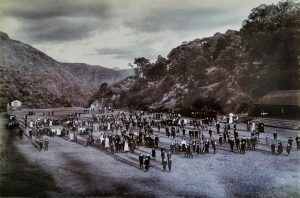
I was a toddler when I first heard of the Railway School from my grandfather. He had, on a lark, decided to take me on a walk down the old bridle path to Rajpur and the valley beyond. That was the very same route taken by the early pioneers and empire builders. At an elevation of 5,500 feet above sea level, on the 1st of June 1888, the Railway School moved from the Nepal Ranas’ Fairlawn Palace to its present location in Jharipani, straddling the first ridge of the Himalaya that borders the Doon valley. Oak Grove is set in an emerald sea of trees spread over two hundred sixty-five acres. Unfortunately, there is not much else here to have the visitor linger.

Pic courtesy: Ali’s Collection
‘Nearly halfway to Masuri, at Jheripani, is a small collection of huts,’ observes the chronicler of one of our first Guides, John Northam (1884): ‘which may, by a stretch of generosity, be called a village.’
Of course, in the once-upon-a-time days, there was a halfway house where the thirsty traveller would refresh himself by a brandy or whisky peg or two to quench their thirst at Mrs Grange’s eatery, where every item on the menu had character, an individuality and history that was special to her confections. The magic was in the evenness of the frosting, the symmetry of the pineapple chunks, the wedges atop the chocolate pastry, the crunchy hermit cookies, the candied almonds, the barley sugar, and the groovy candies. But the old khansama, who had presided over the destinies of the establishment, has long since gone, and the hostelry lies in ruins. Here, in the good old days, you would have once found Mr Roberts hanging around after Cupid struck, hoping to woo Penny or Penn Anthony, the niece of McGowan, the principal.
This spot was also once home to the elusive mountain quail, at least that’s what Kenneth Mackinnon believes he saw migrate from south Tibet’s eastern parts from the winter of 1865 to 1876. But he was a shikari-type, who shot several of them. So did Captain Hutton, when he found them scurrying around the undergrowth of his garden. And then there was Major Carwithen, the last documented human being to see these birds alive. He had been out hunting and shot the female of the pair. Which self-respecting bird would not disappear? It was never seen again, except for the ten stuffed specimens in museums in Europe and America.
Pic courtesy: Internet
‘That looks like a Jharpani bat,’ I intercede on behalf of a winged intruder in a bar. ‘It’s one of the smallest bats in the world – a four-inch mammal that means us no harm. Anyway, that’s what Surgeon General Edmund Balfour tells us in 1885!’
‘It’s just a damn rat-on-wings!’ insists my host, bent on chasing it away.
I reiterate my undying gratitude to the late Patrick Corbett, who came to a school reunion and gave me a copy of the early Principal’s Diaries – a priceless record of the trials and triumphs of education in ‘these Etons of the East’ in their infancy. It chronicles the history of Oak Grove in the impressive calligraphy of Principal K. F. McGowan, who steered the school’s destiny in the choppy waters of the post-Independence years, as the school grappled with the shift from a ‘whites-only’ school to one that included students of other skin colours too. Growing up in a boarding school often leaves a bittersweet taste in one’s mouth.
Wash that taste away in Mossy Falls, which supplies the school with water. Legend has it that the waterfall is named after Mr Moss, then the manager of the Himalaya Bank. When the Hearsey family happened to be picnicking by its waters, the banker (a guest) had scrambled over some rocks, lost his footing, slipped and fell to anchor well midstream, to a chorus of guffaws, thus supplying the long-standing name ‘Mossy Falls’.
Indeed, some forests start from baby acorns.
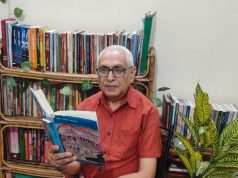
Ganesh Saili, born and home-grown in the hills, belongs to those select few whose words are illustrated by their own pictures. Author of two dozen books, some translated into twenty languages, his work has found renown worldwide.