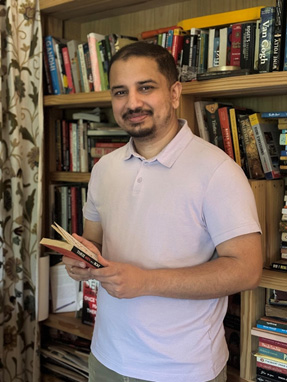
The Books from My Shelves
By Maanas Lal
Going to bed, for me, is an idea where my mind is lulled into calm and stillness by the ruffle of a book’s leaves, the smell of its pages and the satisfaction of learning. There was a time when every book in my small library had pretty much been read by me. Time, work and parenthood have conspired to change that. Today, there are books I have read, books I have started and abandoned, books I have bought with the conviction that I will read them next, and books that have been sitting patiently on the shelf for years, waiting their turn.
I find the last category strangely comforting.
A personal library is, after all, less a record of what one has read than a map of the person one has been, or wanted to be, at different points in life.
I have always bought books impulsively. A title catches my eye. Someone mentions a book in conversation. I read a paragraph somewhere and decide I must have it. Sometimes I know exactly why I am buying it. At other times, I only know that I want the book within reach.
Desperately Seeking Shah Rukh is one of those books whose title barely hints at what lies within. Shrayana Bhattacharya uses fandom for Shah Rukh Khan to tell the stories of a remarkably diverse group of Indian women—their jobs, desires, relationships, frustrations and battles for independence. What stayed with me was the idea of Shah Rukh not merely as a film star, but as an imagined alternative to the oppressive masculinity many encountered around them: a kinder, more attentive man, and a fantasy of intimacy that real life did not always offer. Moving through lives in places such as Rampur, Delhi and Ahmedabad, the book becomes a fascinating portrait of women negotiating money, class, beauty, work and love in post-liberalisation India. Perhaps the most revealing thing about fandom is not who we worship, but what we wish for when we do.
Trevor Noah’s Born a Crime lingered with me for a very different reason. His childhood, his mother and the absurdities and dangers of growing up under apartheid are rendered with an irreverence that makes the darker realities even more powerful. I was struck by how easily humour can become a way of surviving things that would otherwise be unbearable.
I have always had a weakness for books about journeys, perhaps because the best journeys in books are rarely about arriving somewhere. The Motorcycle Diaries is one of those. There is something wonderfully liberating about the young Ernesto ‘Che’ Guevara travelling across South America on a battered motorcycle, with little more than curiosity and a desire to see a continent he had largely known through books. The revolutionary he would become inevitably casts a shadow over these pages, but what keeps coming back to me is the young man before the legend—the gradual discovery that travel can alter not only what you see, but the way you look at the world.
Jerome K. Jerome’s Three Men in a Boat offers a very different version of the same impulse. Here, the journey is less about discovering the world and more about discovering how three perfectly capable men can complicate the simplest tasks. I have returned to it over the years and its humour remains wonderfully fresh. If The Motorcycle Diaries reminds us that a journey can change our view of the world, Three Men in a Boat reminds us that sometimes the greatest adventure is simply getting through the journey without getting in our own way.
- J. James’s Anti-Clock was a rather different experience. Set in Kerala and beginning with Hendri, a coffin-maker shaped by loss, the novel introduces a 112-year-old clockmaker and the idea of an ‘anti-clock’—a device that challenges our understanding of time. What fascinated me was not so much the mechanics as the question it raises: if we could turn time backwards, would we really know what to change?
Rohit Prasad’s Blood Red River took me into a part of India where the familiar language of development begins to sound rather different. Based on extensive travels through Chhattisgarh, it brings together Adivasis, Maoist ideologues, bureaucrats and contractors caught in a conflict involving land, natural resources and ideology. It raises a larger question: when we celebrate India’s growth story, whose story are we actually telling?
Mark Tully’s Non-Stop India appeals to another lifelong fascination—the India beyond the obvious India. I enjoyed its sense of movement and its willingness to leave contradictions intact. India does not become more comprehensible by being simplified. It becomes more interesting when allowed to remain untidy.
And then there is A Little Life, perhaps the most difficult book on this stretch of my shelf. It is one of those novels that does not politely leave when you close it. Its characters stay around. Their friendships, wounds and attempts to love and care for one another become difficult to separate from the reader’s own emotional response. Some books you admire; some exhaust you. Occasionally, they are the same book.
My shelves also contain books that mark phases of life. Becoming, Michelle Obama’s memoir, is one. What captivated me was not merely the public story of becoming First Lady, but the ordinary progression underneath it—the family, ambitions, compromises and effort involved in building a life before the world begins paying attention.
Nayantara Sahgal’s Indira Gandhi occupies a different place. Sahgal’s familiarity with Indira Gandhi makes her growing disillusionment particularly striking. She examines the concentration of power around the Prime Minister, the weakening of institutional checks and the increasingly personal nature of politics, including the influence of Sanjay Gandhi. The book is compelling because personal familiarity does not soften political disappointment; in some ways, it sharpens it.
Kane and Abel belongs to an older category of reading pleasure. Jeffrey Archer’s ability to construct momentum is something I appreciated long before I thought analytically about books. The Biblical echo of Cain and Abel becomes an epic tale of rivalry, ambition and reversals—the kind of book that makes you promise yourself just one more chapter and then discover it is considerably later than you thought.
Looking at these books together, I realise how impossible it is to arrange a personal library sensibly. There is no taxonomy. Travel sits next to cricket. A film star next to apartheid. A Himalayan journey beside a family saga. A comic boating expedition shares shelf space with one of the most emotionally demanding novels I have read.
And perhaps that is exactly how it should be.
Books are not meant to be arranged according to logic. They follow us through our lives and acquire meanings that have little to do with what the author intended. A book bought at twenty-five may speak differently at fifty. Some become associated with a particular room, journey or person. Others are remembered simply because of where we were when we read them.
That is what I like about looking at my shelves late at night.
They are not silent.
Every spine has a memory attached to it. Some books remind me who I was. Some of what I wanted to know. Some of people who recommended them. And a few remind me, rather pointedly, of all the reading I have promised myself I will get back to.
So, tonight, when the house finally settles and the day has exhausted its last demand, I will do what I have always done. I will reach for a book.
Perhaps one I have read before.
Perhaps one I haven’t.
The shelves, thankfully, aren’t going anywhere.
(Maanas Lal is a best-selling author, visual artist, TEDx speaker and musician.)