By Arun Pratap Singh
Garhwal Post Bureau
Dehradun, 6 Apr: In a significant political development within Uttarakhand Congress, Leader of the Opposition and senior Congress leader Yashpal Arya today called on veteran party leader Harish Rawat. The incident has naturally triggered speculation. It may be reminded here that Uttarakhand Congress continues to grapple with visible internal turbulence as the 15-day political hiatus announced by former Chief Minister Harish Rawat has sparked intense speculation, factional unease and a series of political reactions across the state unit. Even as Rawat remains formally on a break from active politics since March 27, he has continued his characteristic outreach, meeting party colleagues, political leaders and members of the public, signalling that his political presence remains intact despite the declared break from politics.
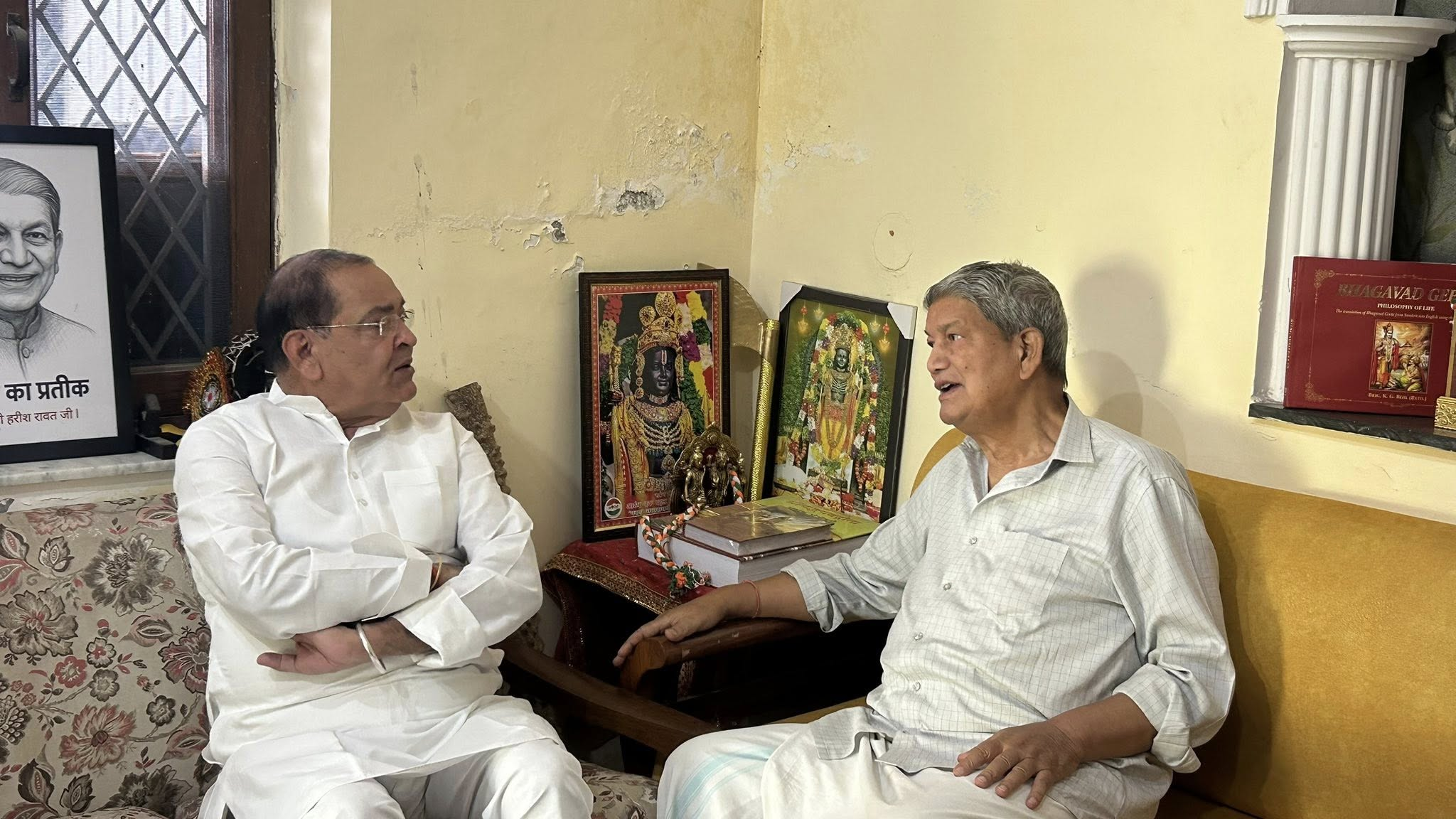
In a development that has drawn considerable attention within political circles, Leader of the Opposition Yashpal Arya called on Rawat at his residence in Dehradun today. The meeting, described as cordial by both sides, comes at a time when the Congress is witnessing heightened speculation over internal dissent and leadership equations.
Rawat later took to social media to describe the interaction as a “meaningful exchange” on contemporary issues, public concerns and the developmental trajectory of Uttarakhand. The meeting is being seen as significant in the wake of the fact that the relationship between both these leaders has never been considered to be cordial ever since the formation of Uttarakhand as a separate state.
It may also be reminded that Rawat’s decision to step back temporarily from active politics has been widely interpreted within the party as a signal of discontent with the central leadership as well as the state unit’s functioning. Some political observers however assert that Rawat’s announcement of temporary break may well be part of his pressure tactics and that he has indulged in such tactics in the past too. At the same time, some party insiders suggest that the immediate trigger may have been the reported approval of Rawat’s efforts to facilitate the induction of Ramnagar-based leader Sanjay Negi into the Congress fold. The development is being viewed as indicative of diminishing internal consensus and a possible assertion of authority by sections of the organisation that may not align with Rawat’s political preferences.
The undercurrent of unease was publicly articulated by former Assembly Speaker Govind Singh Kunjwal, who remarked that sidelining a leader of Rawat’s stature could prove detrimental to the party’s electoral prospects in Uttarakhand. Kunjwal’s statement, however, triggered a sharp rebuttal from senior Congress leader Harak Singh Rawat, who cautioned against what he termed as the “illusion” that the party’s fortunes depend on any single individual. Harak Singh Rawat further observed, in a pointed remark, that Harish Rawat has held almost every significant political office, ranging from Block Pramukh to Chief Minister, suggesting that the reasons for his present resentment were difficult to comprehend.
The remarks had not gone down well with Rawat’s supporters, particularly Harish Dhami, who reacted strongly and even called for collective resignations by party loyalists in protest. The episode briefly escalated tensions within the party and also caused concern among allied Left parties, who have urged Congress leaders to maintain unity in the run-up to the 2027 Assembly elections.
Adding another layer to the political speculation was the recent meeting between Cabinet Minister Khajan Das and Harish Rawat, which triggered conjecture in some quarters about a possible political realignment, including rumours of Rawat switching sides. Those who have been following Rawat’s politics since long dismiss this possibility and claim that Rawat’s move is pressure politics. The Congress, officially was also quick to dismiss such speculation, terming the meeting a routine courtesy call. Meanwhile, the conspicuous silence of state Congress president Ganesh Godiyal has further fuelled debate within political circles, with many questioning the absence of a clear organisational response at a time when the party appears to be navigating one of its most delicate phases ahead of the next electoral cycle.
Beyond the immediate turn of events, the present situation has once again brought to the fore the long-standing factional dynamics within the Uttarakhand Congress. The relationship between Harish Rawat and Yashpal Arya, despite public displays of political courtesy, has historically been marked by a lack of political warmth. Arya, who currently serves as Leader of the Opposition, was once regarded as a close associate of former Chief Minister Narayan Dutt Tiwari, widely seen as a political rival of Harish Rawat within the Congress ecosystem.
The political equations took a dramatic turn in 2017 when, during Rawat’s tenure as Chief Minister, Yashpal Arya, then a cabinet minister, exited the Congress to join the BJP and later also served as a minister in the BJP government. His return to the Congress fold in 2022, just ahead of the Assembly elections, and subsequent elevation as Leader of the Opposition, was seen as a strategic move by the party leadership, but it also revived old rivalries and competitive power centres within the organisation. Party sources have, over the years, informally claimed that Rawat may have played a role in Arya’s earlier replacement as Pradesh Congress Committee chief, although such claims have never been officially substantiated.
Political analysts further note that the current phase of uncertainty reflects deeper structural issues within the Uttarakhand Congress, including leadership ambiguity, competing factions and the challenge of balancing legacy leaders with emerging political aspirations. Rawat’s temporary withdrawal, rather than being an isolated personal decision, is being interpreted as a manifestation of these broader tensions that continue to shape the party’s internal discourse.
As the Congress attempts to consolidate its position in the state ahead of the 2027 Assembly elections, the unfolding developments underline the urgency for cohesive leadership and strategic clarity. The meeting between Yashpal Arya and Harish Rawat may offer a temporary indication of possible reconciliation or realignment within the party, but the underlying political contradictions within the party remain unresolved, keeping the focus firmly on how the Congress navigates this critical juncture in Uttarakhand politics.