 By Ganesh Saili
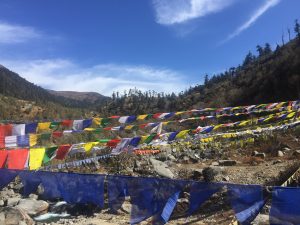
The two of us stood breathless at Nathu La. At 14,150 feet, this border outpost on the Roof of the World is where two nations face each other, eyeball-to-eyeball. Inched along a road carved out of the mountain face to a rusty barbed-wire that marks the Line of Control. Beyond, covered in indigo hues lies the sprawl of the Tibetan plateau.
We gasp for air.
Comes another sledgehammer blow – sucking the very breath of life out of us. We gasp again but this time though, it’s on reading the history of what happens when a small kingdom hangs on to the hem of three bigger neighbours. This is also a cautionary tale for the ruling elite who believe that tilling of their traditional agricultural land is best done by outsiders. In the end, the outsiders end up with the land (and political power) while the original owner usually ends up empty handed.
Pic courtesy: Author’s Collection
Sikkim was always a tiny sliver of land, no more than seventy miles by forty miles. It caught the imagination of the world when the Chogyal Thondup, the last King of Sikkim, the scion of a ruling Buddhist family, fell hopelessly in love with a teenager. Hope Cooke was seventeen years his junior, and when international media (including Time magazine and National Geographic) splashed pictures of their wedding evoking images of Shangri La, it attracted the very attention that started the chain of events that unfolded.
If one went back to 1890, in the days of the Raj, one would find that a British Resident was posted in Gangtok, who was no more than a ‘whisper behind the throne, but never for an instant the throne itself’. For the Brits, it was a launch pad which served as an outpost to gain influence in the Great Game.
Schooled at Bishop Cotton, Shimla, Thondup joined the ICS School in Dehradun, then running from a tented colony, but nonetheless ‘renowned as the training ground for bureaucrats’. A forerunner of LBSNAA today, teaching its charges the basics of administration, with an eye on the day when the empire would pack their bags and leave. It was here that he picked up his love for all things western. However, Sikkim’s sensitive geopolitical position dealt him an almost unplayable hand.

Pic courtesy: Author’s collection
Summer breaks saw Thondup return to his unpretentious lifestyle in the Palace, to be with his two beautiful sisters, Coocoola and Kula, who were loved by all who had seen them.
‘Who would have suspected,’ wrote the Italian traveller and author, Fosco Maraini, seeing Kula ski on the slopes below Nathu La, ‘there was so much strength and determination in her pearl porcelain body?’
Smitten by love was the Austrian climber and explorer, the Nazi Heinrich Harrer, who wrote: ‘The Tibetan words to fall in love is sem schor wa and means to lose one’s soul. In the case of Coocoola, this was accurate.’
Of course, this feature is much more than the telling of the Chogyal’s story – a man who failed to get others on board to understand that small was beautiful. It covers the gamut of political developments: the uprising; the revolt and the dithering before the final denouncement. On the morning of 29 January 1982, Chogyal Palden Thondup passed into history.
As we drove back to Gangtok, past the tin-shed built to facilitate border trade, past the rhododendron reserve (which has thirty species that were favoured by the 18th century naturalist Sir Joseph Dalton Hooker), I am lost in daydreams of the curtain that fell in April 1975, ending three centuries of Namgyal rule, when Sikkim became the twenty-second state of India.
On a cold winter’s day of 19 February, the Chogyal’s body was carried to the royal burial ground six miles further up towards the Tibetan border. ‘And when the clouds of smoke from the funeral pyre billowed into the sky, they seemed to be taking away the last of a friend.’
Rarely does one get to see the transfer of power take place. History cannot get better than this story of a mountain kingdom, which falls between a fairy tale romance and a political thriller.
(Ganesh Saili, born and home-grown in the hills, belongs to those select few whose words are illustrated by their own pictures. Author of two dozen books, some translated into twenty languages, his work has found renown worldwide.)