 By RAJAT AIKANT SHARMA
With the Purkul–Mussoorie Ropeway entering its final stage of development and plans for additional ropeway corridors under discussion, Mussoorie may be standing at the threshold of its most significant mobility transformation in decades.
For generations, Mussoorie has lived with a paradox. Millions travel to the Queen of Hills in search of fresh mountain air, peaceful walks and panoramic Himalayan vistas, only to spend a significant part of their visit caught in traffic. For residents, business owners and visitors alike, congestion has gradually become an accepted part of life in the hill station.
This week, however, the conversation around Mussoorie’s future appeared to take an important turn.
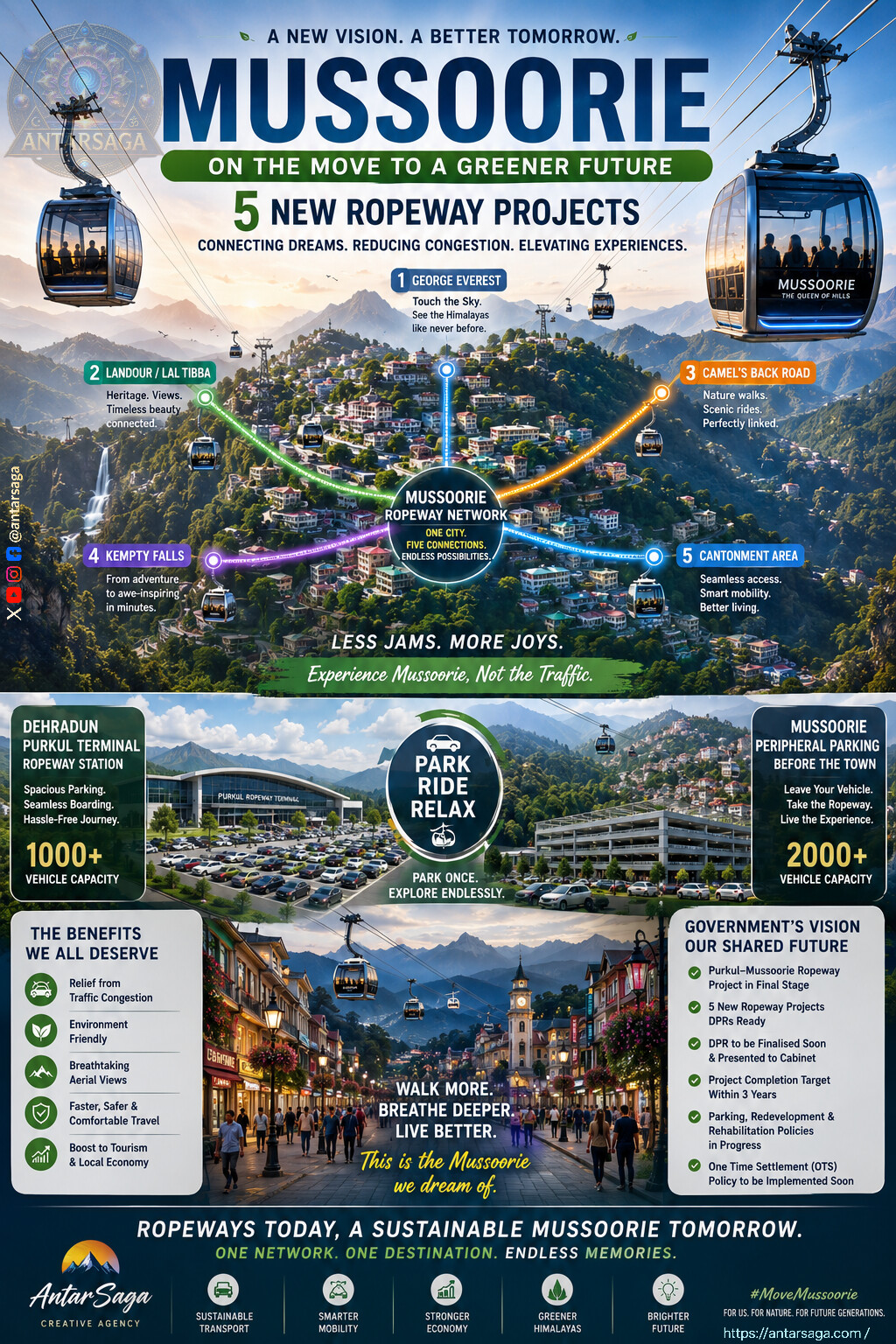
During a detailed inspection of proposed ropeway corridors, Uttarakhand Housing and Urban Development Secretary Dr R Rajesh Kumar outlined a vision that goes well beyond the already announced Purkul–Mussoorie Ropeway. Accompanied by officials, he inspected the proposed alignments through Camel’s Back Road, the Eye Hospital area, George Everest, Kempty Falls and the Cantonment area, reviewing possible routes and directing officials on the next stage of planning.
Speaking to the media, Dr Kumar said the government’s objective is no longer limited to bringing tourists from Dehradun to Mussoorie. The larger vision is to connect major tourist destinations within Mussoorie through a ropeway network, allowing visitors to move between attractions without depending entirely on road transport.
According to the Secretary, the alignment has largely been identified and the Detailed Project Report (DPR) will be finalised before being placed before the Cabinet. Following the required approvals, the government has set an ambitious target of completing the project within approximately three years.
One of the most significant announcements during the interaction was Dr Kumar’s statement that the Purkul–Mussoorie Ropeway project is now in its final stage of development, while proposals for five additional ropeway projects are being taken forward. Detailed alignments are yet to be made public, but the announcement represents a significant expansion of the original concept.
The inspection also highlighted a broader urban development agenda. Dr Kumar said the state is preparing a comprehensive Parking Policy, along with Redevelopment and Rehabilitation Policies, to improve planned urban growth. He further stated that the implementation of the One Time Settlement (OTS) Policy in Mussoorie is progressing in accordance with Supreme Court directions, with the aim of resolving long-pending development issues.
Taken together, these announcements suggest that the government is looking beyond individual projects towards a more integrated approach to mobility and urban planning. Unlike many transport announcements that focus on a single project, this vision brings together ropeways, parking reform, redevelopment and long-term urban planning as parts of one interconnected mobility strategy. That integrated approach is what makes this development particularly significant for Mussoorie.
More Than a Ropeway
Until recently, discussions largely focused on one question: How would people reach Mussoorie?
The latest announcements introduce another, equally important question: How should people move once they are here?
That distinction is significant.
A ropeway connecting Purkul and Mussoorie improves access to the town. A network connecting destinations within the town has the potential to change the way visitors experience Mussoorie itself.
A Town That Was Never Built for Cars
Mussoorie’s roads tell the story of another era.
When the town developed during the nineteenth century, movement depended on walking, horses, hand-pulled rickshaws and narrow mountain roads. The charm of Mussoorie was never found in wide highways or expansive parking lots. It was found in leisurely walks along Mall Road, quiet afternoons on Camel’s Back Road and viewpoints where reaching the destination was as memorable as the destination itself.
Over the decades, tourism expanded rapidly while the geography remained unchanged.
Hotels multiplied.
Vehicles increased.
Weekend tourism became commonplace.
Yet the mountain remained the same.
Unlike cities on the plains, hill towns cannot endlessly widen roads or create new parking spaces without affecting forests, slopes and the fragile ecology that makes them attractive in the first place.
Perhaps Mussoorie’s challenge has never been simply about traffic.
It has always been about mobility within the limits of a mountain.
Planning for Tomorrow, Not Yesterday
This vision becomes even more relevant when viewed alongside improving regional connectivity.
The Delhi–Dehradun Expressway and other highway upgrades are steadily reducing travel time to Uttarakhand’s foothills. As travel becomes easier, Mussoorie is likely to attract even more weekend visitors and short-duration tourists in the years ahead.
Transport planners often describe this phenomenon as induced demand—improved connectivity encourages more travel, which eventually places fresh pressure on destinations. Simply put, when travelling becomes easier, more people choose to travel.
In that context, planning for internal public transport today is not simply about solving present-day congestion. It is about preparing for future demand before it becomes unmanageable.
The Opportunity Ahead
If implemented thoughtfully, Mussoorie could witness a gradual shift in the way people experience the town.
Visitors could leave their vehicles at well-planned peripheral parking facilities before entering the hill station.
The Purkul–Mussoorie Ropeway could become the primary gateway into town.
From there, ropeway links, pedestrian-friendly streets and efficient last-mile connectivity could make it possible to explore major attractions with far less dependence on private vehicles.
Such a model would not only improve visitor convenience but could also reduce traffic pressure on some of Mussoorie’s busiest roads while creating a more pleasant environment for residents and businesses.
Better mobility is not only about reducing traffic; it can also reshape the local economy. When visitors spend less time sitting behind the wheel or waiting in queues, they gain more time to explore the town itself. That often translates into longer walks along Mall Road, more visits to cafés and restaurants, greater footfall for local shops and a deeper engagement with Mussoorie’s heritage.
For generations, many businesses have depended on visitors who arrive on foot, browse at leisure and spend time in the town rather than simply passing through it. A mobility system that encourages walking instead of constant driving has the potential to strengthen that experience. While the long-term impact will depend on careful planning and effective implementation, the vision presented by the government offers an opportunity to imagine a Mussoorie where tourism, local livelihoods and sustainable mobility reinforce one another rather than competing for limited road space.
Of course, ropeways alone cannot transform mobility. Their long-term success will depend on how effectively they are integrated with parking infrastructure, electric shuttle services, pedestrian facilities, clear wayfinding and practical traffic management policies. Infrastructure works best when it functions as part of a connected system rather than as isolated projects.
Looking Towards the Next Decade
Imagine arriving in Mussoorie ten years from now. A visitor parks at a modern mobility hub near the foothills and boards the ropeway instead of joining a queue of vehicles climbing the hill. Within minutes, the town opens beneath the cable cars. Families spend more time exploring markets, cafés and viewpoints and less time searching for parking. Residents reclaim quieter streets. Businesses benefit from visitors who stay longer on foot. The experience of Mussoorie begins to resemble the mountain town it has always aspired to be.
Whether this vision becomes reality will depend on careful planning, sustained implementation and coordination across multiple agencies. Yet the direction being discussed today is encouraging because it looks beyond immediate congestion and towards the long-term future of the town.
For generations, the answer to congestion has often been to build another road.
Perhaps the future asks a different question.
Instead of asking how we can accommodate more vehicles, perhaps we should ask how we can help more people experience Mussoorie with fewer vehicles.
Great mountain towns are remembered not by the width of their roads, but by the quality of the journeys they offer.
If the vision announced this week evolves into a truly integrated mobility system—combining ropeways, peripheral parking, walkable streets and efficient public transport—Mussoorie may one day be remembered not simply as a town that built ropeways, but as a town that rediscovered how a mountain is meant to be experienced.
Sometimes the most meaningful journey is not the one that takes us farther.
It is the one that helps us arrive more thoughtfully.
(Rajat Aikant Sharma is a Writer, Columnist and Photojournalist.)