The Books from My Shelves
By Bijoya Sawian
I will let this piece flow naturally …
It all began with the much-awaited hour, an integral part of my childhood. In the huge, rambling matrilineal home in Shillong my mother’s unmarried sister was the story teller. When she was little there was a professional story teller who would travel all the way from the border town close to Bangladesh She would spend a few nights relating stories from her impressive repertoire. She was simply known as Kong Majai, after the name of her home town.
My world of books began with Enid Blyton, when I was old enough to opt out and be on my own, reading. I went on to read Georgette Heyer, two Barbara Cartlands and a Mills and Boon. At this stage Daphne du Maurier was my favourite and Rebecca topped the list. Even as I write, I remember the opening lines, “Last night I went to Manderley again” and it sends a shiver down my spine. I want to hold the book again and visit the house and meet the brooding Maxim de Winter, his second wife, who remains unnamed right through the book, the sinister Mrs Danvers and feel the presence of a forlorn ghost who refused to leave the manor.
When Patrick White won the Nobel Prize in 1973, I decided to discover Australia through his award- winning book, The Tree of Man. It turned out to be a discovery of not only the country but also of the effect of our environment on our character and characteristics, on our mind and on our soul. This brilliant work which takes the reader to the desolate Australian bush where Stan Parker and his family settle down, also underlines the inevitability of permanence and impermanence and the victory which only rural folk could achieve because they understood and accepted the vicissitudes of Nature.
Reading Stephen Alter’s ‘Becoming A Mountain’ was an experience. This book of great depth and beauty also reveals the indispensable role of Nature. Connecting with it is the best way to heal. Sleeping on a sun warmed mountain slope, braving the steep mountain slopes, exchanging smiles with the hill folk was not only therapeutic but it awakens the best emotions within us. That was how Steve healed and reconnected with the mountains he loved after the trauma of an unfortunate incident in his Mussoorie home which shook all of us.
Environment could also be made of people. Aldous Huxley’s ‘Crome Yellow’ was a satire on the foibles of upper-class England but I saw it from a different angle. My interpretation made me dream of having weekends in my home teeming with poets and writers, good conversation and vibrant discussions all day and well into the night. At home in Shillong, I had heard of the visits of Christian von Ehrenfels, Margaret Barr, Prashant Kumar Roy, Rai Bahadur Sivanath Dutta, Father Abel, Soso Tham, Rabon Singh Suka to name a few and the long hours of readings, discussions and debate. Crome Yellow inspired me to relive those days. Then Dehradun suddenly became a bustling capital and somersaulted into an unrecognisable space with different values and attractions. I gave up the idea.
Sometime in the 1980s I found a collection of six books by the Parisian author, Francoise Sagan, in a big trunk along with the books by Jim Corbett and several English cricketers. Sagan’s first book ‘Bonjour Tristesse, Hello Sadness’ published in 1954, was a spectacular success and it shook the Parisian literary world. This deceptive ‘light romantic book’ was actually a startling treatise on morality and immorality. Sagan’s debut novel revolves around the lives of three people, a loving father and his feisty daughter and the father’s girlfriend. The style was light and bouncy and did not prepare me for the brutal end which left me wondering – as it was meant to be. Is right and wrong always in black and white?
Blurbs are important in book covers. The blurb on the back cover of Jerry Pinto’s outstanding translation of the first autobiography by a Dalit inspired me to read Bulata. Daya Pawar belonged to the Mahar community of Maharashtra. He was a schedule caste, a slave, he had no time table. It was a disturbing read for me not because of what the book contained but because it neither saddened nor infuriated me like it would have a few years back. I know the caste system will never be erased from the Indian psyche even if the governments in different states juggle around for the sake of votes. Yes, I was not happy with my nonchalance but that is the truth.
In his book, ‘Great Minds on India’, Salil Gehwali has compiled the observations of philosophers, scientists, scholars, writers, artists and poets from all over the world. It is an important read for everyone because we have forgotten the depth of the all-encompassing wisdom of the Vedas and base India’s greatness only on the ephemeral.
We discover so many worlds in books. Okakura Kakuzo was a Japanese art critic. He was born in Yokohama on the 14th of February 1863 and died on September 2 1913. His ‘Book of Tea’ was, to me, a delightful read because it made me realise that what my mother always emphasised was actually correct! Okakura introduced Teaism, a combination of Taoism and Zennism, which meant finding beauty in the simple common activities and revelling in them, to lighten the darker side of life. Even drinking tea with my mother in those quiet evenings as the sun was setting, was unparalleled catharsis.
One summer I was reading Temsula Ao’s heart-wrenching collection of short stories, about Nagaland, ‘These Hills Call Home’. The book highlights the plight of the simple and the innocent and how they cope with violence and yet manage to find moments of enjoyment amidst the terror and the war not all of them understood. Delhi waltzes in once in a while. The army does the rest. While reading it, I sipped cups of tea and thought of Okakura Kakuzo with gratitude.
‘The Great Conciliator’ by Dr Sanjeev Chopra is well written and well timed. The book has done justice to a man known for his honesty, simplicity and his achievements during his short tenure as India’s second Prime Minister. Earlier, when a terrible train accident took place during his tenure as railway minister, he resigned without hesitation. That is the calibre of this great man. The Great Conciliator is an important addition to the books on our political history. I read it with respect.
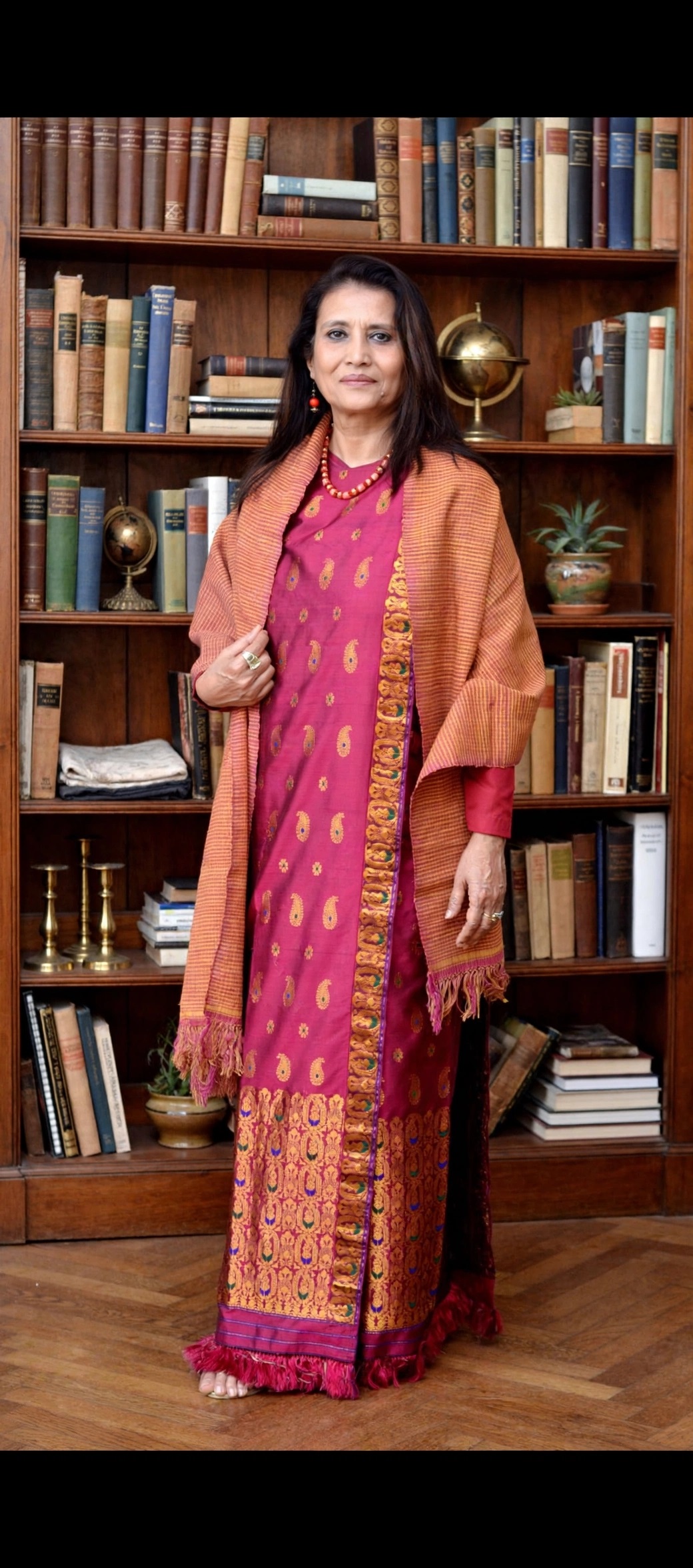
(Bijoya Sawian is a writer, translator and educator from Shillong, Meghalaya who, presently, resides in Dehradun. Sawian did her schooling in Seng Khasi High School and Loreto Convent Shillong. She graduated in English Honours from Lady Shri Ram College, New Delhi, and did her Post Graduation in English from Miranda House, Delhi University.
Her debut novel, ‘Shadow Men and Two Stories’ published by Speaking Tiger Books was nominated for the prestigious Rabindranath Tagore Literary Prize 2020 and considered “one of the most important works that has emerged from the North-East”. (Namita Gokhale).
Bijoya Sawian’s essays on Shillong and ‘Divination – The Art of Foretelling’ are the gems of two highly acclaimed anthologies – Between Heaven and Earth edited by Ruskin Bond and Bulbul Sharma, published by Speaking Tiger Books, and ‘Mystics and Masters’ edited by Namita Gokhale and published by Harper Collins. The highly acclaimed biography on her father, ‘From Sylhet to Shillong – The Story of The Last IGP of Undivided Assam’, published by Speaking Tiger Books, New Delhi, is a family saga which records the socio-political scenario of the region spanning two centuries. Hill Songs of Love and Longing is a collection of short stories published by White Falcon Publishers. It was shortlisted for Best English Fiction 2025 by the Valley of Words Arts and Literature Festival. Dr Sanjeev Chopra, the Director of Valley of Words, in his review wrote, “Each story is a masterpiece.” Bijoya Sawian’s latest work, Chocho Momo and What Time Cannot Erase is a memoir of her idyllic childhood and her experience of living in patriarchal North India since 1967. It is a frank and sensitive narration, startling and, sometimes, disturbing.
(Bijoya Sawian is also a keen educationist. She is the Chairperson of The Annfield Senior Secondary School in Vikasnagar, Dehradun, a co-educational institution affiliated to CBSE New Delhi. A passionate advocate of learning beyond books for the complete growth of a child, Sawian personally supervises the teaching of values, etiquette and the overall personality development of the students.)