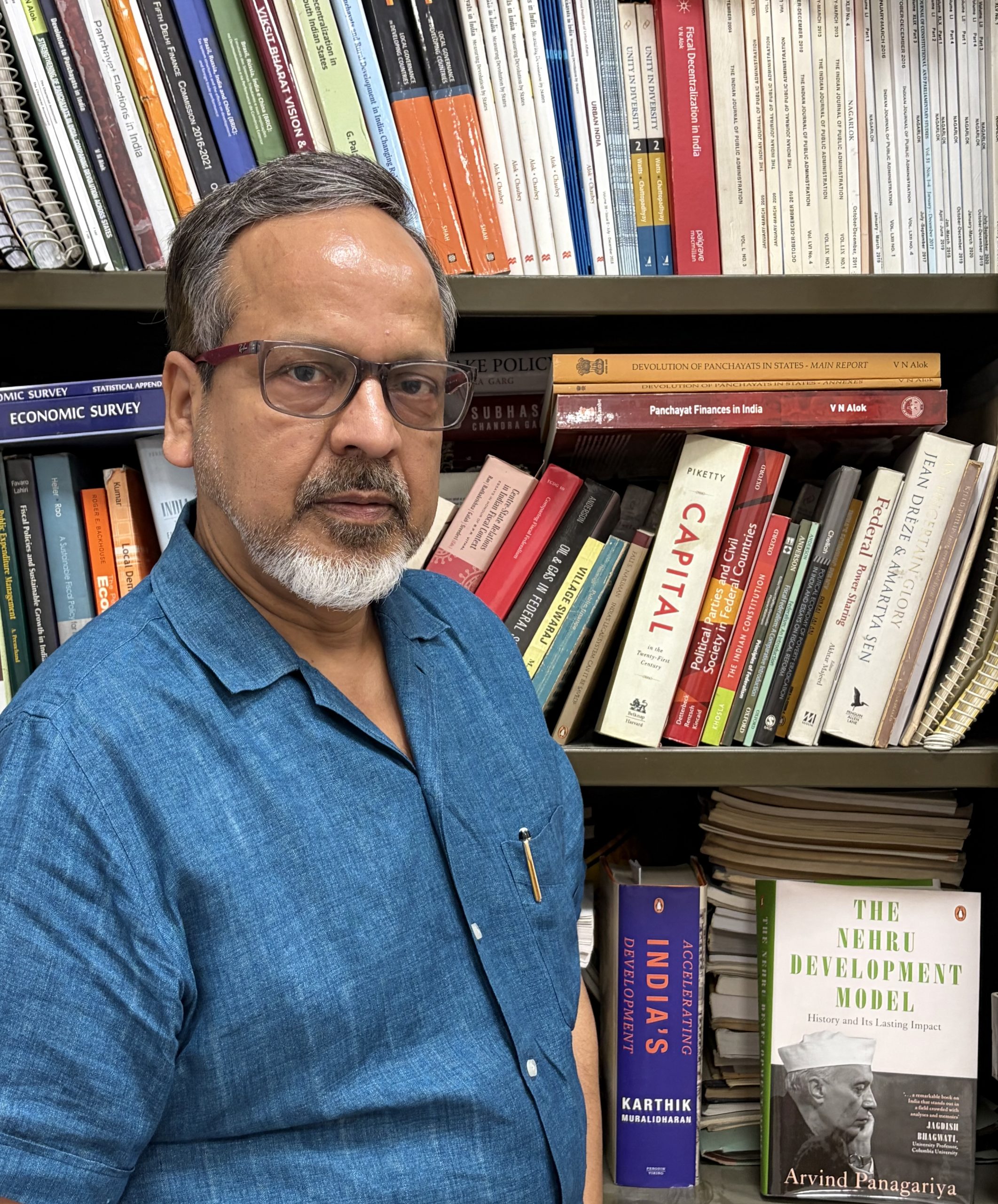
The Books from My Shelves
By VN Alok
Selecting ten books from my personal library, as suggested by Shri Nrip Singh Napalchayal, might seem like a simple task. For a public policy economist, however, it is far from easy. Much of my collection consists of specialised works on public policy, governance, and development economics that have shaped my professional thinking but hold limited appeal beyond academic and policy circles.
With the Hindi Pakhwara (14-28 September) underway, I chose instead to revisit a cherished collection inherited from my father, a Professor of Hindi Literature in Agra, as well as a respected writer, critic, and orator. His library was not merely a repository of books but a doorway to the rich tradition of Hindi literature and Indian thought.
Growing up in Agra, then a thriving literary hub, I was fortunate to interact with many distinguished poets, writers, and critics who frequently visited our home. Family birthdays were often celebrated through Kavi Goshtis, where renowned Hindi and Urdu poets recited their works. Among them, the legendary Gopaldas ‘Neeraj’ remains an enduring memory.
My reading journey began with magazines and comics such as Paraag, Champak, Nandan, Chandamama, Amar Chitra Katha, and Tintin, later expanding to literary publications like Dharmyug, Sarika, Reader’s Digest, and Illustrated Weekly. Surrounded by classics and literary discussions at home, I developed a deep appreciation for India’s cultural and intellectual heritage.
In this series, I will highlight a selection of lesser-known books from my father’s library, particularly from the 1960s, 1970s, and 1980s, that vividly reflect the social realities of their time. These books are presented not by merit or preference, but simply as random yet inspiring choices from a treasured collection.
Hindi literature underwent a profound transformation during the 1960s. As my father often explained, it was a period of transition from the progressive optimism of Pragativad to the psychological complexity of Nayi Kavita and Nayi Kahani.
This shift is vividly reflected in Mohan Rakesh’s Andhere Band Kamre, which examines loneliness, marital discord, and the identity crisis of India’s emerging urban middle class. The title symbolises the closed, suffocating emotional worlds in which the characters live. The novel presents superficial relationships, and growing materialism of the urban society.
In contrast, Phanishwar Nath Renu’s Maila Anchal had earlier brought the rustic life and cultural richness of rural Bihar into the mainstream literary imagination. The novel vividly depicts village life and highlights problems such as poverty, hunger, disease, illiteracy, and exploitation by powerful groups. Both novels left a lasting impression on me, revealing the diverse realities of post-independence India.
By the mid-1970s, the optimism of independence had given way to inflation, political unrest, and eventually the Emergency. Hindi literature responded with sharp dissent and existential questioning. Poetry and theatre became powerful tools of resistance.
Dushyant Kumar’s celebrated collection of ghazals, Saaye Mein Dhoop, gave voice to public frustration over political betrayal, corruption, inequality, and unfulfilled promises. Reading his lamentation “Kahaan hotay thay charaghan har ek ghar ke liye, kahaan charagh mayassar nahin shahar ke liye” under the dim light of frequent power cuts remains one of my most vivid memories. Who can forget his immortal words, “Kaise aakaash mein suraakh nahi ho sakta?”
The political anxieties of the era were further explored in Mannu Bhandari’s Mahabhoj. Revolving around the suspicious death of a Dalit youth named Bisu, the novel exposes how politicians, bureaucrats, police officials and journalists exploit personal tragedies for electoral gain. Similarly, Rahi Masoom Raza’s Katra Bi Arzoo, set during the Emergency, portrays an atmosphere of fear, repression, and public discontent while highlighting the gradual erosion of democratic values. Together, these novels transformed literature into a powerful critique of contemporary politics and society.
Alongside these works, Sudha Chauhan’s biography of her mother Mila Tej se Tej introduced me to the extraordinary life of the renowned poet and freedom fighter, Subhadra Kumari Chauhan. The book brought alive her courage, patriotism, and literary brilliance, reminding young readers of the sacrifices that shaped India’s freedom struggle. While my father taught me about the power of literature, these books demonstrated how writing can capture both the grandeur of history and the intimacy of personal sacrifice.
The 1980s and early 1990s witnessed major social and political upheavals, including communal tensions, political assassinations and economic liberalisation. During this period, Bhisham Sahni’s Tamas, although published earlier, remained deeply influential, especially through Govind Nihalani’s acclaimed screen adaptation in that decade. The novel stands as one of the most powerful explorations of communal violence in Indian literature, portraying its devastating human cost and exposing the political interests that fuel religious divisions.
At the same time, writers increasingly turned their attention to the emotional and psychological challenges of modern life. Usha Priyamvada’s Shesh Yatra explored urban loneliness, emotional displacement, and the inner struggles of individuals caught between tradition and modernity. Kamleshwar’s Registan employed the image of a desert as a metaphor for alienation and emotional barrenness in a rapidly changing society. These works reflected a growing concern with the complexities of personal identity and belonging.
My literary journey also led me beyond the Nayi Kahani tradition to Hazari Prasad Dwivedi’s remarkable historical novel Banabhatta Ki Atmakatha. Set in seventh-century India during the reign of Harshavardhana, the novel imaginatively presents the autobiography of the Sanskrit poet Banabhatta, who never actually wrote such a work. Drawing upon historical sources such as Harshacharita, Dwivedi blends history and fiction with extraordinary skill. Characters like Bhattini and Nipunika are his own creations, embodying ideals of dignity, selflessness, love, and sacrifice. Through them, the novel elevates love beyond romance into an expression of freedom, compassion, and moral strength.
Looking back across these decades, from the books discussed in my father’s library in Agra to the digital screens of today, literature has remained my most faithful companion. Politics and economics may shape our material circumstances, but literature preserves our humanity, memory, and spirit. Through these works, I learned not only about India’s changing social and political landscape but also about the enduring power of stories to illuminate the human condition.
(VN Alok is an author, public orator and commentator. He is working as a Professor of Urban Finance in the Indian Institute of Public Administration, New Delhi.)