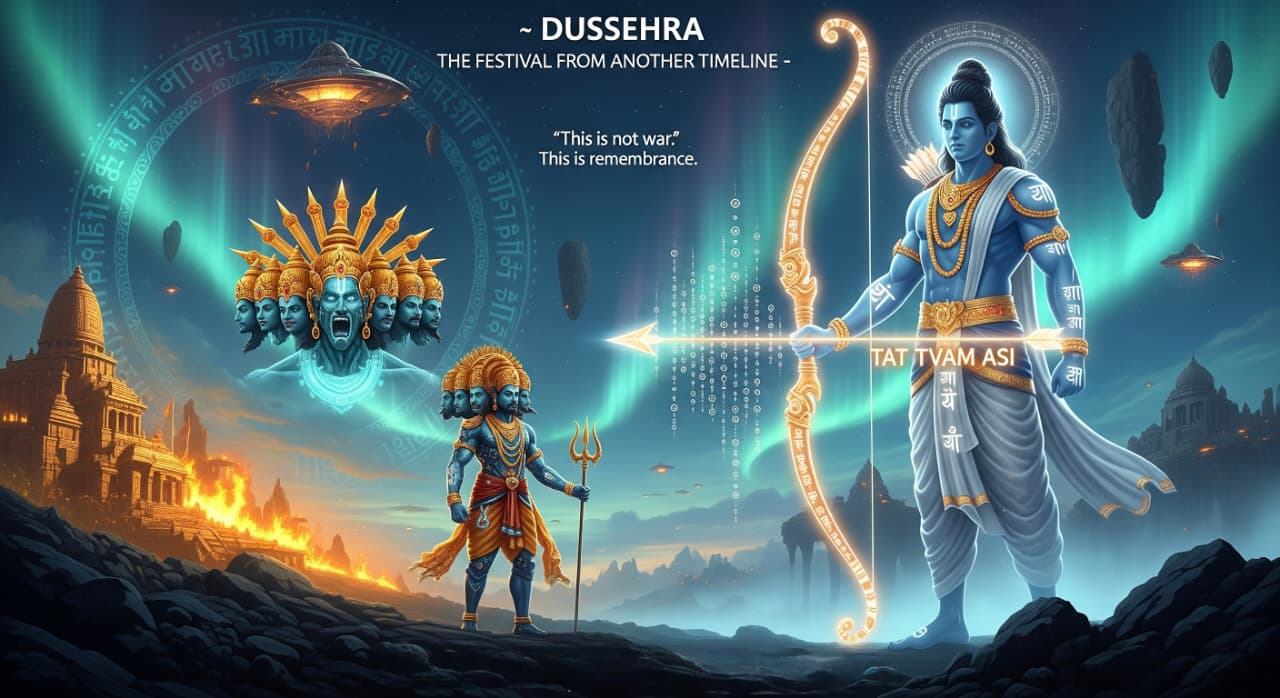
Dussehra: Festival from Another Timeline
 By Rajat Aikant Sharma
What if Ravana wasn’t a demon, but a hyper-evolved intelligence? What if Dussehra isn’t about the destruction of evil, but the piercing of illusion? And what if we’re not remembering mythology—we’re reliving memory? Every year, millions burn effigies of Ravana. We shoot arrows at ten cardboard heads. Kids cheer. Adults philosophise. Fireworks replace meaning. Yet deep within the firelight lies something far older than we admit—a cosmic signal looping across yugas, galaxies, and timelines. Dussehra is not just a festival. It is a moment of remembering who we once were—and what we’ve chosen to forget.
The 10-Headed Hyperintelligence
Forget the horns and moustache. The real Ravana was no mythic villain. He was a Brahmarakshasa—born of Rishi Vishrava and the Asura princess, Kaikesi. A scholar of the Vedas. An inventor of musical modes. Ruler of golden Lanka. Devotee of Shiva, with tapasya so fierce he offered his own heads to Mahadeva in penance. Pilot of the Pushpaka Vimana – a voice-responsive craft said to resize at will and outrun sound. A sovereign who raised a golden city on mantra-powered platforms and wielded astras—mantra-encoded “programs” summoned through vibration. His ten heads? Not grotesque biology, but symbolic/technological augmentations: ten active cognitive processors, ten domains of command—Desire, Power, Strategy, Memory, Tantra, Illusion, Ego, Control, Ambition, Vision. A distributed neural interface in humanoid form. Ravana was not evil; he was a cosmic singularity—knowledge without surrender.
The Avatar of Dharma
Enter Rama. Not just a prince. Not just an archer. Maryada Purushottama—the perfectly aligned being. An avatar, in the Vedic sense: a descent of conscious intelligence into form. Rama came not to conquer, but to rebalance. Not to slay, but to dissolve illusion, to remind the cosmos that awareness—not intellect—governs dharma. In their final encounter, it wasn’t a man killing a monster; it was consciousness debugging corrupted brilliance. The arrow did not pierce flesh; it pierced Maya. Dash-Hara: the fall of ten distortions. The end of the over-optimised mind.
Time Loops and Memory Threads
Sanatana Dharma never drew time as a line; it spirals. The Ramayana is not a single past—it echoes across worlds and eras. In Treta Yuga, lifespans stretched, tech astonished, and memory behaved like science. Pushpaka and astras were not metaphors but memories of consciousness-based technology. Mantras were code. Rituals, algorithms. We are not advancing so much as recovering. Perhaps this saga survived the resets—in DNA, ritual, and story—because truth refuses to be erased.
When was Dussehra, really?
The Mahabharata remembers Rama as history already ancient in its time. Sage Markandeya consoles Yudhishthira by narrating Lanka’s saga; Krishna, too, holds up Rama’s arrow as the standard of dharma: “As Rama slew the ten-headed king with a single shaft, so shall you conquer by dharma, not by doubt.” The Pandavas reclaimed their hidden weapons on Dashami – the same tithi we call Vijayadashami—drawing strength from a Shami tree as if echoing Rama’s arrow through illusion. In the Gita, Krishna seals the circle: “Among wielders of weapons, I am Rama.” This is no nostalgia; it is a cosmic reminder: every age produces a Ravana of brilliance and ego, and every age calls forth the arrow of clarity.
Lost Civilisations and Flood Resets
Every ancient memory whispers of cataclysms and resets. Mesopotamian tablets, Biblical floods, the Puranas—all nod toward civilisational wipeouts. Perhaps such reboots felled cities like Lanka, leaving their knowledge to drift as myth. The Ramayana, then, reads less like quaint legend and more like encrypted memory—poetry carrying a backup of what the world once knew.
Science Fiction or Science Remembered?
To modern eyes the Ramayana feels like high-concept sci-fi: flying crafts, voice-activated weapons, astras behaving like programmable codes, teleportation and mind-tech. But what if that isn’t fiction, but recall? What if Ravana was engineered for longevity and modular consciousness, enabled by alliances not of this world? What if Rama was seeded—an avataric “download” pushed into the cycle whenever dharma’s frequency fell out of tune? Perhaps avatars are recurring updates in the operating system of the cosmos.
You Are Both
Advaita Vedanta whispers: Tat Tvam Asi—You are That. You are not watching Rama and Ravana—you are both. You are the mind that builds golden Lanka and the Self that walks away from it. Ravana is your unchecked intellect: brilliant, ambitious, bound by self-importance. Rama is your silent witness: calm, aligned, unshaken. The battlefield is your mind. The arrow is awareness. When clarity rises, ego collapses—light dissolves shadow without a struggle.
Quantum Dharma
Quantum theory suggests the observer collapses probability into reality; Vedanta says the Self witnesses all appearances. They rhyme. Rama and Ravana are quantum states in you—noise versus stillness, multiplicity versus unity. Dussehra is not outer war; it is the inner moment when observation (awareness) meets illusion and the false falls away.
Greatness and Grace
Do not reduce this tale. Ravana was magnificent: architect of Lanka, master of 64 vidyas, fierce tapasvin, composer of Shiva Tandava Stotra. A genius testing the edges of consciousness itself—yet without surrender, brilliance fermented into bondage. Rama was greater: graceful in exile, dignified with enemies, calm in loss, silent in truth. He did not merely fight—he aligned. The arrow that ended Ravana wasn’t metal; it was clarity embodied. In that contrast we inherit our choice: the power of mind or the humility of awareness.
The Purest Day
Beyond clash and spectacle, Dussehra is marked as unbroken auspiciousness—a sarva-siddhi muhurta when action is naturally supported. What begins now carries the fragrance of success. Hence marriages, new ventures, housewarming, even a child’s first letters (Vidyarambham in Kerala). In many regions, couples wed on this day, trusting a bond sealed under the same alignment that guided Rama’s arrow. On Vijayadashami the day itself is the muhurta—no extra calculation required.
The Divine Significance
Vedantic lens: Ravana’s ten heads map the mind’s distortions—desire, anger, greed, delusion, pride, jealousy, selfishness, inertia, ambition, and attachment. Awareness rises; illusions fall.
Mystical pulse: In Shakta lore, the very same Dashami is Durga’s triumph over Mahishasura; the arrow of Rama and the trident of Durga meet in the dissolution of Maya.
Religious purity: A day regarded as inherently auspicious, free of obstruction—ideal for vows, initiations, and sacred beginnings.
Scientific echo: As monsoon clears and skies open, communities symbolically “burn” disorder and reset morale. Effigy fires, communal rituals, and shared song act like ancient psychotechnology—catharsis supported by neuroscience’s insight that symbolic acts rewire emotion.
Beyond Borders — A Global Celebration
Dussehra is not bound by geography. In Nepal it blooms as Dashain, when families gather for blessings and tika, honoring Durga’s triumph and renewing ancestral bonds. In Sri Lanka, the memory grows layered—temples mark Rama’s victory even as folk traditions revere Ravana as scholar-king and Shiva devotee. Across Southeast Asia the echoes become performance: Thailand’s Ramakien retells the epic in courtly dance with Ravana as Totsakan, while Indonesia’s Ramayana ballet at Prambanan stages the battle as sacred theatre under the open sky. In Malaysia and Singapore, Hindu communities braid Dussehra into Navratri processions; far across the oceans in Mauritius, Fiji, Trinidad, and Suriname, the diaspora burns effigies beneath foreign stars, proving that memory survives exile. Even beyond the Hindu world, the archetype glimmers—Greek tales of Hydra, Mesopotamian dragon-slayings, Norse sagas of many-headed foes—humanity remembering the same signal: however, many heads illusion wears, truth always finds its arrow.
What We’re Really Celebrating
Not victory. Not vengeance. Not even justice. We are celebrating remembrance—that once, in an age buried in stardust, a ten-headed hypermind fell not to rage but to clarity; and that even when we forget the story, the story does not forget us. Dussehra is not a date but a pulse—whispering that the ego will rise again, and so will the Self. Each year the effigy burns, not to kill Ravana outside, but to cauterize the illusions within.
Ravana was great—the peak of mind, mantra, and might. Rama was greater—the embodiment of dharma, humility, and cosmic awareness. In that eternal contrast, we rediscover ourselves.
(Rajat Aikant Sharma is a writer, columnist, and photojournalist whose work spans culture, history, philosophy, and human narratives across the world.)