 By Dr Satish C Aikant
The generally accepted view about Indian ‘modernity’ is that it came to us through British colonialism and that it is the only viable modernity that exists. Its defining features -egalitarianism, democratic governance, individualism and rational social organisation -supposedly replaced native traditions. Modernity as an ideology also provided justification for colonial conquest (and in its wake, the plunder). The basic assumption here is that modernity debunks what belongs to the past and is irrelevant for our purposes today. However, it must be admitted that values such as egalitarianism and spirit of inquiry cherished by modernity do not expressly require colonialist ideology but can be found in native traditions across diverse cultures. Studies on ‘alternative modernities’ question the idea of a singular modernity raising possibilities regarding how distinctively modern values have been articulated in the contexts other than the modern West.
The conception of modernity as a radical rupture from the past runs parallel to the conception of Europe as the primary locus of global history. Rather than confining the provenance of modernity to a single western tradition, ‘alternative modernity’ goes beyond the West to see it in a transcultural and pluralistic light. Modernity does not have a singular core or essence or a causal centre. Its key features need to be disaggregated and new configurations imagined.
Gandhi is often lauded for being a critic of the modern West. This is only partially true as this understanding arises from a totalising view of the West and ignores the fact that Gandhi’s thinking was always evolving. His ideas were not really aligned with the mainstream ‘materialistic’ West but with its alternative visions. We should keep in mind that Gandhi’s major criticism was directed against the ‘modern’ West. He called this West the ‘modern civilisation’ and lived with the hope that the ‘other West’, which was prior to it and was not tainted by this misrepresentation, would one day reassert itself. The other West was about the ideas disseminated through American transcendentalism and thinkers and writers such as Thoreau, John Ruskin and Leo Tolstoy. Their ideas of respect for nature and shared community are what appealed to him most. He maintained that Indians could assimilate many ideas from the West without their indiscriminate imitation. While critiquing modern civilisation, Gandhi was actually offering a model of ‘alternative modernity’, through a reinterpretation of tradition.
By modern or Western civilisation Gandhi meant that mode of conduct which emerged from the Enlightenment, and more precisely, from the Industrial Revolution. The Industrial Revolution for him was much more than a mere change in the mode of life, embracing a people’s outlook on nature and human nature, religion, ethics, science, knowledge, politics and economics. According to this outlook, nature was taken to be an autonomous entity operating according to its own laws, something to be mastered and possessed at will for the satisfaction of human needs, desires and ambitions. Gandhi fervently believed that every civilisation was nurtured by a specific concept of human beings, and if that conception was flawed it corrupted the entire civilisation. That was perhaps the case with the modern civilisation. Although it had many achievements to its credit, it was fundamentally flawed, which inevitably showed in its nature that is aggressive, violent, exploitative and devoid of a sense of moral purpose.
Gandhi argues that far from achieving the objectives of human needs, what modern civilisation does is make man a prisoner of his craving for luxury and self-indulgence, release the forces of unbridled competition and thereby bring upon society the evils of poverty, disease, war and suffering. It is precisely because modern civilisation looks at man as a limitless consumer and thus sets out to open the floodgates of industrial production that also becomes the source of inequality, oppression and violence on a scale hitherto unknown in human history. As a general rule, Gandhi was against technologies which replaced the uniquely human aspect of man. In advocating the use of a machine like the charkha, his argument would have been that the charkha was a morally superior and a techno-economically more effective machine than the cotton mill because it did not supplant human beings.
Living through the era of British imperialism, and when the most insidious effects of colonialism were showing in India, Gandhi was anxious to teach the Indians that ‘modern civilisation’ posed a greater threat to them than did colonialism and that in any case colonialism itself was a product of modern civilisation. Gandhi holds that the great weakness of modern civilisation was its failure to understand the nature and limits of reason while it made a fetish of reason. This view of modernity is powerfully seductive, which stems from its proclivity to speak to what Gandhi considers a natural but partial aspect of the human condition. In his view, modernity displaces other modes of thinking and moral points of reference, such as those found in religion and tradition.
As against the modernity exemplified by a historical linearity, Gandhi extols tradition, which speaks to the moral, cooperative nature of man and challenges the self-interests that are lodged in every person and every society. Every tradition was a resource, a source of valuable insights into the human condition, and part of a common human heritage. Gandhi valorises traditional India for as much as it was able to maintain a certain openness of cultural boundaries, a permeability that allows new influences to flow in and be integrated as a new set of age-old traditions. With such a base, Indians would cope better with modernity.
Since modernity is also associated with modernisation, a key manifestation of industrialisation, Gandhi is often criticised for being anti-modern. This is far from being true. As the word machine became the dominant metaphor of the modern scientific age, Gandhi was acutely sensitive to how technology could dehumanise and alienate the human. However, his attitude to the use of machinery seemed to undergo a gradual change. “What I object to,” he said, “is the craze for machinery, not machinery as such. If we could have electricity in every village home, I shall not mind villagers plying their implements and tools with electricity.” The big machines seemed to him to lead inevitably to the concentration of power and riches.
Gandhi’s thinking about religion and modernity both continued and broke with the Hindu tradition he inherited. His seminal work Hind Swaraj (1909) presents a radical moral critique of modernity, a position he explicitly continued to affirm for the rest of his life. As Ashis Nandy puts it: ‘Gandhi was a traditionalist because he borrowed elements from modernity, without being defensive about them, and fitted them within the traditional Indian worldview.’ A malignant feature of modern civilisation is that it is falsely identified with dynamism and energy. This obsession with motion and movement is harmfully destabilising, upsetting human relations with the environment and undermining all sense of community. Nevertheless, Gandhi does concede some achievements to modern civilisation. He admires its open-minded spirit of scientific inquiry and appreciates some of the advantages of modern civilisation’s ability to control the natural world.
The very nature of the constitutive feature of modernity is to reduce social relations to market relations, the alienating effects of capitalism. Where Gandhi differs from other critics of modernity, however, is in his belief that modernity is still a curable disease. Hind Swaraj, his foundational text, a critique of modern civilisation and the plea for a return to the simple self-sufficiency of ‘traditional’ village life, is also his manifesto for ideological independence. Environmentalists, social scientists, political theorists and those most critical of contemporary ‘global’ thinking often draw upon his ideas to meet the challenges of modernity to incorporate alternative visions incorporating the strengths of modernity.
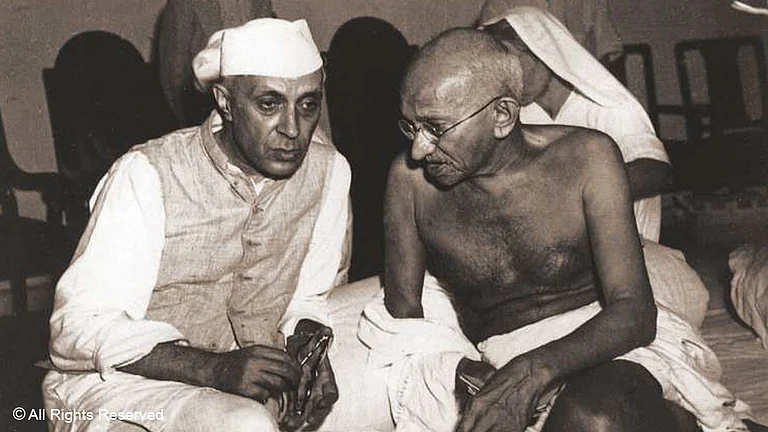
It is significant that Gandhi chose Nehru, with his modern and forward-looking outlook, as his political heir as free India required it. The Nehru-Gandhi paradigm should take us beyond the emblematic rituals of charkha, swadeshi, mud packs and prayer meetings, to envisioning modernity not as an abrupt discontinuity with tradition but as alternative modernity seamlessly evolving from the usable past. One could also invoke the medieval Bhakti poets who questioned ritual orthodoxies and reoriented social movements toward a distinctive Indian modernity.
(The writer is former Professor and Head of the Department of English, HNB Garhwal University and former Fellow of the Indian Institute of Advanced Study, Shimla.)