A satirical look at the hoardings that greet us before the mountains do
 By Atul Rawat
There is no place quite like our very own Doon. The city has a charm that refuses to fade.
The people are gentle and the mountains lush and inviting. Ancient trees arch gracefully over the roads, their sprawling branches forming a green canopy that seems to embrace every passerby.
And then there are places that have become part of our collective memory—Rajpur Road, Ghanta Ghar, Paltan Bazaar and Sai Mandir, to name just a few. There are old bakeries whose irresistible aroma has tempted generations, and the cafés where conversations linger long after the coffee has gone cold. Every corner has a story to tell. These are more than landmarks; they are repositories of memories, woven into the everyday lives of those who have called Dehradun home. They are the threads that bind the city’s past to its present, reminding us that a place is defined not merely by its buildings or roads, but by the countless moments lived within them.
As a whole new generation embraces modernity and affluence, our Doon has acquired a new character. Buildings have begun to outnumber the trees. Snarling traffic and the relentless chorus of honking vehicles have become our constant companions. The quiet charm of unhurried roads has given way to the urgency of a city forever in motion.
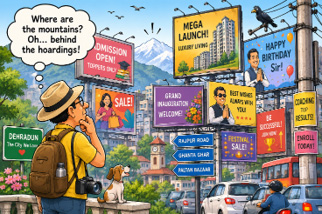
And then there are the hoardings. They are both gigantic and colourful, and are impossible to ignore. They stand proudly along the roadsides, rise from traffic islands, tower above buildings, cling to electric poles, and appear almost anywhere that gravity permits. They don’t merely occupy space—they dominate it, demanding the attention of every passerby.
Some advertise apartments. Others promote coaching institutes or weekend sales. And then there are those that advertise people who seem permanently engaged in wishing the rest of us on every conceivable occasion. Happy Birthday. Happy Independence Day. Happy Diwali. Congratulations. Welcome. Best Wishes.
Every occasion appears incomplete unless accompanied by a large smiling portrait. It makes one wonder whether these important personalities ever find the time to live their own lives. They seem permanently occupied wishing the rest of us.
Some hoardings are so enormous that they seem to proclaim not just a message, but the financial might of those who erected them. The passerby instinctively looks beyond these towering displays, hoping for a glimpse of the mountains that have long defined Dehradun’s skyline. Driving along Rajpur Road, you occasionally catch sight of the distant range—provided it isn’t obscured by a giant smiling face announcing yet another grand inauguration, celebration, or congratulatory message.
Yet nature carries on with quiet dignity. Flowers continue to bloom. The mountains stand patiently in the distance. The old trees keep stretching their branches over the roads, asking for nothing and expecting even less.
It is only the humans who are at their best to hide these natural beauties behind forty-foot rectangles of vinyl. Finding a road sign has become something of a treasure hunt. One peers around the hoardings hoping to spot it. “Turn left after the giant politician.” “No, not that one—the giant luxury apartment.”
In fact these hoardings have now become our new landmarks.
“Meet me near the giant mobile phone advertisement.” “Which one?” “The one next to the giant coaching institute.”
Sometimes I wonder what would happen if a benevolent fairy appeared one night and, with a single wave of her wand, made every hoarding disappear.
The mountains would suddenly become taller. The roads would seem wider. The trees would look greener. Even the electric poles might finally discover what they actually look like. Tourists would probably think the city had undergone a massive beautification drive.
In reality, we would simply have removed everything that was hiding its beauty. Of course, this is only wishful thinking. They are now part of the modern urban aesthetics. Maybe natural beauty is no longer considered complete unless someone has erected a twenty-foot banner in front of it.
Perhaps one day tourists won’t ask, “Where are the mountains?”
Instead they’ll ask, “Can someone move that advertisement? We’d like to see Dehradun.”
Until then, Doon remains every bit as beautiful as it has always been. The mountains are still there. The trees are still there. The quiet grace of the valley is still there. It is simply waiting to be seen again. Perhaps one day we will discover that the finest advertisement for Dehradun was never printed on vinyl. It was the city itself.