 By Atul Rawat
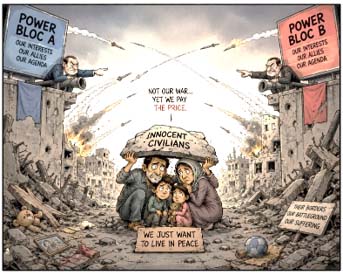
Every few years, the world discovers a new crisis. Today it is West Asia. Yesterday, it was somewhere else. Tomorrow it will bear a different name.
Elected leaders debate national interests. Military planners draw up strategies. Governments make decisions. Markets react. Television studios fill with experts who dissect the conflict for hours on end.
Thousands of kilometres away, an ordinary family wonders whether the next sound they hear will be another drone or another missile.
Who is right and who is wrong is a question history will continue to debate. The more immediate question is simpler – who judges the loss of millions of ordinary lives and livelihoods? Is there no higher authority? Are the rules only for the weak?
Some proclaim that the world is safer after every military operation. Others spend the rest of their lives picking up pieces of homes, businesses and memories buried beneath concrete and dust.
Everyone seems to have a voice except those who suffer the consequences.
Presidents speak of strategic national interests. Diplomats respond in nuanced jargon.
Military spokespersons count sorties flown, targets destroyed and battle damage assessments. Television anchors echo the narrative of those in power. Ratings matter.
Economists calculate the impact on GDP, inflation, energy prices and exchange rates.
Only the civilians caught in the geopolitical crossfire remain speechless.
Leaders declare, “The operation has achieved its objectives.” A victory parade is organised.
Unfortunately, the grocery shop that disappeared under the rubble had objectives too.
The school that will never reopen had objectives. So did the hospital that ran out of medicines have objectives.
The family business built over three generations had objectives. So did the young student whose future vanished overnight had objectives.
Yet we were naïve enough to believe that large-scale wars belonged to history books.
Those who give the green light remain protected inside physical and economic cocoons, insulated by security details, reinforced buildings and stable supply chains.
Others walk for days carrying everything they own in a single suitcase. They wait in refugee camps, search lists of the missing, and depend on the kindness of strangers in countries they never imagined calling home.
To history, they become statistics.
History remembers the Generals and the Presidents. It remembers the Treaties and the Victories. Rarely does it remember the innocent civilians caught in the geopolitical crossfire. They remain just numbers.
The headlines move on. TRPs demand a new story.
Governments move into another election cycle, once again promising a safer and better world.
Meanwhile, somewhere in the rain and cold, a family searches for clean water, a blanket, a meal and a missing child.
The economic consequences travel far beyond the battlefield. Food becomes more expensive thousands of kilometres away. Fuel costs rise. Inflation quietly pushes another struggling family below the line of survival. Recovery rarely arrives; hardship simply becomes the new normal.
Who accepts responsibility for all of this? Who should accept the responsibility for all of this?
Perhaps those who press the button should spend a few scary days in the battle zone—standing in line for a morsel of food, searching the ruins of a school, waiting outside a bombed hospital, or living in a shelter where privacy and dignity have become distant memories.
Perhaps then phrases like “acceptable losses” would become harder to pronounce.
Some justify the military action to make the world safer.
Perhaps they are right.
But safer for whom?
Humanity has been divided into invisible boxes. Our fate is often determined by the place of our birth, while the rest is left to the unpredictable currents of geopolitics.
Soon governments will change. Alliances will shift.
The present crisis will fade from memory. Another will take its place.
And somewhere, once again, an ordinary family will discover that the decisions taken in a distant, dimly lit war room have arrived uninvited at their front door.
In a conflict, truth is the first casualty, memory is the second casualty—and the ordinary civilian is often the third. Amen!