 By Devendra Kumar Budakoti
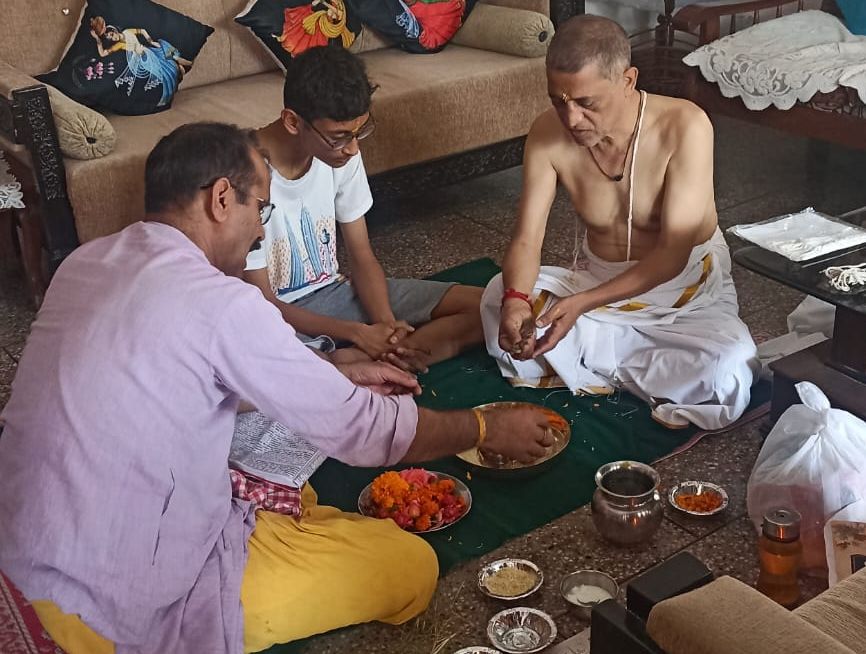
All the religions have some form of ‘Rites of Passage’, particularly those related to Birth, Marriage and Death. In Hinduism, these rites of passage are generally called the ‘Karmkand’ and performed by the priest. This Karmkand is more elaborate as this is done for most of the ‘Life Cycle’ activities, for example, rituals before birth, after birth, the baby purification rites along with the naming ceremony, Anaprashan – giving of first solid food to the baby, puberty ceremony in some Indian communities, first cutting of hair – Mundan, Sacred thread ceremony in some caste groups, engagement, followed by elaborate marriage rituals, and finally the death rites, followed by 13th day rituals, and later followed by six monthly and annual-Barsi ceremony.
The Karmkand in the Vedas refer to performance of rituals and sacrificial rites and performed by the priest in exchange for Dakshina. The ceremonies mark important events in stage of one’s life – birth, childhood, adulthood, marriage and death. These are some of the ceremonies, which are important and elaborate in Sanatan Dharma.
The term rites of passage was first used by A Van Gennep in his classic study The Rites of Passage , where he mentions how individuals in societies went through transition, through ritualistic ceremonies from birth to death.
The Gurukul schooling in ancient times, till the British came to influence our education system, mainly through Macaulay’s policy of introduction of English education and its use in civil services, judiciary, and professional education and training, slowly damaged our Vedic education, Vedic philosophy and karmkand ritual training in the Gurukul Ashram school system. The karmkand survived through family and kith and kin traditional training and practices, and families still largely used the practices to initiate all rites to passage ceremonies from birth to death. In light of the New Education Policy, the government should encourage and promote Gurukul schools and Home Schooling by having a provision, whereby any individual who has attained the age of 17 (seventeen) can apply/appear directly for standard 12 board examination of any state and/or central education board.
For most of the emergent middle class families, the Karmkand ceremonies have become an elaborate show of power, status and position in society. These days the best example of this is seen in the marriage ceremonies. Lakhs of rupees are spent to showcasing their position. The families spend a good amount of money in marriages ceremonies, programmes, tent house and decorations, DJ-music system, videography, and food including alcoholic drinks, gifts, gold and other ornaments. When it comes to giving of dakshina, the families give a pittance to the priest, compared to the total amount spent on the marriage programme. And then they have the audacity to say, Panditji, Naaraz Mat Hona! May I, as a sociologist suggest families at least pay 2 to 3 percent of the total amount spent on the marriage programme to the Priest. For example, if a family spends Rs 10 lakhs on the marriage programme, they should at least pay the priest an amount of Rs 20,000 to Rs 30,000. Is this a huge amount/sacrifice?
The film industry has also promoted the grandiosity of the marriage ceremony and it has become a status symbol for families to showcase it. In fact, the marriage programme has become more of a party than a ritual. Ladies’ Sangeet has become more of a cocktail party, where some family members are trained by chorographers. What to wear and how to wear a new dress – a kind of fashion show by one and all. This becomes more of a ‘Daru’ party and takes precedence over the fact that two individuals are getting married. The Haldihath ceremony in the morning used to be a very sanctified and emotional occasion for families, particularly for the girl’s side, but today it has become a fun and drama event. If these karmkand ceremonies become ‘theme parties’ for the new generation, then God save our Sanatan dharma!
The Supreme Court in its latest order on the marriage rituals says, “Where a Hindu marriage is not performed in accordance with the applicable rites or ceremonies, such as saptapadi, the marriage will not be construed a Hindu marriage. In other words, for a valid marriage under the Act, the requisite ceremonies have to be performed and there must be proof of performance of the said ceremonies when issues/controversies arise.” Should we still be saying, Panditji Naaraz Mat Hona!