‘UCC Draft Committee’ releases Vols 2 and 4 for public
By Arun Pratap Singh
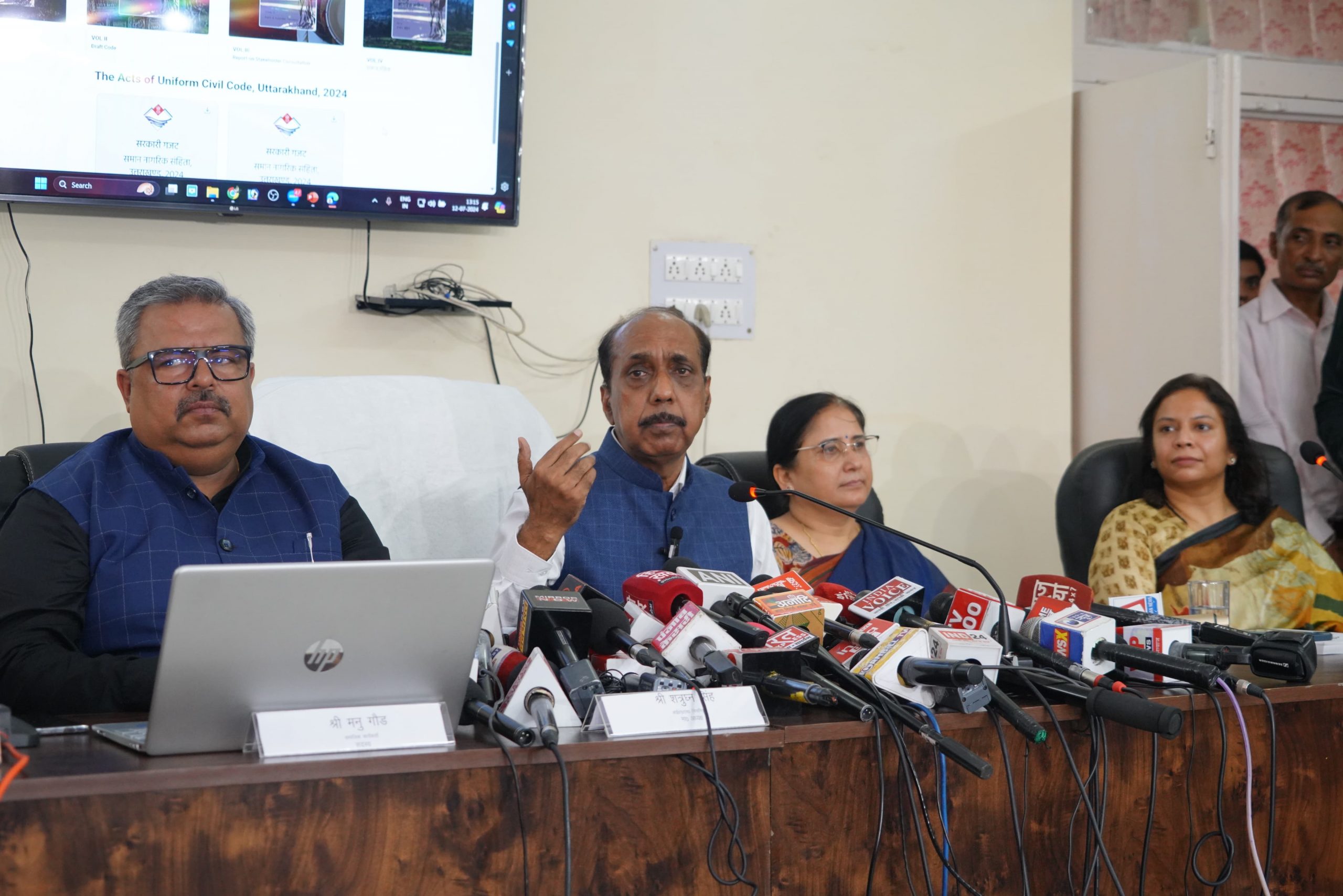
Dehradun, 12 Jul: Chairman of the Rules and Implementation Committee and also a member of the UCC Drafting Committee, Shatrughna Singh released volumes two and four of the UCC Draft report before the media at a press briefing held here today.
Other members of the Rules and Implementation Committee namely Vice Chancellor of Doon University Prof Surekha Dangwal, IPS Officer and Special Secretary, Home, Ridhim Aggarwal, Manu Gaur and ADG Amit Sinha were also present. Singh reminded that two out of the total four volumes of the Draft report could not be released earlier as by the time they were published, the Model Code of Conduct in view of the Parliamentary Elections was in force. On this occasion, he formally released the complete draft report for the public by uploading it on the website http://ucc.uk.gov.in and shared that any citizen can now access the report by visiting the website. With this development today, the entire Draft Committee report has become public now and anyone can access is by visiting the UCC website.
Singh said that the entire report of the expert committee constituted for the Uniform Civil Code under the chairmanship of retired Justice Ranjana Prakash Desai has now been made public. He reminded that a five-member committee was constituted under the chairmanship of retired Justice Ranjana Desai on 27 May, 2022, to prepare the draft report on UCC. During this period, the committee had received suggestions from 2.33 lakh people through 43 public dialogue programmes and various mediums. On 2 February, 2024, the committee submitted its report on the Uniform Civil Code to the state government, which was passed by placing it on the table of the Assembly. On 11 March, the President also gave approval to the Uniform Civil Code Bill. He shared that the state government ordered the rules committee to make the report of all four sections available to the public, in which order the complete report of the code will be available to the people from today.
Singh who was not only the member of the draft committee but now is the chairman of Rules and Implementation Committee in respect of the UCC stated that the Committee is an advanced stage regarding the rules but the technicalities of implementation may take a little longer in finalisation. In response to a question, Singh said that, as declared by Chief Minister Pushkar Singh Dhami in Delhi, the UCC will be implemented from October 2024 onwards. The Committee will try to finish its job within the stipulated time so that the UCC can be implemented at the earliest. He admitted that technicalities are taking time because the objective is to make the rules as people friendly as possible. For registering cases, the complainants will not have to visit any office but will be able to file an online complaint which will be linked to courts concerned.
Singh shared that before laying the foundation of Uniform Civil Code (UCC) in Uttarakhand, in-depth research was done from the Vedic period of India onwards and also regarding the discussions held by the Constituent Assembly. In addition, detailed research was also done on issues like the impact of the personal laws of different religions applicable at different times in the country and abroad on the lives of common people. He added that the committee even studied whether the state government had the jurisdiction to bring in UCC and after studying various reports of the Law Commission, the discussions in respect of the UCC in the Constituent assembly and reached the conclusion that the state government is well within its legal rights to bring in UCC.
Singh also spoke about the right of Muslim women to get alimony and maintenance under UCC and said that the courts have from time to time stressed on the need to bring UCC and also on the right of Muslim women to get maintenance allowance after divorce for life instead of just during the Iddat period of 3 months as provided in the Sharia. He reminded that the Supreme Court has recently reiterated that divorced Muslim Women have right to claim maintenance from husbands through their life under Section 125 of CrPC which in the new Criminal Laws is provided under Section 144 of Bharatiya Nyay Suraksha Sanhita (BNSS). The UCC has also made a mention of it under the chapter related to marriages and divorce. He added that based on its research of laws applicable in several countries and in light of several judicial decisions, UCC will grant right of adoption to every person irrespective of religion. In addition, the UCC also provides for legalising a uniform minimum age of marriage for women irrespective of religion. He admitted that in line with the Constitutional provisions in the country, the tribal communities have been left out of purview of UCC which has been made optional for them.
He admitted that questions have been raised against the provision of registration of live-in relationships but added that there are good grounds and arguments in favour of this provision also. Recently many cases of crime against women in live in relationship have surfaced. While right to privacy is important there are good grounds to support intimating the parents about the live-in relationship. If this provision is challenged in the court, the courts will take a final call in this respect.
Singh also shared that there is a provision of minimum age for marriage of women in several Islamic countries as well, like Turkey where in the past the minimum age for women for marriage was 15 and now 18 years is the minimum legal age. He added that Napolean Bonaparte was the first ruler in the world who brought UCC in 1804 and later the UCC was made the law in several European countries. The Committee also studied laws of 12 countries including USA, Turkey, Indonesia, France, Australia and Canada. He admitted that lot of suggestions from the public had been received against the UCC also but added that a large number of objections were photocopies of one original objection and were probably dumped with UCC committee in the confusion that a referendum was being held. He clarified that though the public feedback was studied seriously, by no means was it a referendum.