The Books from My Shelves
By DR NOOR MOHAMMAD
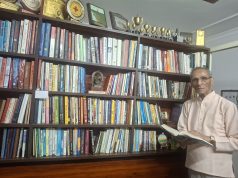
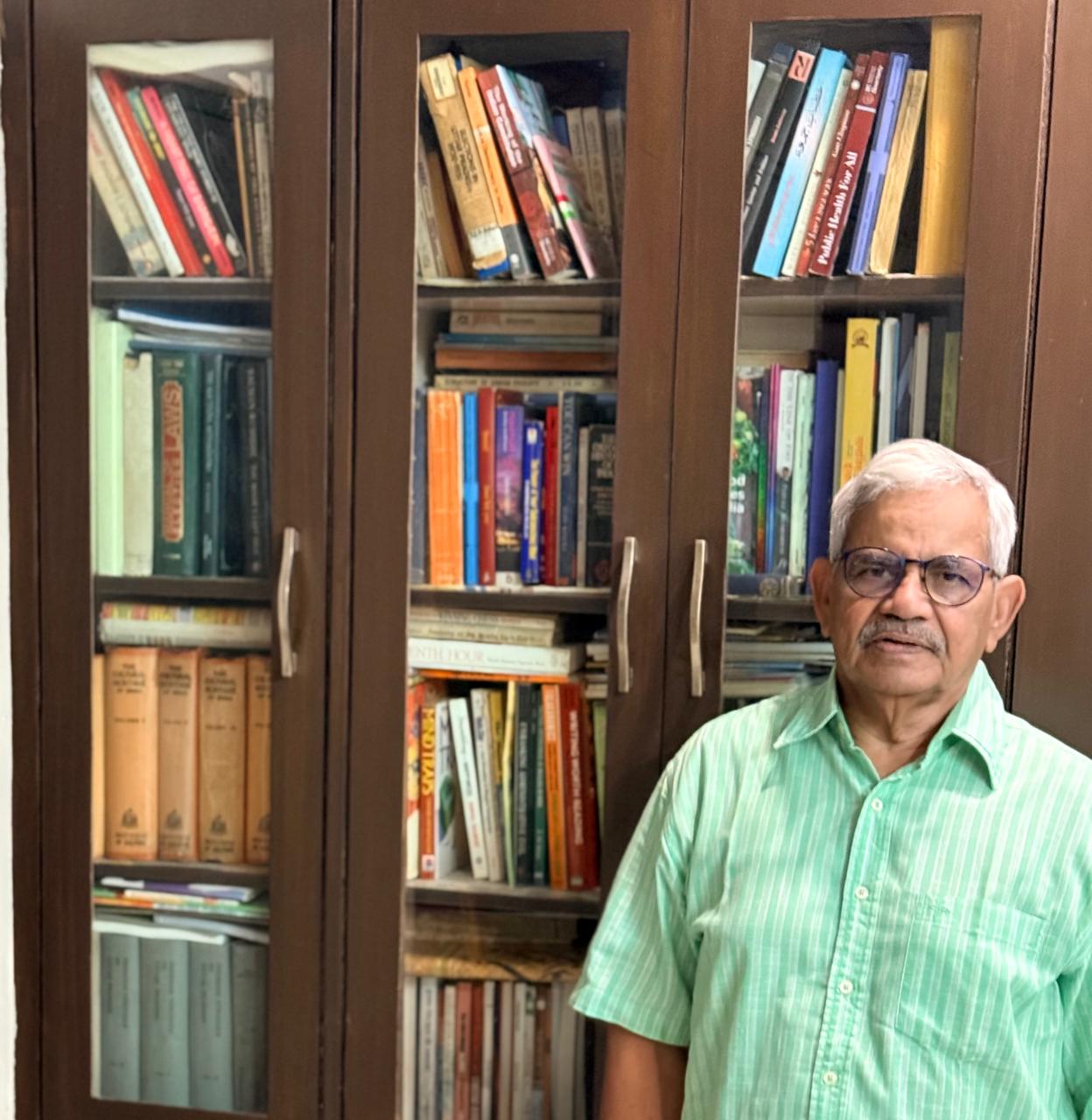
Books have always seemed to me like the most reliable of companions. They do not demand an appointment; they are available on demand, twenty-four hours a day, seven days a week. They do not mind being put aside when duty calls, nor do they complain if we return to them after a long absence. They wait patiently for us to resume the conversation. Yet, in this age of smartphones and social media, these faithful companions seem to be crying for attention.
The reading habit I acquired very late
I come from rural India, from a background where libraries were virtually unknown. In the village where I grew up, there was no library one could casually walk into, browse through shelves and discover a book that had nothing to do with one’s school curriculum. The school itself had a very utilitarian idea of reading. A good student was expected to read textbooks, learn the prescribed lessons and reproduce them in examinations.
Reading for pleasure was not regarded as an essential part of education.
There were no shelves filled with novels, biographies, travelogues, history books or collections of essays from which a curious child could choose. There was no culture of saying, “Have you read this book?” or of lending a book to a friend and discussing it afterwards. Consequently, I passed through my formative years without developing what I now consider one of life’s most valuable habits—the habit of reading.
I sometimes wonder how much I missed. I cannot recover those lost years. But I have gradually discovered the pleasure and intellectual companionship that books can provide.
Books came to me when I was forced to slow down
An important change came in 2007–08, when I fell seriously ill and was confined to bed for a considerable period. With little else to occupy my time, I turned towards books. What began almost as a necessity became a discovery.
I read a number of serious books during that period, mostly on history, economy, religion, democracy etc. I read many books on religion which included – A History of God by Karen Armstrong, Discovery of God by Rafiq Zakaria, Mohammad and Quran by Rafiq Zakaria as a response to Satanic Verses by Salman Rushdie and many others. However, I would like to walk through the main learnings from the books I read on democracy and elections – which may be of interest to readers given the controversies related to democracies and elections currently. These books are Sheshan: An Intimate story, Chronicle of an Impossible Election, An Undocumented Wonder, Why Elections Fail, How to Rig an Election and How Democracies Die.
Seshan: An Intimate Story — K. Govindan Kutty, based on T.N. Seshan’s experiences
It was T.N. Sheshan, the then Chief Election Commissioner who pulled me into Elections and appointed me as Chief Electoral officer of Uttar Pradesh in 1994. I was unwilling to take up the assignment as any other officer in those days would be. As there was no escape I joined but later found working with him was a pleasure. This biography, written by journalist K. Govindan Kutty from T.N. Seshan’s narrated experiences, offers an account of the man who transformed public expectations of India’s Election Commission. As Chief Election Commissioner from 1990 to 1996, Seshan became known for his uncompromising insistence that political parties and candidates obey election laws. His tenure brought the Model Code of Conduct, expenditure restrictions and the Commission’s constitutional authority into the centre of public debate. The book helped me understand the personality behind this assertive approach to election administration: a civil servant prepared to confront powerful political interests rather than allow electoral rules to remain merely on paper. Seshan’s significance lay not simply in his enforcement of existing provisions, but in demonstrating that an institution’s effectiveness depends partly on the determination and integrity of the people who lead it. His methods attracted both admiration and controversy, making his story an illuminating study of constitutional authority, administrative courage and the relationship between democratic institutions and political power.
Chronicle of an Impossible Election: The Election Commission and the 2002 Jammu and Kashmir Assembly Elections — James Michael Lyngdoh
I read this book to find if my contribution to Kashmir elections was reflected in it or not – I was CEO UP at that time but the Commission desired my help in computerizing the electoral rolls and providing Urdu knowing election staff from UP which I did. In this book, former Chief Election Commissioner James Michael Lyngdoh recounts the challenges of conducting the 2002 Jammu and Kashmir Assembly elections in an environment of militancy, violence, intimidation and widespread public distrust. The task was daunting. Candidates faced threats, security arrangements were complicated by militant activity, and electoral rolls running into hundreds of thousands of pages had to be updated in Urdu. Above all, the Election Commission had to confront the cynicism of citizens whose earlier experiences had left them doubtful that elections could be genuinely free and fair. The stakes extended beyond the formation of a government: the credibility of the Election Commission and the possibility of restoring public confidence in democratic participation were at issue. The book illustrates how electoral administration requires more than logistical efficiency. It demands institutional independence, courage, impartiality and a willingness to withstand political pressure. Lyngdoh’s account demonstrates that even under exceptionally difficult circumstances, a determined election authority can help create conditions for meaningful democratic choice.
An Undocumented Wonder: The Making of the Great Indian Election — S.Y. Quraishi
Yet another book on Indian elections, by former Chief Election Commissioner S.Y. Quraishi. The book offers an insider’s account of how India conducts elections on an extraordinary scale despite its vast geography, enormous population and immense social, linguistic and cultural diversity. Drawing on his experience as an Election Commissioner and Chief Election Commissioner, he explains the administrative machinery, institutional arrangements and human effort that make this enormous democratic exercise possible. The book explores electoral preparations, voter registration, political competition, election management, voter education and the challenges of ensuring participation. It also discusses the reforms and innovations introduced to improve the functioning of the electoral system. What makes the account particularly valuable is its first-hand perspective: the reader gets an understanding of the pressures, practical difficulties and institutional responsibilities that are not always visible in newspaper reports. The book celebrates the achievement of Indian elections without reducing them to a mere administrative success story.
How to Rig an Election — Nic Cheeseman and Brian Klaas
This book provides an interesting perspective on how elections are rigged across the world. Disenfranchisement through defective voter list is one of the popular methods to rig elections because the activity is done well before elections when the stakeholders are not very vigilant. It is an interesting read for people interested in understanding the on going Special Intensive Revision of electoral rolls in India. The writers investigate a disturbing paradox: authoritarian rulers often hold elections not because they intend to surrender power, but because elections can provide legitimacy, domestic support and international acceptance. The book examines the techniques through which incumbents manipulate electoral competition while preserving the outward appearance of democracy. These include voter intimidation, vote buying, ballot stuffing, manipulation of electoral boundaries, suppression of opposition supporters, misuse of state resources and the dissemination of misleading information. Distortions can occur long before polling day, through flawed delimitation and voter registration. The book also examines how authoritarian leaders conceal manipulation. Its broader lesson is that the existence of elections is not proof of electoral integrity. Safeguarding democracy requires vigilance throughout the electoral process, not merely on polling day.
Why Elections Fail — Pippa Norris
Pippa Norris examines why elections in different countries fail to meet accepted standards of electoral integrity. Rather than treating every disputed election as a simple case of fraud, she explores the structural and institutional conditions that influence electoral quality. Problems may arise through discriminatory electoral laws, outdated voter registers, biased media coverage, unequal campaign finance, intimidation, vote-buying, violence or manipulation of the counting process. Electoral authorities themselves matter: their independence, competence, resources and commitment to impartiality can determine whether elections are credible. Norris also shows that electoral failures cannot always be explained by the conduct of election officials alone. Poverty, weak institutions, political conflict and authoritarian legacies can make fair elections difficult to organise. Its central argument is that credible elections require both sound institutional arrangements and effective implementation. Electoral integrity must be protected throughout the electoral cycle, from the framing of rules to the resolution of disputes.
How Democracies Die — Steven Levitsky and Daniel Ziblatt
This book answers the most intriguing question on why democracies being rule of the people, by the people, for the people slides down wards. The book challenges the conventional belief that democracy is destroyed mainly through military coups or violent revolutions. The authors argue that democracies can also die gradually, through the actions of elected leaders who weaken the institutions and conventions that sustain democratic government. They examine how authoritarian-minded politicians exploit democratic procedures to consolidate power. They warn against the denial of political legitimacy to opponents and emphasise the importance of mutual toleration and institutional restraint: political rivals must recognise each other’s right to compete, while constitutional powers must be exercised responsibly. The central message is that elections alone cannot guarantee democracy. Independent institutions, a free press, respect for opposition and a commitment to constitutional norms are equally essential. Democracy can be undermined from within, even when elections continue to be held.
My UN assignments in Afghanistan – Election Commissioner and Chief Electoral Advisor – were full of challenges. I escaped two bomb attempts but kept going on to establish and defend democracy there. This assignment increased my curiosity to know more about democracy in the world and my books have been the greatest companion and guide in meeting this curiosity.
Books, as evident from above, offer a vast treasure of knowledge. They are always there for us, ever willing to help us become batter humans.
(Dr. Noor Mohammad, born on 30 July 1951, in Basti (UP), is a Ph.D. in Economics. He joined the IAS in 1977 and worked as Secretary, Basic Education and Chief Electoral Officer in UP, Deputy Election Commissioner in Election Commission and UNO appointed Election Commissioner in Afghanistan.)