 By: Ganesh Saili
‘Good news is rare. No news is good news. Good news is excellent news,’ writes a friend on hearing that his children were heading home for a week. ‘If you don’t hear from them, it is good news,’ he says, adding: ‘They rarely come home, but when they do, that’s excellent news!’
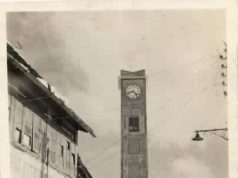
Up here, if you walk from Picture Palace to Library, chances are that one of two things is going to happen: you’ll either get hit by a two-wheeler or bump into one of the forty-eight journalists peopling this station. They represent our local, regional and national print media.

Mussoorie was the first of our hill stations to have its own newspaper, of which no copies are known to survive. One happy day, Pramode Sawhney, who owns the Art Press, tells me: ‘My luck today! While replacing a crazed mirror, I found this perfectly preserved newspaper behind it!’ It’s an old copy of The Mussoorie Times, which he generously gave me.
Our rag chase began in 1842 when John Mackinnon brought out The Hills, which perished eight years later. Then in 1860, his son, Arthur, brought it back to life, ‘publishing every Thursday, subscription for one year, in advance, of Rs 20!’ Despite the advance, it came to a sudden end in 1865.
Along came The Mussoorie Exchange Advertiser of 1870, which was essentially a broadsheet for advertising, and it changed the old spelling of Mansuri to Mussoorie, without explaining why.
Worse was when Mr Coleman started the Mussoorie Season in 1872, but unfortunately, he had the knack of rubbing people the wrong way. This precious gift has led to the ruin of many of our trumpeters.
In an article about a fete held to raise funds for a charity, the paper rashly reported that the local magistrate’s wife had spent some of the fete’s funds on ‘pegs and dresses.’ Back then, editors could say such things and continue to stay alive, but not this time. One evening, at the ‘Criterion Restaurant’ at the Library, which was the hill station’s popular rendezvous, ‘the magistrate, horse-whip in hand, met the libelling scribe, introduced him to the handy weapon, and left him to more scribbling – not to his usual readers but to his lawyers.’ The newspaper perished.
Of course, everyone breathed a little easier when Mr Coleman packed his bags and left for home.
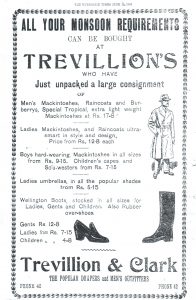
Pic courtesy: Pramode Sawhney.
Ah! Reckless times, when The Statesman of 22 October 1884 said: ‘Ladies and gentlemen, after attending church, proceed to a drinking shop, a restaurant adjoining the Library, and there indulge freely in pegs, not one but many.’ and ‘At a Fancy Bazaar held this season, a lady stood up on her chair and offered her kisses to gentlemen at Rs. 5 each! What would they think of such a state of affairs at home?’
Wonder what the correspondent would have said of inflationary trends if he were around for the 1932 benefit show, when a lady stood up and auctioned a single kiss, for which a gentleman paid Rs. 300!
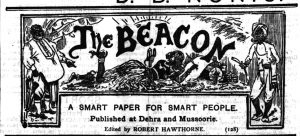
Anyway, John Northam merged The Mussoorie Season with the Himalaya Chronicle, and soon after, Charles Liddell started The Mafasilite (often spelt ‘Mofussilite) and in 1901, Mr F. Bodycot turned The Mafasilite into a printing press, and the newspaper became The Mussoorie Times.
That was where you would have found the Australian-born author John Lang editing The Mafaslite in the sunset years of his life. That newspaper has been republished by the maverick journalist Jai Prakash Uttarakhandi for twenty-two years now as a tribute to the author. He continues to publish annual supplements on the author, and holds candlelight vigils over the grave of Lang in the Camel’s Back Cemetery on August 20th 1864.
In those days, a flourishing photographer displayed his work by the roadside. One day, amongst the exhibits, there appeared the beautifully executed likeness of the editor of one of Mussoorie’s papers mounted on an ass. Of course, fireworks followed!
Today, our excitement is limited to that provided by five thousand rental scooters driven by kamikaze pilots.
Walking across the Mall, glancing at a local daily, I almost made it into next day’s headlines!
Ganesh Saili, born and home-grown in the hills, belongs to those select few whose words are illustrated by their pictures. Author of two dozen books, some translated into twenty languages, his work has garnered worldwide renown.