By Arun Pratap Singh
Garhwal Post Bureau
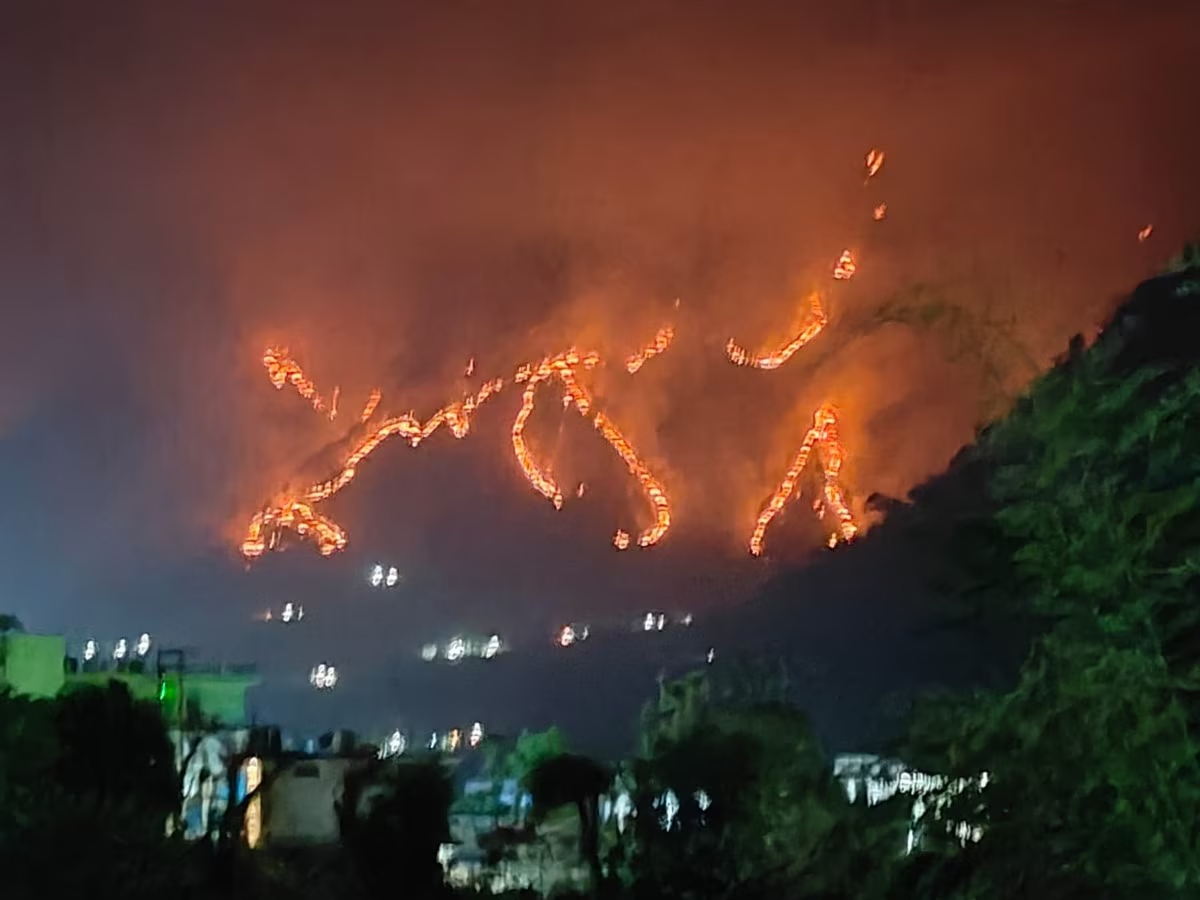
Pithoragarh, 24 Apr: With the onset of summer, vast stretches of forests across Uttarakhand have once again begun to be impacted by raging fires, raising serious concerns over administrative preparedness and environmental impact. In Pithoragarh district, the situation has turned particularly alarming, with fast-spreading forest fires advancing dangerously close to habitation areas, leaving residents living in fear and uncertainty.
The crisis has deepened with the blaze reaching the Askot Musk Deer Sanctuary, a protected habitat known for its rare wildlife. Sources in the region claim that the sanctuary has been burning for over ten days, with thick plumes of smoke rising continuously, threatening the fragile ecosystem and the survival of species such as the endangered musk deer, besides animals like bears, leopards and deer inhabiting the region.
Ground reports from multiple forested zones across Pithoragarh reveal an alarming spread of fire incidents since the beginning of the summer season. Areas including Berinag, Gangolihat, Ganai, Thal, Didihat, Munsyari and Dharchula have witnessed extensive forest damage, while adjoining regions in Bageshwar district such as Dharmagarh, Kapkot, Kanda and Garud are also grappling with similar conditions. Thousands of hectares of valuable forest wealth have already been reduced to ashes, with the environmental and ecological consequences becoming increasingly severe.
The fires have not only devastated forests but have also significantly impacted air quality, with dense smoke spreading from hills to towns, posing a serious health hazard. Experts and environmentalists have expressed concern over the deteriorating situation, particularly as the fire season, which typically extends from mid-February to mid-June, has intensified unusually early this year due to insufficient winter snowfall and rainfall.
A ground assessment by independent people and groups claims glaring gaps in preparedness to deal with forest fires on part of the state forest department. Despite claims of prior mock drills and preventive measures, most of affected areas were found burning unchecked. In a few locations, forest personnel were seen attempting to control the fires using conventional methods, while in several others, there appeared to be no active firefighting presence. This has raised questions over the effectiveness of existing strategies and the timely deployment of resources.
Medical professionals have also flagged serious health risks arising from prolonged exposure to forest fire smoke. Dr Siddharth Patni, in charge of the Community Health Centre in Berinag, warned that inhalation of such smoke could lead to severe respiratory ailments, including chronic lung disease and even cancer, with elderly individuals being particularly vulnerable.
Concerns have also been raised over the apparent neglect of traditional forest management practices, especially the maintenance of fire lines. Experts point out that despite substantial annual expenditure by the government and forest department on fire control, the results on the ground remain unsatisfactory. Fire lines, which are crucial barriers designed to prevent the spread of flames, are often cleared only after fires have already broken out, rendering them largely ineffective.
The official data indicates that the state has fire lines stretching across thousands of kilometres, including approximately 2876.49 km of 100-feet-wide lines, 2520 km of 50-feet lines and 1333.43 km of 30-feet lines. However, a lack of regular maintenance, coupled with the accumulation of highly inflammable pine needles and vegetation, has significantly reduced their utility. In several areas, even trees have grown along these lines, further compromising their effectiveness. Restrictions on tree felling above 1000 metres altitude have also limited the creation of new fire lines, compounding the problem.
The issue has now naturally taken a political turn and the Congress has launched a strong attack on the state government, accusing it of failing to put in place effective fire prevention and control measures. Senior Congress leaders have alleged that hundreds of hectares of forest in Gangolihat constituency had been destroyed and claimed that party workers had themselves taken part in firefighting efforts in the absence of adequate government response. He described official claims as hollow and lacking visible impact on the ground.
Pithoragarh MLA Mayukh Mahar has also echoed similar concerns, accusing the government of being completely ineffective in tackling forest fires and holding it responsible for the large-scale destruction of forest resources. The Opposition’s criticism has intensified the political debate around disaster management and environmental governance in the state.
Adding to the gravity of the situation are allegations that some fires may be deliberately set by the poachers to facilitate illegal hunting, particularly in sensitive zones like the Askot sanctuary. Despite repeated assurances by the forest department regarding strict action against such conspiracies, there have been no significant arrests, raising doubts about enforcement and surveillance mechanisms.
Responding to the situation, Berinag Forest Range Officer Chanda Mehra claims that continuous efforts are being made to control the fires and that teams were being dispatched promptly upon receiving information. She added that strict legal action would be taken against those found responsible for igniting fires and appealed to the public to cooperate in preventing further damage.