 By Aloke Lal
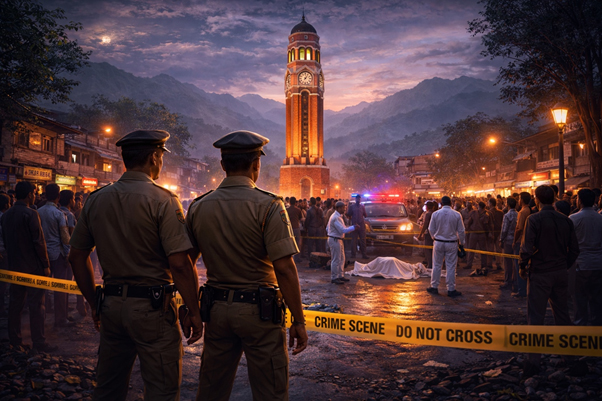
When one closes one’s eyes and gets lost in thoughts of Dehradun, the background is one where tranquillity prevails, a serene assurance pervading the natural surroundings and peace reigning supreme. The senses are immersed under a blanket of security, where looking over the shoulder to spot any disrupter of this tranquillity is entirely inessential. Hold on—are we seeing things change? A spate of violent crimes, including gruesome murders in broad daylight, has changed the aura. There is disturbance in the air; toxicity seems to have occupied a new address.
When a city known for safety and social stability experiences a sudden rise in murders, the shock is felt not only in law enforcement circles but across the entire community. Fear spreads quickly, rumours multiply, and public trust can weaken if the response appears slow or fragmented. Handling such a crisis requires swift, structured, and multi-layered action that combines policing, intelligence, administration, and community partnership.
Such situations often lead decision-makers to lunge for options that may not entirely come from the textbook of ideal responses in such circumstances. Some sudden, even knee-jerk, attempts are made to set the climate right. But are such measures the real answer? In my estimate, a few key changes in the line-up of personnel are not always the best or most desirable step. The transfer of the chief of the district police may be good for optics and have an immediate impact on public perception, but one must ponder deeper and prioritise actions that lead to a fundamental upgrade of the apparatus that controls crime.
The first priority is an immediate operational response. Police visibility must increase in vulnerable and high-traffic areas to deter further violence and reassure citizens. Patrols should be intensified and redistributed based on identified hotspots rather than routine locations. Specialised investigation teams should be formed to focus exclusively on the recent cases, ensuring speed and continuity. Crime scenes must be processed with high forensic standards, and evidence handling should be fast-tracked to prevent delays that could cost critical leads.
Next comes analytical and intelligence-driven work. Investigators should quickly determine whether the murders are connected by motive, geography, victim profile, or method. Known violent offenders, recently released prisoners, gang members, and individuals with prior histories should be reviewed and, where lawful, placed under surveillance. Informant networks and local intelligence sources should be reactivated and incentivised to provide timely information. Strengthening criminal intelligence networks is something that cannot be postponed until tomorrow.
Coordination among officials manning the affected police stations is equally important. A centralised command structure helps avoid duplication and confusion. Daily inter-jurisdictional briefings— involving SHOs, Circle Officers, and SPs — allow real-time sharing of findings and timely decision-making.
The public should be provided with regular, factual briefings to prevent panic and rumour-driven narratives, but sensitive details that could compromise investigations should be withheld. Citizen cooperation should be encouraged through anonymous tip lines and community meetings. When residents feel involved, the flow of useful information increases significantly.
Preventive measures should run parallel to investigations. Illegal weapon checks, targeted raids on known criminal hubs, and enforcement against repeat offenders will send the right warning signals, preventing potential future crimes. Improvements in street lighting, camera coverage, and access control in high-risk areas add immediate deterrent value. Civic authorities can play an important role in the fight against crime.
The above measures will help control the immediate spike, but a deeper review must follow. Authorities should study root causes — whether organised crime activity, personal dispute trends, substance abuse networks, or economic stress factors — and design long-term interventions. My belief is that the sky-rocketing real estate prices in and around Dehradun are an important factor leading to crime.
We need to take a serious look at training upgrades, technology adoption, and community policing programmes. As the uniformed guardians of the law, police officers need to seek the help of the ‘policemen not wearing uniform’ — the responsible citizens of the city — to restore durable safety.
A sudden surge in violent crime is a severe test for any city, but with a disciplined response, data-driven policing, and community partnership, stability can be restored and strengthened.
(Aloke Lal is a former DGP and best-selling author. He is the Festival Director of the Crime Literature Festival of India.)