Around the World with the Most Travelled Indian
 By Nitin Gairola
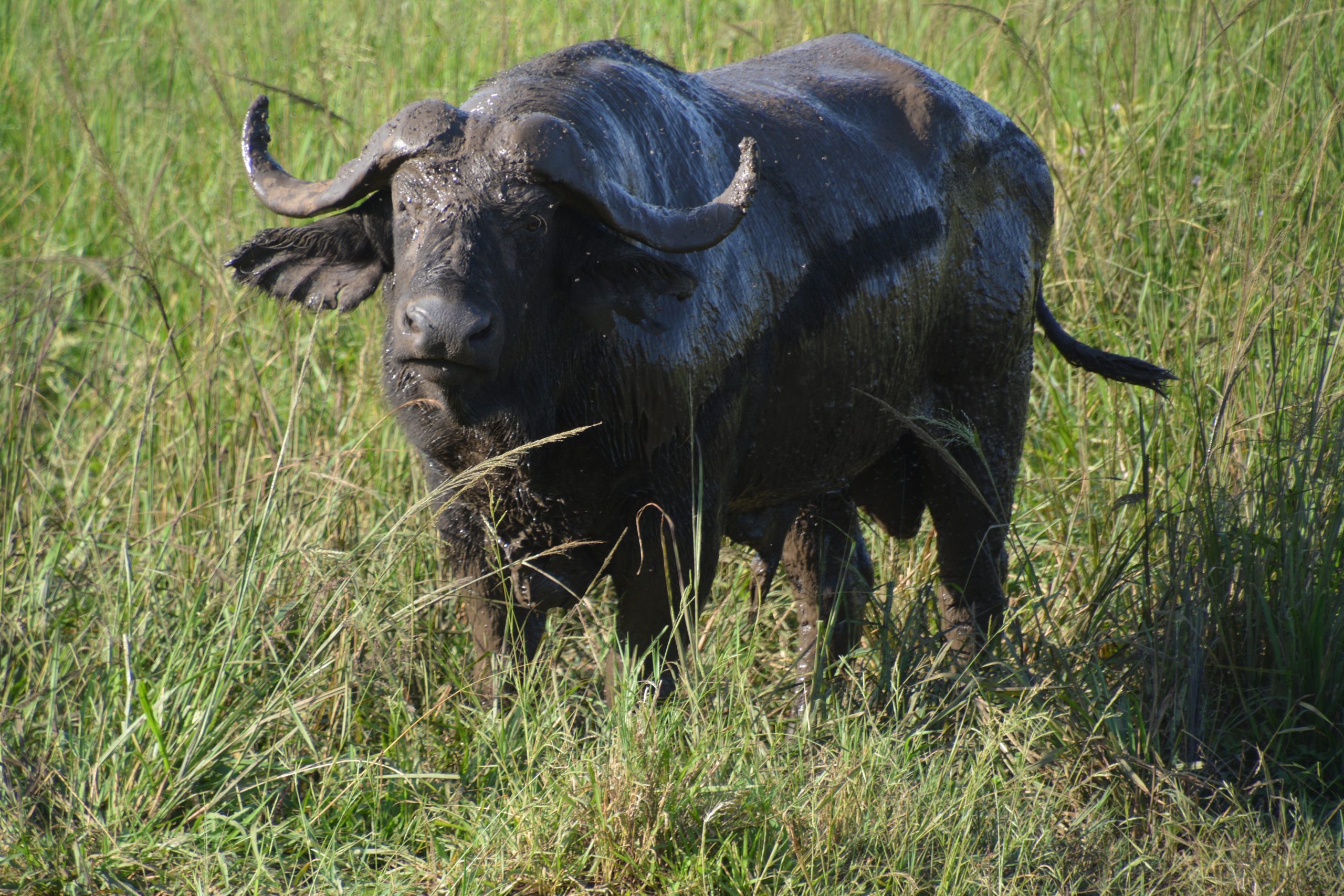
I used to wonder why they considered a buffalo among the ‘big 5’ in the African safari goers’ bucket list. Is this really one of the top 5 animals that tourists want to see on a ‘game drive’? Years later I figured out what the ‘big 5’ originally meant. As you would know from my previous features on this topic, ‘big 5’ is actually an old term coined by animal hunters to describe the 5 most dangerous animals to kill for sport in Africa. And once you see this big angry buffalo in person, you will understand why it made it as the 5th in the ‘big 5’ list of these hunters and also the 5th of my 5 features on this topic.
But what really makes a memory is when you see these bovines in the multitudes. It’s a vision of a hundred black battle tanks ‘grinding’ towards you (in this case ‘grazing’ towards you). Now seeing that many together can be somewhat imposing and intimidating and you should know that if the mighty king of the jungle were a solitary hunter like the leopard, then it would not have been able to kill a fully-grown buffalo on its own – it can only kill with the support of the pride. Buffalos have been known to give a thrashing to lone lions in situations where the reinforcements did not arrive or were not there. It’s only when the lions collectively spread fear in the herd and then gang up around the weakest, are they able to pull down the buffalo and win the pride a large meal (and keep their ‘pride’ intact, so to speak). So, believe me when I say that this animal is no pushover, unless it meets an elephant or a rhino and perhaps a hippo. But I haven’t seen that meeting of muscle with my own eyes, so I can’t comment any further.
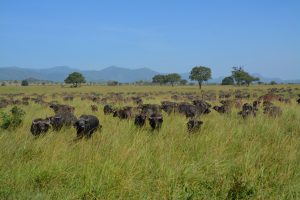
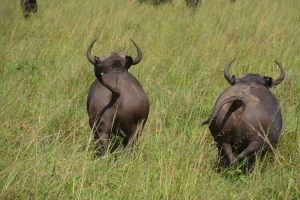
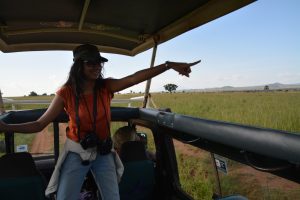
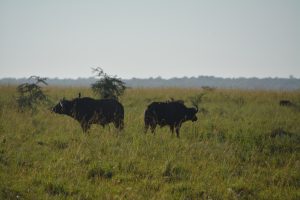
And I am sure you will see African Cape Buffalos in all your safaris in East and Southern Africa since they are abundant. We have seen them in all of ours as well, but even then, some places stand out. After seeing these angry bulls in East Africa, we weren’t expecting to be wowed at the trans-frontier Kidepo National Park that stretches from Uganda to South Sudan, with the latter being a very troubled land. Kidepo is the place to go if you want to witness the herbivores in mind-boggling numbers, especially the Elephants, Giraffes and Cape Buffalos and also the various antipopes. And I almost missed mentioning the largest bird in the world – the prehistoric looking Ostrich, which sometimes looks like a mini-dinosaur from Jurassic Park. And so, in one of the safaris at Kidepo, our jeep got surrounded by these black bovines and there wasn’t much room left for the driver, Moses, to manoeuvre. While we were not in any danger, since Buffalos don’t typically gang up together against safari vehicles as sometimes elephants can do, but it was still quite an experience and a spectacular spectacle.
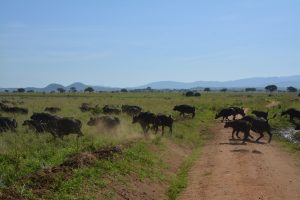
Also, unlike my experiences with the other big 5 that I have narrated previously, i.e., with Elephants, Lions, Leopards and Rhinos, there isn’t much to write home about when it comes to standout memories with Cape Buffalos. Their safari magic is in the multitudes and the backdrop that they lend to the safaris. They are not the main attraction for sure – Just imagine you go on an African safari and see buffalos and more buffalos but no lions or leopards. That won’t go down too well, would it? But without buffalos, both the grassland ecology and the safari experience would go down several notches. Let’s say they are like the salt of the safaris and the ‘big 5’ tag may have worked better for the hunters than it does for the safari tourists.
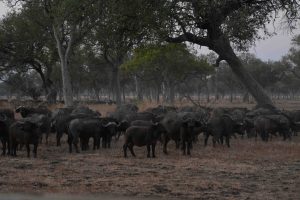
In all the safaris we have taken, frankly my strongest recollection of direct encounters with the buffalos is at that one place in Kidepo and also a similar experience in Zambia where we were at sunset and this super massive herd was gathering together and bunching up for protection from the lions. The lions naturally hunt at night, given their keen vision and the upper hand (or upper paw) they get over their bulky prey and hence most animals bunch together for safety in numbers. We just enjoyed our sundowner watching these tanks gather around at dusk. And the sundowner was done outside the jeep, which now doesn’t sound too wise since by the time the celebrations ended, the sun had already gone down and the sounds of the wild could be heard.
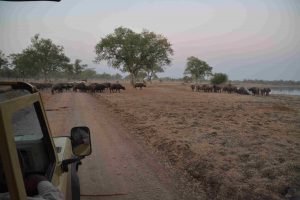
The other incident that stays in my mind is in Tanzania where we saw a pride of 16 or 17 lionesses (one of the largest ever) as it was heading towards a herd of buffalos. We never got to know what really happened since the herd was a bit far away, but we knew that the lionesses were planning their kill as they had six or seven cubs with them too.
I feel if I have to capture and bring to life a visceral lion vs buffalo fight, then I have to go to the Okavango Basin in Botswana in the driest of dry seasons, typically in September or October. This is when and where there is desperation due to the lack of rains and prey. Here the lions are designed to kill big prey like the buffalos and they are built accordingly. The lions of Okavango are big and muscular and they always go after their favourite meal. And after travelling the world for two decades, I still have some spots left on my so-called ‘bucket list’ (I find the term very cringe). The Okavango in October is one such place on my long list. As you would notice, with the natural world and with wildlife in particular, it’s not just the place but the time of year, i.e., the season that really, really counts.
And as difficult as it is for me to accept the Cape Buffalo in the African safari ‘big 5’ over say a Giraffe or Hippo or even the Ostrich (which all are unique to Africa, too), I guess I am never disappointed when I witness these unsocial, yet socialising beings in the wild. They add a very unique flavour to the African Savannah experience which is very hard to describe the experience unless and until you are there to feel it in person.
Nitin Gairola, is from Uttarakhand and has travelled to every major desert & forest ecosystem on Earth besides other natural world biomes on our planet and around 150 countries as well. These extensive world travels have lent him the unofficial title of the ‘Most Travelled Indian’ and this multi-decade exploration project to witness the natural world is called ‘Borderless Planet’. Nitin is a published writer & poet too. Join him @ www.instagram.com/MostTravelledIndian/