The Books from My Shelves – 1
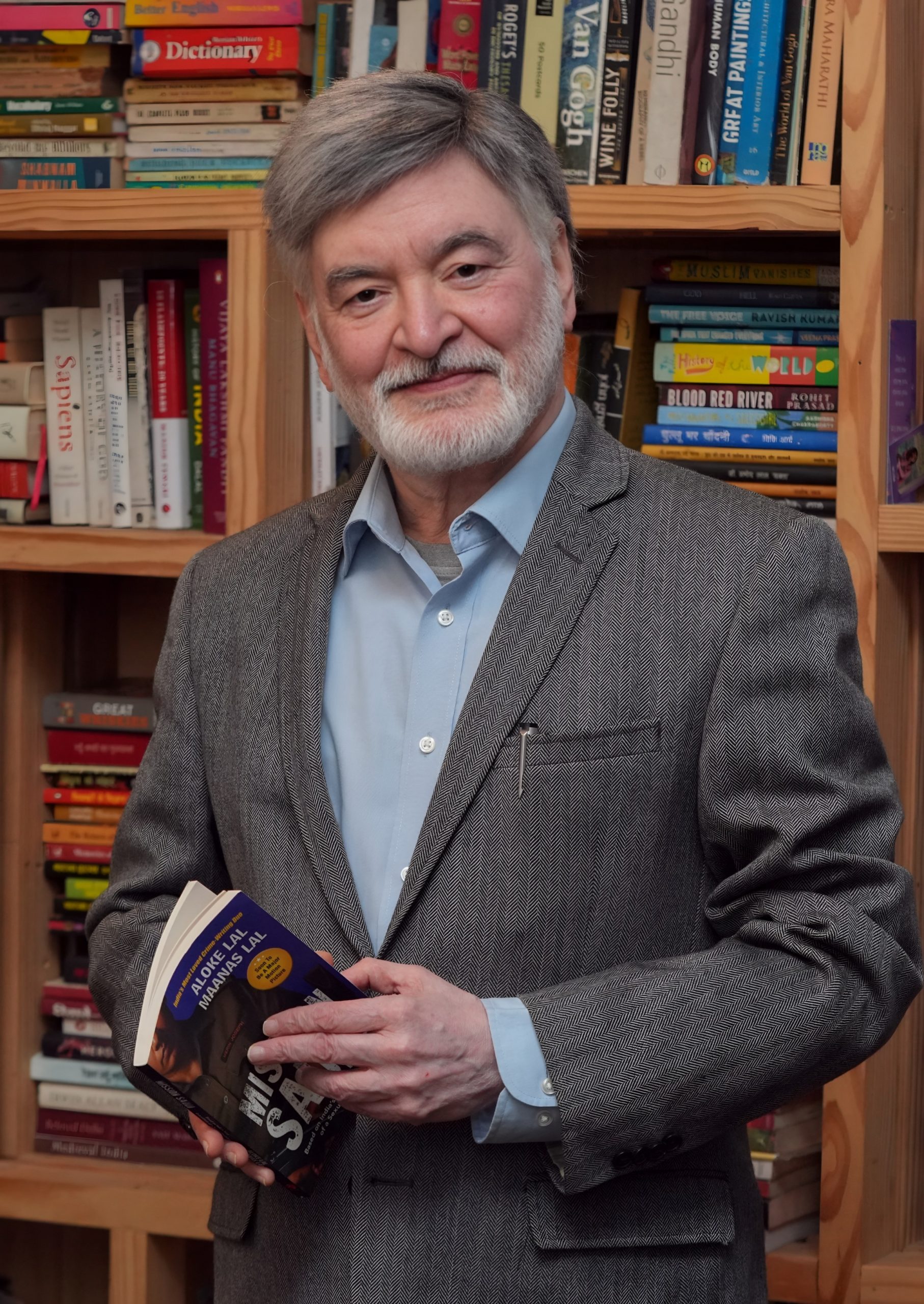
By Aloke Lal
One book on a shelf is an object. A hundred books become a presence.
There is something intimate about the relationship between a reader and a book. You hold it in your hands, carry it from room to room, take it to bed, abandon it for a while and return apologetically. You underline a sentence, leave a visiting card between its pages, sometimes even argue with the author in the margin. No two people quite read the same book because each brings to it a different life.
And when the reading is over, the book does not really leave. It finds a place on the shelf, carrying something of that encounter with it.
Standing together, books acquire a living stature. Some are frequently taken down; others have slept undisturbed for years. Some arrive yesterday and stand beside companions that have travelled with us through several homes. The battered ones often possess the quiet authority of old friends. And, inevitably, there are formidable volumes bought in moments of intellectual ambition that remain unread. They are not failures; they are promises.
There are memories hiding within the pages of my books. A forgotten visiting card, a pencilled line, perhaps something placed there years ago and rediscovered by accident. Ahmad Faraz’s beautiful line comes to mind: “Jis tarah sookhe hue phool kitabon mein milen.” Sometimes opening an old book is like opening a small door into another time.
Some books on my shelves carry memories deeper than my own. They are inheritance.
The oldest came from my father, whom we called Babu: Gandhi, Nehru and Ghalib—two great heroes and one unparalleled master of poetry. Babu had himself participated in the Satyagraha inspired by Gandhi, while Nehru was his hero. His copies of My Experiments with Truth and The Discovery of India therefore possess something no new edition could: the convictions of the man who read them before me.
Ghalib’s inheritance is more intimate still. Inspired by the great poet, Babu wrote Urdu poetry himself, adopting the takhallus, ‘Talib’. When I open his Deewan-e Ghalib, I sometimes wonder whether my eyes have paused at a couplet over which his too had lingered.
Books were part of our household long before I began acquiring them. They bore a stamp: “Lals’ Bookshelf. Number……”
There was something faintly bureaucratic about numbering them, but also rather grand—as though we were running a private library whose principal borrowers happened to be ourselves. My mother, too, was a writer, and I suspect my interest in Hindi literature owes something to her. The habit proved hereditary: all my siblings today possess enviable collections.
My present shelves are rather argumentative.
Ramachandra Guha’s ‘Makers of Modern India’ introduces the thinkers whose ideas shaped modern India; ‘India After Gandhi’ tells the improbable story of what we subsequently made of it. His ‘The Commonwealth of Cricket’ reminds us that cricket can accommodate empire, nationalism and memory within the same boundary rope.
William Dalrymple’s ‘The Anarchy’ tells the astonishing story of a trading corporation becoming a colonial power; his son, Sam Dalrymple’s ‘Shattered Lands’ examines the later fragmentation of the vast region that once constituted British India.
Bhagat Singh’s ‘Why I Am An Atheist’ occupies a special place. Don’t we remember too readily the young revolutionary in the felt hat and often forget the voracious reader and fiercely questioning intellect behind the icon?
Harsh Mander’s ‘Looking Away’ invariably reminds me of Faiz: “Aur bhi dukh hain zamane mein mohabbat ke siwa.” As Mander turns our gaze towards hunger, homelessness and inequality, another haunting image from the same poem returns— “ja-ba-ja bikte hue koocha-o-bazaar mein jism, khak me luthde hue khoon me nahlae hue”. There are books that inform us; this one leaves behind the discomfort of having looked away.
The Russian troika Tolstoy, Dostoevsky and Chekhov were my college-time favourites. I was also struck by Boris Pasternak and Alexander Solzhenitsyn during my days as a student.
Shashi Tharoor’s ‘Pax Indica’ turns the gaze outward towards India’s place in the world, while Saeed Naqvi’s ‘The Muslim Vanishes’ uses a disturbing conceit—India’s Muslims suddenly disappearing—to hold up a mirror to what is going on within the country.
Purushottam Agrawal’s ‘Kabir: Sakhi aur Sabad’ brings another great questioner to my shelf. Ghalib smiles at certainty even as Kabir attacks it. I am happy to have both within reach.
Gauhar Raza’s ‘Mithakon se Vigyan Tak’ travels from myth towards scientific temper, while Pranay Lal’s ‘Indica’ tells the subcontinent’s story on the immense scale of geology and evolution. Gavin Menzies’s ‘1421: The Year China Discovered the World’ makes a sweeping and much-disputed claim about Chinese exploration. I keep it nevertheless. A bookshelf need not contain only authors with whom one agrees.
Another part of my shelf belongs to painting. ‘Van Gogh: The Complete Paintings’, Robert Wallace’s ‘The World of Van Gogh’, and ‘Great Paintings: The World’s Masterpieces Explored and Explained’ are books through which I wander rather than read. Van Gogh especially rewards repeated looking: his skies move, his fields breathe, his trees seem incapable of standing still. The eye, too, is a reader.
Crime thrillers cannot be away from the shelf of someone who himself writes crime novels. John Grisham’s ‘The Rainmaker’ and Jeffrey Archer’s ‘Kane and Abel’ remind me that there is considerable virtue in a book that makes sleep less urgent than the next chapter. Of course, Agatha Christie, Edgar Alan Poe, Stephen King, and my young adult day’s favourite Erle Stanley Gardner also have a significant presence.
Abdulrazak Gurnah’s ‘Paradise’ offers a slower, more haunting encounter with Africa and colonialism. Arundhati Roy’s ‘Mother Mary Comes to Me’ brings memory, family and the making of a writer into an intensely personal reckoning.
Perhaps that is what a bookshelf eventually becomes. Not storage, not decoration, not even merely a collection, but an extension of one’s being. Over the years, certain sentences enter our vocabulary, certain characters inhabit our imagination, certain ideas alter the way we look at the world. The physical book returns to the shelf; something from it stays within us.
We think we collect books. Though I suspect that slowly, almost without our noticing, the books begin collecting pieces of us.
And somewhere along the way, the bookshelf on the wall becomes the bookshelf within.
(Aloke Lal is a former DGP, author of six bestselling books, painter and TedX speaker. He is the Festival Director of the Crime Literature Festival of India.)