 By Atul Rawat
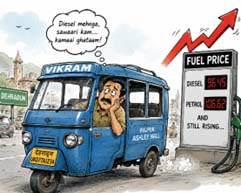
The other evening, I boarded the famed and ubiquitous Vikram of the Doon ecosystem from Rajpur to Astley Hall. Sitting next to the driver, one is literally on the hot seat — right above the engine. As he expertly navigated the chaotic traffic, I struck up a conversation with him.
“Diesel ka price badh gaya hai,” I remarked innocently.
It was as if I had touched a raw nerve.
He burst out emotionally about how the rising diesel prices, coupled with the stagnant Vikram fare — still a minimum of Rs 10 — were eating away whatever little profit he managed to make.
Soon, our conversation drifted to the rising cost of daily essentials — milk, cooking gas, vegetables, school fees, medicines — everything seemed to be becoming more expensive by the day.
With a weary smile he said, “Kya karen sir… kaam to karna hi hai. Bachhon ko, family ko, aur mataji-pitaji ki dekhbhal bhi to karni hai.”
He then narrated the story of a friend who runs a tea stall nearby. Same struggle. Same anxiety. Same helplessness.
Our conversation soon turned international when I asked him: “Do you know who the President of the United States is?” He looked at me with genuine confusion, as if wondering what this had to do with life in Dehradun. Wiping the sweat off his forehead, he gave me a look that silently asked whether this information was really necessary for me to reach Astley Hall safely.
Then he replied honestly: “No idea, sahib… but diesel has become expensive again.” I shifted uneasily on the seat above the roaring engine.
Let me try again, I thought. “Do you know where the Strait of Hormuz is?”
A look of concern crossed his face. Perhaps he thought the heat had finally affected me. Or maybe he assumed it was the name of some new bypass road being constructed in Dehradun — after all, government is always building something to ensure we reach Amrit Kaal at the earliest.
“Somewhere abroad?” he replied sheepishly, slightly embarrassed by my strange line of questioning. Technically correct, I thought.
The truth is, he did not care where the Strait of Hormuz was. And honestly, why should he? His geography consists of potholes, traffic diversions, petrol pumps, tea stalls, and the ever-decreasing quantity of food on the family table. Yet, ironically, his entire life — and ours — is controlled by events unfolding thousands of kilometres away in places we neither understand nor care about. A conflict erupts in the Middle East. Oil prices fluctuate. Shipping routes become tense. Global markets panic. Television experts appear with arrows, maps, and complicated jargon.
And suddenly, the Vikram driver in Dehradun pays more for diesel, while the tea vendor quietly reduces the sugar in each cup by half a spoon. As I sat there listening to him, a sense of resentment slowly welled up inside me. Why should ordinary people become unwilling stakeholders in international conflicts? Most of us do not care which country threatened whom, or what strategic alliance is collapsing somewhere across the globe. We only know that life has become more expensive and more difficult.
Crores of people struggling through the daily grind may not know what NATO is, but they certainly know that cooking oil has become costlier. That is the cruel reality of globalisation in its purest form.
A man who has never stepped outside Dehradun suddenly finds his life affected by decisions taken in distant capitals thousands of kilometres away. Unknowingly, we have all become participants in trade wars, oil diplomacy, sanctions, currency fluctuations, shipping insecurity, and geopolitical power struggles.
For all this, we require neither a passport, nor a visa, nor — most importantly — our consent. Meanwhile, television experts sitting in air-conditioned studios solemnly remind us: “The Strait of Hormuz is strategically critical.”
Perhaps it is. But strategic importance means little to the common person whose immediate concern is tomorrow’s school fee, the next gas cylinder, or whether vegetables can still fit into the monthly budget.
And perhaps that is the greatest tragedy of modern economics. The common person neither starts distant conflicts nor understands them fully, yet their consequences arrive uninvited at the doorstep — through fuel prices, food inflation, electricity bills, transport costs, and finally through that silent, painful moment when one more item is removed from the grocery list.
Somewhere between the Strait of Hormuz and a rattling blue Vikram in Dehradun lies the entire story of the common people. They may never know where the Strait of Hormuz is, but every time diesel prices rise, the Strait of Hormuz finds them.