 By Ranee Kumar
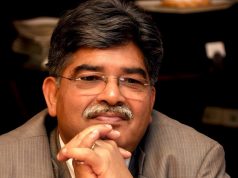
He is a cut above the rest- the OT is his lifeline, the patient, his precious protection whose success at survival is both a test and pride of his skill. Meet Dr. Satyaki Nambala, the no-nonsense cardio thoracic surgeon, the pioneer of robotic heart surgery in India.
His career path makes for an intriguing study of how, by sheer determination, diligence and dedication one can make his dream come true. With a busy schedule that doesn’t pause for an extra breath, getting to Dr. Satyaki for a talk on his medical journey was nothing short of a trapeze! A patient wait and he was there, fresh as ever, ready to traverse into the past to make the present intelligible.
What was his inspiration to do medicine in the first place?
“More than out of the blue inspiration, it was the family environs that hardly gave me a scope to look elsewhere. Mine was a houseful of doctors. My father an ENT surgeon, a double MCH from Edenborough; my maternal uncle an Orthopedist and well, I grew up on the precincts of their clinics. In the 70s and 80s, most doctors owned small places close to their home or attached to it and as a child I remember the clinic being my playfield. Like an errand boy I used to hand over medical equipment to my busy doctor elders. So, I didn’t think twice about what I wanted to do. Medicine of course! It was the most natural thing to do for me.”
Born and brought up in Bangalore, Dr Satyaki’s ancestral roots are traced to the exotic Shimoga district of Karnataka. He graduated in MBBS in 1982 from Mysuru’s JSS Medical College and went ahead to do his Masters in Surgery from St. John’s Bengaluru. “While doing my PG, I was passionate to take up cardiac surgery but fought shy to declare my intentions.”
Reason? “Simple. It was not a subject that gains approval by elders in the field nor by my family of doctors nor my colleagues/classmates. When I broached my intention, my professor presented a bleak scenario: there was no future in cardiology; this was in late 80s. Mortality rate high in cardiac surgery. Further it was still an evolving area in India. Here the medical profession considered and claimed that cardiac surgery was a dead profession. After a few failures by bad luck, the surgeon may be left with no work. Come what may, I couldn’t douse my professional passion to make it to my goal.”
So finally? “Yes, I went on to qualify for the then famous Sri Chitra Thirunal Institute for Medical Sciences and trained for three years in cardiac surgery. In my final year, I happened to watch the famous Canadian cardiovascular surgeon Dr. Tirone E. David (known for The David Procedure) operate upon a patient. I was fascinated by this complex operation and then and there I decided that if ever, I want to work with Dr David. That was a tall order I gave myself. Didn’t at once know how to go about it. I took up a job in Manipal. Before I go further, I’d like to make a point. If we keep the fire of passion burning with grit and determination, the universe will take a U-turn to bestow us with what we want. It so happened that Dr. David had one vacancy for a trainee and the surgeon who applied for it from UK couldn’t make it. And here, I was frantically waiting for an opening. I was asked to apply and in 2003, I landed in Toronto. Dr. David’s unit was teeming with experts. My exposure and experience to them was nothing short of excellent because my entire personality underwent a change. They transformed me from a shy surgeon to an assertive/commanding doctor in the OT. It was a sort of ‘hands on’ training ground. A senior lady cardiac surgeon entrusted me with the entire operating room with directions that it is me who has to call the shots, take control, make decisions, give orders. Till I do it, nobody in the OT team will take the initiative. This was like an exam, “Dr Satyaki laughed. “I geared up, first a bit hesitant and then in full control. So too, at the operation table. I recall a meticulous Chinese Canadian surgeon known to be a perfectionist, expects trainees to tow the line, made me stand at the foot of the patient on table and do nothing. Just when I thought I can’t survive this indifference and wanted to quit. Just at that juncture, he asked me what I want to do. I told him and he said, he’d give me one ‘anastomosis’ and if I came up to his expectations, I’d get my hands to perform full surgery. I met his level of expertise and next I saw myself lots of surgeries-my dream come true. Though I could get a job there, my unquenched thirst to learn more pushed me towards Brigham & Women’s Hospital of Harvard Medical School which was top notch in mitral valve surgery and in fact in many other specialties. My aim was to do the two-year duration learning in minimal invasive surgery under Dr. John Michael Gaziano. My mentor Dr. David’s recommendation earned me a 10-year Visa to the USA. But I chose to come back to my home city and work.”
Was it a cakewalk to Apollo Hospitals? “It was going by my qualification and work in Canada and US.” But when the going is tough, the tough get going. Dr. Satyaki was performing 5-6 surgeries a month way back in 2009 when he joined Apollo at Bengaluru. He was prodding with Valve surgery with no mentor. He began his minimal invasive as a programme pegging the price low. “Initially it used to take nothing less than 8-10 hours, sapping my team of all energy. Many young surgeons left, unable to take the stress. I didn’t despair; instead went to conferences like in Delhi where I actually demonstrated the surgery. In 2018 we had a state-of-the-art conference in Bengaluru. It was a benchmark conference where the best surgeons world over came and spoke. I made a request to the MD of Apollo to buy a robot. She was aghast as it was a fortune to buy a robot. After much debate, we got the da-Vinci surgical system (robot). There were none doing heart surgery in India with robot. Most just do the harvesting. We are one of the 15 in the world doing full-fledged robotic heart surgery.”
Later, he revealed how exactly he mastered this surgery. It is bizarre for any non-medical person to know that robotic heart surgery is learnt on cadaver (corpse). Dr. Satyaki trained in Asan Medical Centre at Seoul where he did multiple procedures on cadaver with getting finer expertise and tips in the course of training. It was with this last sojourn of training that he confidently and successfully performed 600 plus robotic surgeries to date, a no mean achievement. Awards and accolades sit light on his unassuming shoulders.
In the course of the conversation, he had two things to say. One is about an old lady who came to the hospital insisting on a hand-driven surgery and not robot and within hours of speaking to a patient who underwent robotic surgery, came back to say that she wanted nothing but robotic on herself.
Does the surgeon have anything to say to aspiring medicos? “Firstly, they should forget that it is strenuous work with no instant gratification. It is a steady one-step-at-a-time progress. The passion for perfection should be the driving force. Though I say this, I know how dejected one can get when all others who started with you are somewhere up the ladder and you have to struggle 18-19 years minimum to become a cardiac surgeon. Society doesn’t empathize; it ridicules your inability to reach the top. All I can say is no material possessions including currency can equal the sense of fulfilment in this profession,” he signs off.
(Ranee Kumar is a journalist who has worked with mainstream papers like The New Indian Express and The Hindu. Her area of work was mainly on business desk and reporting as well as art & culture. She is now settled in Doon and actively involved in writing).