Garhwal Post Bureau
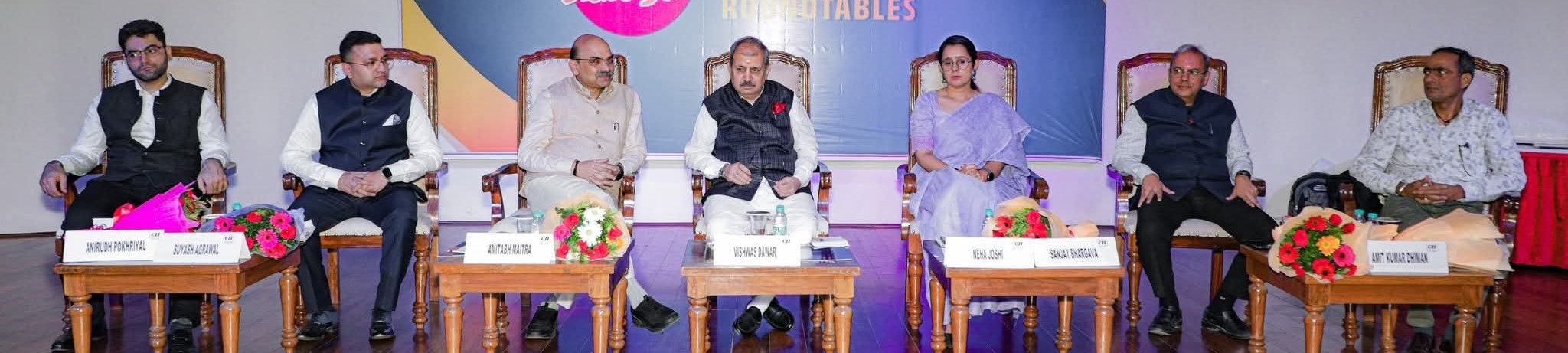
Dehradun, 8 Jul: In a landmark initiative addressing the critical challenges of infrastructure development in ecologically fragile regions, a roundtable discussion on “Building the Infrastructure for the Future” was convened at Graphic Era Hill University, here, recently. The event was organised as part of the Viksit Bharat Young Leaders Dialogue (VBYLD) Young Professionals Roundtable, in collaboration with MY Bharat, the Ministry of Youth Affairs and Sports, and CII Young Indians (Yi). This was the 9th roundtable in the series.
Vishwas Dawar, Vice President of the Infrastructure Monitoring Council, Government of Uttarakhand, highlighted the transformative impact of the Chakrata Road widening project during a recent infrastructure forum. He noted that the project resulted in a fivefold increase in local tourism revenues, underscoring the critical link between infrastructure development and economic growth. He emphasised the state’s commitment to expanding road projects through 12 active Public-Private Partnership (PPP) frameworks, with over 80 infrastructure projects currently underway.
Emphasising CII’s strong commitment to the growth of Uttarakhand, Suyash Agrawal, Chairman of the CII Uttarakhand State Council, stated that CII recognises the state’s immense potential and is eager to collaborate with the government, private sector, and local communities. “Together, we can accelerate infrastructure development and promote a sustainable future for Uttarakhand,” he added during his address.
Emphasizing the ecological fragility of Himalayan states, Neha Joshi, National Vice President, BJYM, stressed the need for sustainable urban planning that includes both residents and the large seasonal tourist population. Joshi also emphasised integrating the Sustainable Development Goals (SDGs) at grassroots levels—districts and panchayats.
Sanjay Bhargava, Regional Chief, HUDCO, Dehradun, pointed to the need for comprehensive urban and peri-urban planning, advocating for the development of counter-magnet towns like Doiwala to reduce stress on Dehradun’s resources. He urged stronger individual and organizational roles in ecological stewardship.
Amitabh Maitra, Chairperson, RERA Uttarakhand, emphasised the importance of transparency, accountability, and efficiency in the real estate sector. He discussed RERA’s evolving role in ensuring consumer protection and sustainable building practices and urged greater awareness among both developers and buyers.
Anirudh Pokhriyal, Director of Hotel The Great Ganga, highlighted challenges of unregulated urban growth due to limited rural opportunities. He proposed the 3S Model—Sadak (roads), Suraksha (safety), and Swachhta (cleanliness)—and advocated for QR-based tourist tracking, homestays, and smart, sustainable development.
Professor Amit Kumar Dhiman, IIT Roorkee, stressed the importance of disaster resilience in Uttarakhand through sensor deployment and structural retrofitting. He urged increased funding for safety infrastructure and called for youth-driven awareness and proactive safety initiatives.
The initiative brought together over 150 students and 35 young professionals, fostering a vibrant exchange of ideas between youth and experts from key sectors.