SDC Foundation Releases Report on Char Dham Yatra 2025
Garhwal Post Bureau
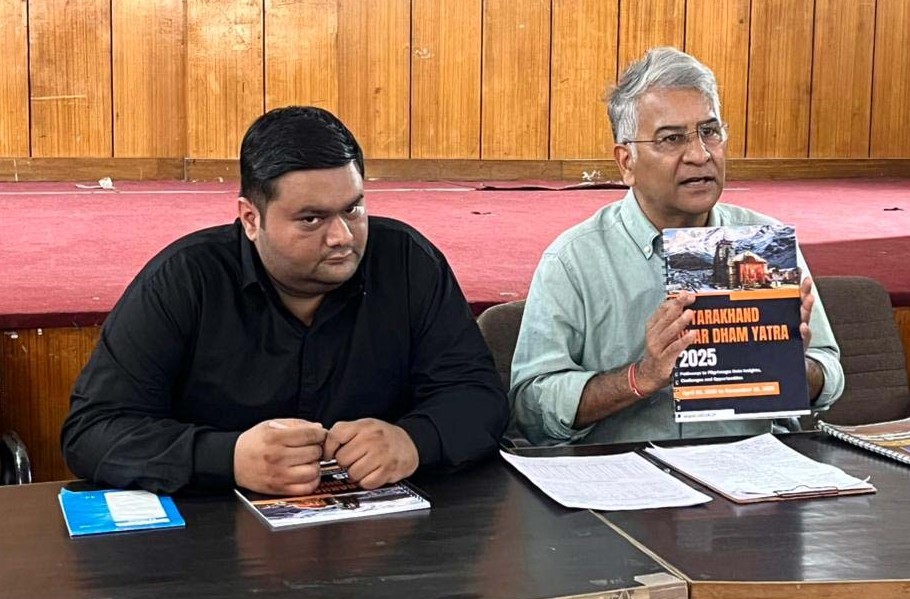
DEHRADUN, 21 Mar: SDC Foundation has released its latest report on the Char Dham Yatra 2025 titled Pathways to Pilgrimage: Data Insights, Challenges, and Opportunities. The report was launched at a press conference held at the Press Club.
Releasing the report, founder of SDC Foundation Anoop Nautiyal, highlighted key insights from the report which includes 210 days and 30 weeks of detailed analysis along with 14 graphs. The report presents ten major data highlights and provides a comprehensive assessment of the Yatra using daily, weekly, and monthly datasets.
The report captures pilgrim trends across the shrines of Gangotri, Yamunotri, Kedarnath, Badrinath and Hemkund Sahib. It includes stakeholder perspectives and expert inputs on safety and management. While 48,01,167 pilgrims visited the Char Dhams in 2024, there was a 6.4% increase in 2025 with 51,06,346 pilgrims. However, the 2025 numbers are considerably lower compared to the total pilgrim footfall of 56,16,653 in the Char Dham Yatra of 2023.
The portal opening dates for the 2025 Yatra were April 30 for Gangotri and Yamunotri, May 2 for Kedarnath, May 4 for Badrinath and May 25 for Hemkund Sahib. One of the most significant insights is that 72% pilgrims completed the Char Dham Yatra within the first 60 days of the season. Specifically, 34% pilgrims visited between Day 1 and Day 30, while an additional 38% visited between Day 31 and Day 60.
In contrast, only 9 per cent pilgrims had visited between Day 61 and Day 90, followed by 3% between Day 91 and Day 120 and 5% visiting between Day 121 and Day 150. While 9 per cent pilgrims visited between Day 151 and Day 180 from end September to October end, post the monsoon period, the remaining 2 per cent pilgrims completed the Yatra in the final 30 days.
Thus, the monthly analysis shows that in 2025, May and June together accounted for nearly 72 per cent of total pilgrim footfall, while July, August and September accounted for only 17 per cent due to monsoon-related disruptions.
The report highlights that the sixth week of the Yatra from June 4 to 10 emerged as the busiest week, during which 5,47,084 pilgrims visited the Char Dhams. This accounted for 11% of the total Yatra footfall within just one week of the 30-week-long pilgrimage.
This uneven distribution highlights the intense pressure during the initial phase of the Yatra and comparatively low utilization in later months.
The 2025 Char Dham Yatra footfall pattern, when simplified into percentages, shows clear patterns across shrines. Kedarnath displays a relatively balanced distribution, with about 44% days experiencing low footfall (below 5,000 visitors), around 25% falling in the moderate range (5,000–15,000), and roughly 27% qualifying as high-footfall days (above 20,000). Badrinath follows a somewhat similar trend but is slightly more skewed toward lower traffic, with nearly 51% of days in the low-footfall category, about 26% in the moderate range, and approximately 10% in the high-footfall bracket.
During Char Dham Yatra 2025, a total of 86 Zero-pilgrim days were recorded across the five shrines. Additionally, 67 days saw footfall between 1–500 pilgrims while 80 days recorded 501–1,000 pilgrims. Yamunotri reported the highest disruption with 38 zero-footfall days, followed by Gangotri with 35. Kedarnath, Badrinath, and Hemkund Sahib also experienced multiple low and zero-footfall days, indicating significant variability and repeated interruptions in daily pilgrim arrivals throughout the season.
The report outlines several challenges including overcrowding during peak periods, stress on infrastructure, aero safety and overall safety concerns in high-altitude zones, and environmental degradation along the Yatra routes. It emphasizes that increasing pilgrim numbers without corresponding planning and safeguards could pose serious risks.
During the 2025 Yatra, at least five helicopter incidents were reported within about six weeks, including two fatal crashes that caused around 13 deaths, highlighting serious safety concerns on routes serving Kedarnath Temple. One major chopper accident near Gaurikund alone killed all seven people on board, underscoring the risks of flying in fragile Himalayan conditions. This is a major challenge because helicopter services are essential for access and crowd management, and repeated accidents not only endanger lives but also disrupt operations and reduce pilgrim confidence in the yatra system.
The zero pilgrim and low pilgrim days disruptions, largely driven by extreme weather, landslides, and damaged infrastructure, significantly reduced pilgrim flow. This creates a major challenge because the yatra is a key economic lifeline, and prolonged low turnout directly impacts the livelihoods of local communities dependent on tourism. The situation underscores the urgent need to shift focus from record pilgrim numbers to building resilient infrastructure.
The report offers 10 key recommendations for safe and sustainable management of Char Dham Yatra and mainly stresses on prioritising safety over record breaking footfall, implementing carrying capacity based regulations and establishing a comprehensive disaster management protocol. It advocates strengthening aero safety regulations for helicopter operations, pursuing climate adaptation and sustainable infrastructure development and improving medical preparedness and health safety systems.
Other recommendations include enhancing governance and accountability, strengthening stakeholder involvement including local communities, promoting waste management, clean mobility and environmental protection and building a data driven, technology enabled yatra management system
A dedicated section of the report includes stakeholder expressions and expert contributions. Capt DK Yadav, a veteran helicopter pilot, contributed an article on aero safety, highlighting the need for stricter weather compliance, improved pilot training, and regulation of helicopter operations in high-altitude areas.
Bhaskar Dimri, former member of the Badrinath-Kedarnath Committee, emphasized improving coordination among agencies, strengthening infrastructure, and enhancing emergency response systems to ensure overall Yatra safety.
Emphasis on Safety and Sustainability along with Data-Driven Governance
Anoop Nautiyal reiterated that SDC Foundation had prepared a similar report during the 2024 Char Dham Yatra and continues to advocate for evidence-based planning. He stressed that the government must move beyond celebrating record numbers and focus on ensuring safety, sustainability, and better management practices.
Praveen Upreti of SDC Foundation was present at the press conference and was acknowledged by Anoop Nautiyal for his extensive work in data compilation and analysis. He remarked that if a civil society organization with limited resources can produce such a detailed report, it raises serious questions about the absence of robust evidence-based data-based policy and planning by government agencies. He added that the report will be submitted to the Tourism Minister, Chief Secretary, and other key stakeholders.