
 By Rajshekhar Pant
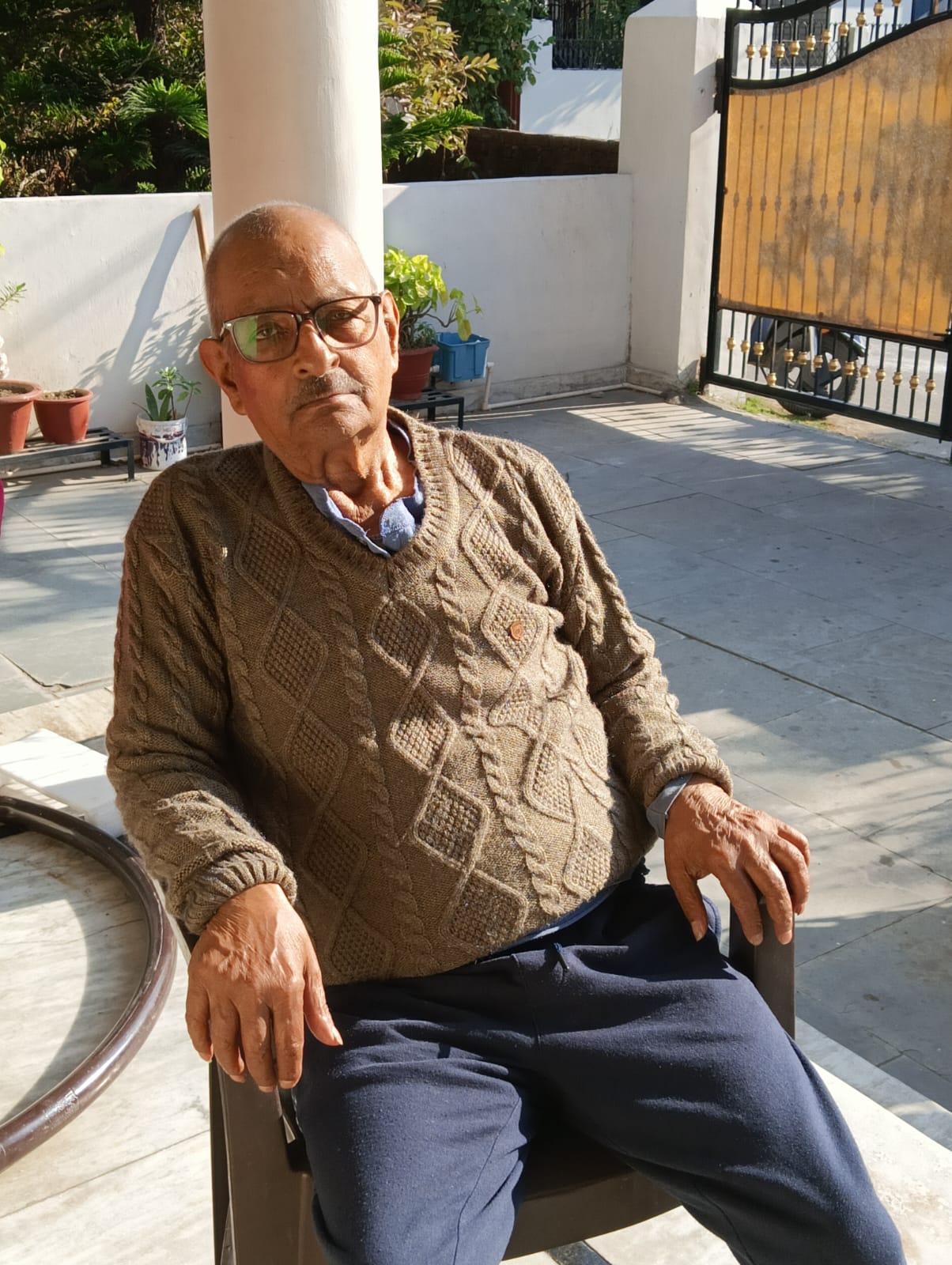
A few days ago, after an unreasonably long interval, I found myself in the foothill town of Haldwani, walking into the modest courtyard of Prabhat Upreti ji—known, with affection, as Polythene Baba (thanks to his relentless crusade against polythene). I had meant to visit him for a long time; life, with its quiet obstructions, had intervened. The last I had heard, he was preparing to undergo chemotherapy.
There is a certain stillness about him—an inward composure—that turns even the simplest meeting into an experience. If you ask about his health, he gathers it into a sentence or two, almost dismissively, as though to suggest that one’s own troubles are never the whole story.
That morning, in an effort to move the conversation away from the body and its frailties, I asked what had been on his mind of late. He shifted his chair into a slant of sunlight falling across the courtyard and said, almost to himself, “These days, I have been wondering—what is knowledge?” And then, without ceremony, he placed the question before me.
It was not a question I had lived with. Still, compelled to respond, I reached for something familiar. I said that what we gather from books, conversations, and the scattered commerce of ideas is perhaps information—useful, certainly. It helps us secure livelihoods, impress others, arrange our lives into more comfortable shapes, even soothe the vanity of the self. But knowledge, if it is anything at all, must be something other—something that arises from within, unbidden; something for which books are not the only doorway.
Even as I spoke, I knew the inadequacy of my answer.
The question lingered.
What is knowledge? Is there truly a line that separates it from information? Or is that line only imagined? Can an unlettered person be knowledgeable? Is knowledge an inward awakening—or simply a name we give to a certain clarity of living?
Thought does not move in straight lines. It strays. Mine returned to my student days, when I would linger after class to speak with Dr Shakambhari Dwivedi, who taught us ancient Indian history. Those were years when Buddhist philosophy held a particular fascination for me.
One day, she asked me whether I had ever considered the use of what we study—history, literature, any discipline—in life. She explained that learning is not merely the accumulation of facts; it is a way of refining the mind—sharpening intellect, deepening sensitivity, and giving structure to thought.
At the time, I did not fully grasp her meaning. But with the slow passage of years, her words have acquired a quiet authority. What we learn—in books, classrooms, seminars—may be no more than preparation. It tills the soil; it does not yield the harvest. It readies us for knowledge, but is not knowledge itself.
Good and evil may be, in many ways, relative. Yet some things resist relativism. To harm another for one’s own gain remains wrong, regardless of circumstance. War, however justified, carries within it an undeniable tragedy. Beneath such recognitions lie moral values—those slow accumulations shaped by culture and civilisation in their effort to make life more humane.
When the skills we acquire through information come under the guidance of these moral values, they begin to resemble knowledge. Without such guidance, they remain accumulation—nothing more. If, after studying environmental science, the melting of glaciers or the pollution of rivers leaves one unmoved, then what one possesses is information, not knowledge.
And yet, the matter is complicated by the uneasy interplay of reason and sensitivity. Reason draws upon information—it organises, analyses, contests. Sensitivity belongs elsewhere—to that inner terrain of feeling, of finer intuitions, of something unarticulated that unfolds within us over time.
Faith belongs to this realm—intimate, shifting, deeply personal. It does not always submit to the demands of logic. Knowledge, perhaps, refines faith without diminishing it. Reason, on the other hand, interrogates it—sometimes with the sole intention of dismantling it.
All that can be learned or demonstrated may be no more than a pathway toward knowledge, not its destination. Knowledge itself appears less as an acquisition and more as an experience—an inward truth whose presence becomes visible in the texture of one’s conduct.
I am reminded, in this context, of an early memory. The principal of my school in those years was, by most accounts, a corrupt man. My first published story was written about him. He was, nonetheless, a person of cultivated tastes, with a strong command over language and literature.
In the same school worked a fourth-grade employee—a man of striking simplicity. Honest, unassuming, and gentle, he moved through life with an ease that seemed almost effortless. I never saw him angry or heard him speak ill of anyone. He carried others’ sorrows as though they were his own responsibility.
If I were to choose, I would say that he possessed a deeper knowledge than the principal ever did. There was in him a quiet fullness—as though he inhabited each moment completely.
The ability to speak eloquently on the Gita, or to hold an audience as a motivational speaker, does not necessarily arise from knowledge. I often think of a Nepali labourer who worked in our garden. On moonlit nights, he would sit alone on a large stone, long after his work was done. When I once asked him why, he simply said, “How beautiful this world is.”
There was, in that utterance, a stillness—almost a form of equanimity—that is difficult to name. Perhaps he had no quarrel with life. Perhaps he had learned how not to measure his existence against another’s.
To live life in its fullness—without the constant intrusion of comparison—perhaps that is knowledge. And perhaps, without a certain openness of faith, such a state remains inaccessible.
This is not to romanticise renunciation. The labourer likely knew his limits and possibilities. He did not place his life in opposition to another’s. Had he done so, the beauty before him might have remained unseen.
Human nature—what we might call the psyche—is marked by its frailties. To recognise and rise above them may well be the essence of knowledge. It has little to do with status or achievement. One may be widely read, well-travelled, outwardly accomplished—and yet remain inwardly unsettled, diminished by comparison, consumed by envy.
It seems to me that knowledge is rooted more in the emotional life than in the intellectual. Information often conditions this very emotional life—shaping it, directing it, sometimes distorting it. And yet, this conditioning is not inevitable. If it were, the discoveries of science would not so often serve destruction.
To mistake information for knowledge—this, perhaps, is one of the deeper ironies of our time. In an age saturated with information, we find ourselves subtly governed by it, even as our inner lives are left with little space to unfold.
And perhaps it was this dissonance that Jaishankar Prasad sensed:
ज्ञान दूर कुछ क्रिया भिन्न है। इच्छा क्यों पूरी हो मन की।
एक दूसरे से न मिल सके।यह विडम्बना है जीवन की।
– जयशंकर प्रसाद (कामायनी)
(Knowledge is far, while actions stray,
The mind’s desire doesn’t find a way.
They never meet and drift apart;
This marks the irony of the human heart.)
(The author is an amateur filmmaker, a photographer, and a writer, who has written over a thousand writeups, reports, etc., published in the leading newspapers and magazines of the country. He can be reached at pant.rajshekhar@gmail.com)


