Book Review
 By Yauvanika Chopra
============
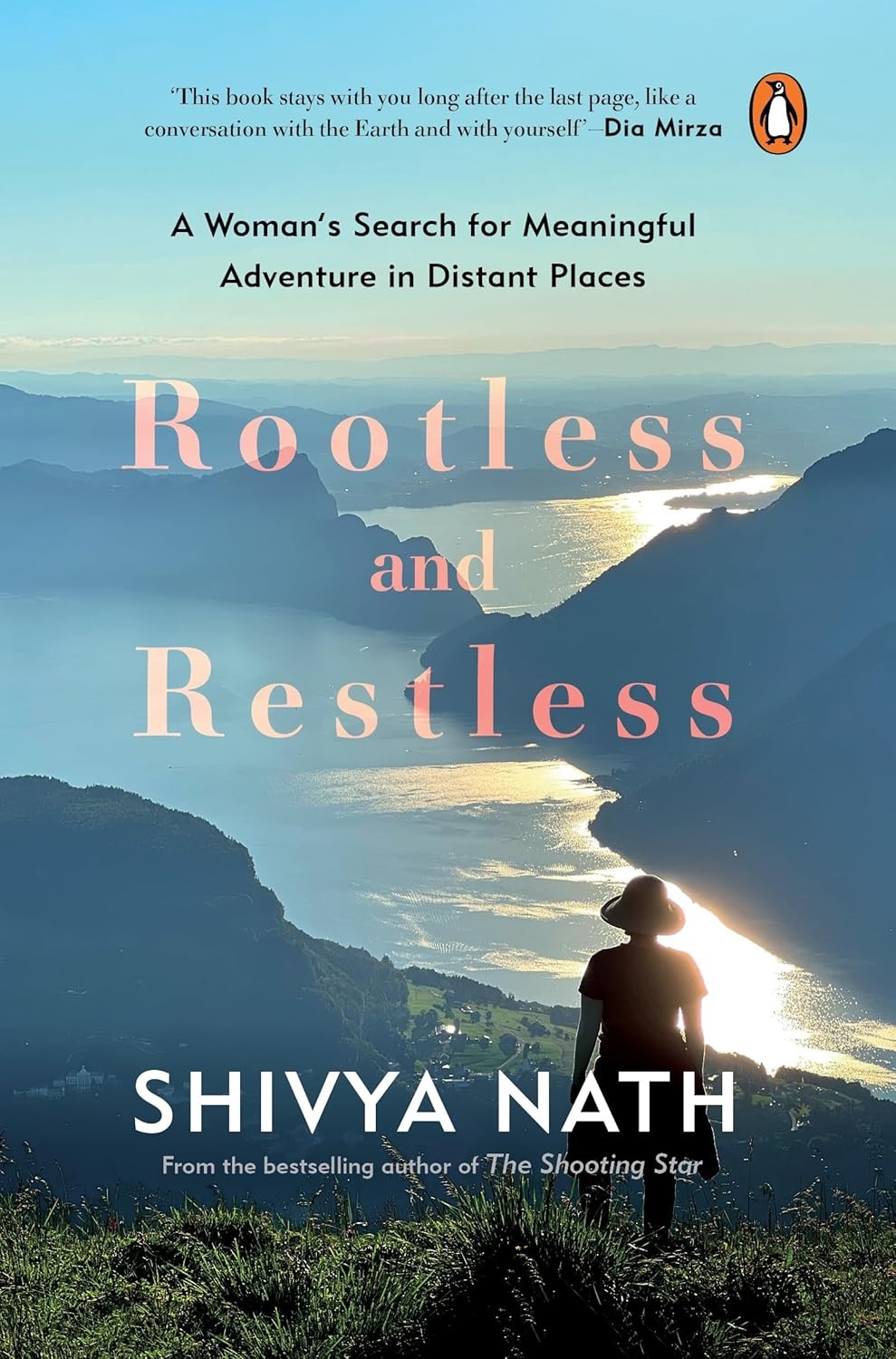
Rootless and Restless:
A Woman’s Search for Meaningful Adventure in Distant Places
By Shivya Nath
============
On a moonlit night, a young woman walks alongside three new friends, upon a Caribbean beach where green turtles usually waddle ashore to lay their eggs on the same land they had once hatched in. The white sand below unexpectedly gives way to a pervasive brownish grass which the four humans identify as algae. Algae has begun to infest this beach over the years; fewer and fewer turtles are coming to shore.
The woman in our book is author Shivya Nath. This chapter is ‘Under the Ocean’ and is about Cuba in 2018. On her first morning in Cocodrilo (Spanish for crocodile), Shivya had dived into a stunning universe of 55-million year old coral reefs whose vibrant colours are bleaching into grey because of plastic waste from ordinary instruments of modernity like water bottles which take 500 years to erode. The cost of human convenience is unequally borne by the non-human. And there are no easy solutions. Cuba has conserved its natural environmental resources due to a socialist regime, but the flipside of that economic structure is that it curtails individual (now somewhat inherently capitalist) dreams like those of slow travel – Shivya’s life calling and profession – for its own citizens. How, she questions, do we contend with a paradoxical world? What is a sustainable balance between consumption and ethics or between individual responsibility and collective fears? Could our personal “handprints” as travellers help offset the global carbon footprint of tourism?
Towards the end of her Cuban trip, as enduring love and urgent worry for the ocean coalesced into overwhelm, Shivya met an elderly islander. Their languages were different and it was unlikely that they would understand each other, but she spoke to him about her increasing anxieties for the future regardless. “As we parted, he tapped his heart with his broad palm, and speaking slowly through rum-thick words, said that we may not understand each other, but we are bound by el idioma del alma—the language of the soul… As I walked along the pebbly beach, under the last light of the evening, I mulled over his words. The language of the soul connects us not just to each other, but also to all other beings we share this planet with. Perhaps there’s hope as long as that remains true.”
“Quelat” means the sound of falling water in the language of the nomadic Chono people in Chilean Patagonia, and lends itself to the name of the Hanging Glacier off the Carretera National Highway. To Shivya, “quelat” becomes a word echoing with the promise of working towards a world with better climate awareness for the glaciers which formed 2.6 million years ago and which continue to store nearly 70 percent of all freshwater on our planet. Much of human history, as Shivya documents along her journeys, has been spent in harmony with these and other ancient ecosystems.
Plant-based food culture, for example, has existed even in spaces which are now known for meat-heavy cuisines. In Japan, the author records that “ito daki mas” is said before every meal as a prayer of gratitude to the plants and animals whose lives are sacrificed for our satiation. Reverence for nature is an ingrained impulse of the Japanese. Travelling through the Kansai countryside, discussing how Shintoism co-exists with Buddhism, Shivya comes upon an unexpected bloom of mitsumata (Oriental paperbush) flowers. “Unlike the planted cherry and plum blossoms, these yellow flowers appeared to be entirely wild and untamed, as though the Earth was exploding with joy at the arrival of spring. Who knows how long they’ve blossomed in that ancient forest, and what relationship they share with the lean sky-gazing cedars?”
“Travellers are in too great a rush these days, in a rush to arrive—whatever it takes. But you do not arrive only at your destination. At every stage of the journey you arrive somewhere…” is the quote from Samarkand by Amin Maalouf which begins the chapter on Uzbekistan (‘Under the Walnut Tree’) in 2019, where Shivya landed one early spring evening for a storytelling project supported by the United States Agency for International Development (USAID). Walking through Tashkent’s Chorsu bazaar and finding herself in an unpleasant situation, she considers the dangers of solo travel as a woman. Debates about courage versus naïvete intertwine within societal realities of gender. There is the kindness of strangers, but also potential for cruelty. “The reason I was okay with those stomach-churning nights before embarking on a solo journey to somewhere unknown was because over time, I felt a deep, unshakable faith in the people I was destined to meet along the way. Especially in a world polarized by religion and politics and the veils we wear both literally and figuratively, I believe our intrinsic character hasn’t changed.” Risk, and reward: in Bukhara, at the Naqshbandi memorial of 14th-century Sufi saint Baha’uddin, an unforgettable witnessing of the sun descending in a blaze of orange to the sound of Sufi chanting from the shrine.
Shivya had quit her full-time corporate job in Singapore in 2011 to pursue a nomadic existence of travel in adventures which have been narrated in her best-selling first book, The Shooting Star: A Girl, Her Backpack and the World. In this sequel, family history emerges when, in Myanmar in 2019 (‘Off the Map’), the author hears of a local Nath family who have turned their Burmese villa into a House of Memories. Potential roots connect in Amritsar, where her family had traveled overnight during the Partition, burying precious ornaments in the soil of Lahore with a prayer for future retrieval. When riots broke out in Amritsar in the late 1980s, the family left again for Dehradun. Shivya was in her mother’s womb at the time, “yet unborn, but journeying on that train with my family’s belongings and anxieties”.
Meaningful experience can be found in near-by places. Under the waning moon of the first COVID-19 lockdown, the author finds herself back in her parents’ home in Dehradun (‘In Limbo’). Between repression and rebellion, rootless and restless, childhood patterns resurface and reconcile. And, still yearning to hear stories from other geographies, there is collaboration with Malika Virdi of Himalayan Ark and Osama Manzar of the Digital Empowerment Foundation for an initiative called Voices of Rural India, featuring tales from people in remote Kerala and Ladakh and Spiti in a fulfilling endeavour of exploration. Recognising one’s changing self in the home and the world is its own journey.
On other moonlit nights, Shivya takes us to Isfahan, former capital of the Safavid Empire, where the once perennial Zayandeh River has run dry. Closer home, she describes a full-moon conversation in Bastar about ‘ghotul’, where Gonds and other forward-thinking communities provide space for exploratory consensual relationships between teenagers. And there are sunrises (although sometimes, she admits, these are missed because of the understandable desire to sleep in just a little longer), alongside days and weeks recorded with a sensory vividness which transport the reader too. Whether the humans around her are humblingly affectionate (like on Robinson Crusoe Island) or icily aloof (as happened through Switzerland), Shivya’s sense of wonder for our planet and universe thrum as the baseline for this extraordinary memoir. There are no simple answers to continuing questions — but many paths to understanding through conscious choice, and the faith that perhaps expeditions well-conducted could help us find freedom at the ends of the rainbows we follow.
(Yauvanika Chopra was Associate Director at the New India Foundation and earlier an editor at Speaking Tiger.)