
 By: Ganesh Saili
For years now, I have heard stories about a piano at the Sergeants’ Mess that tinkled on its own. The story goes that if you hold your breath around midnight, you might hear it too!
I tracked down the old barman, who, after years of mixing drinks, had retired from the nearby Convalescent Depot. He was still in the vicinity, living in a house he had built for the family.
‘Oh yes! That piano would begin to tinkle on its own,’ he remembered with a shudder.
An old commandant had asked the pianist to teach his nubile daughter to play the piano. Apparently, he taught her a little more than just that. Later, to hush up the scandal that followed, she was sent off to England.
Whatever happened to the pianist? Despite my best efforts, I have never been able to find even a trace of him. He seems to have melted into the great greyness of India.
If you walk around the Chakkar at night, you might hear the music. It begins with the scales of a beginner, as if the dainty fingers were dancing lightly on the ivory and ebony, and ends up plunging into Bach’s Moonlight Sonata.
Pic courtesy: Tulika Singh Roy
My old guidebooks tell me there was a time when almost every other bungalow had a piano. The upright pianos, made by Johann Lorenz Schiedmayer in Stuttgart around 1895, were ripped apart during World War I. The boards were used to shore up the trenches. Later, in Kulri, there used to be Liebechen & Co., with a music salon (where Chick Chocolate stands now ). It displayed pianos for hire and purchase. Afterwards, the store was taken over by the Armenian Godin. He lived on the first floor above the shop, overlooking the bazaar. It lasted till he joined the other Anglo-Indian families who emigrated to Australia in the 1970s.
One day in the mail I found the cover and the first page of the Skinner Waltz. It came from Stockholm and belonged to the military historian, Ashok Nath, whose seminal work on the infantry regiments of the Indian Army during the First War (1914-1919) has resulted in a book titled Sowars and Sepoys.
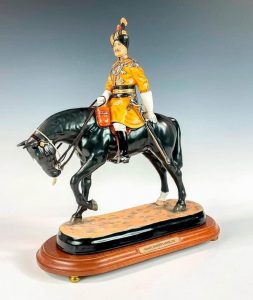
Pic courtesy: internet
Now, having found a single sheet of piano music dating to 1909, composed and dedicated to the famous soldier Colonel James Skinner by his grandson Stanley E Skinner, 1st Duke of Yorks’ Own Lancers, he sent it to me. On realising there were pages missing, I began the search for the complete score.
‘A Skinner Waltz?’ asked Sylvia Skinner, sister of the late Brig. Michael Skinner, the last of the generation of Skinners, still living in Barlowganj’s old Sikander Hall. ‘Never heard of that!’ she said.
The Skinner connection with Barlowganj dates back to Alice Skinner, who built Sikander Hall as a summer home for her less fortunate relatives who too wanted to get away from the heat and dust of the plains. Unwilling to admit defeat, I continued searching, and ended up writing to the antiquarian Hugh Rayner, who living in Bath.
He replied: ‘This is a difficult one! I’m not really plugged into the world of antiquarian sheet music. I shall give it a shot, but if I were you, I wouldn’t hold my breath.’
There are others that I contacted. Finally, a ray of hope came from the Templer Research Centre at the National Army Museum in London. This breakthrough was due to the kindness of the redoubtable David Loyd. Hold your breath in awe, my friends, for David is not the sort who lets you down. A few days later, a padded envelope arrived in the mail. Inside was the rest of the score!
Dear Reader, let me assure you that by now, life’s journey has taught me this: that success is meant only for those who can work through the darkness of bleakest night, with no thought of giving up. Even when every atom of your being cries out loud that the result will be nought.
Soon after, Ashok Nath most generously sent me a recording of the music.
Now, who was it that said: “When words fail, music speaks”?
Ganesh Saili, born and home-grown in the hills, belongs to those select few whose words are illustrated by their own pictures. Author of two dozen books, some translated into twenty languages, his work has found renown worldwide.