 By Kulbhushan Kain
I recently travelled to Gujarat, and one of my primary missions was to visit Dholavira-a place that had long occupied a quiet but persistent corner of my mind.It is after all a site of Indus Valley Civilization.
The journey itself felt like a prelude to something significant. Over nearly 3,000 kilometres, we drove through changing landscapes-busy towns that slowly gave way to vast, open stretches of land, and eventually to the stark, almost surreal emptiness of the Rann of Kutch. There were moments on that road when it felt like driving on a “highway to heaven,” suspended between earth and sky, heading towards something both distant and timeless.
But this was not just a journey of distance.It was, in many ways, a journey of questions.
For years, I had been intrigued by the mysteries of the Indus Valley Civilization. Who were these people who lived thousands of years ago, and yet seemed so startlingly advanced? How did they organise their lives? And most importantly-what happened to them?
And then, almost suddenly, the ruins appeared.
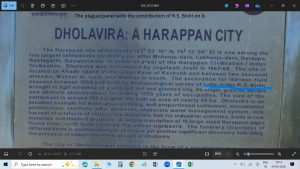
There was no dramatic announcement, no overwhelming monument rising into the sky. Instead, Dholavira revealed itself quietly-like a secret that had waited patiently for discovery. Spread across the arid landscape were the remains of a city that had once thrived over 5,000 years ago.
Before one can fully absorb what lies before the eye, it is worth pausing to remember the man who gave this silence back to the world.
Dr. Ravindra Singh Bisht was born in 1944 in the hills of Uttarakhand-Bhimtal .It was under his patient, painstaking direction that Dholavira was excavated between 1990 and 2005.He retired as Joint Director-General of the Archaeological Survey of India and was honoured with the Padma Shri in 2013. That a son of the Himalayan foothills should travel to the edge of a desert salt flat and resurrect one of humanity’s greatest urban stories is itself remarkable ,one that Uttarakhand has every reason to take pride in.
At first glance, it is easy to underestimate what lies before you. But as you walk through the site, the true magnitude of Dholavira slowly unfolds.
This was no ordinary settlement. This was a meticulously planned city.
The layout is precise-almost astonishingly so. A clear grid system, well-defined roads, and distinct sections-a citadel, a middle town, and a lower town-each reflecting a structured approach to urban living. The houses, though now in ruins, still reveal proportion and durability. The masonry is strong, the alignment thoughtful, the construction enduring.
Then there are the reservoirs.
Massive, geometrically carved water tanks—silent yet powerful reminders of a people who understood the value of water in a harsh environment. Channels, drains, and storage structures all point towards a civilization that had mastered not just survival, but sustainability. Despite the passage of millennia and exposure to harsh climatic conditions. Much of what they built still stands-a quiet resilience in those stones, as if they continue to hold the memory of a time long gone.
And yet, Dholavira is defined as much by its mysteries as by its achievements.
The first question is simple, yet profound-why here? Even today, the Rann of Kutch feels inhospitable. The land is dry, the climate unforgiving, the isolation palpable.
What drew people to this place thousands of years ago? Was the environment different then? Or was there something else-something we no longer understand-that made this location desirable?
The second mystery is more subtle. Where is the evidence of conflict? In many ancient sites, one finds signs of war—destroyed structures, scattered weapons, human remains that tell stories of violence. But Dholavira offers no such narrative. There are no signs of invasion, no layers of destruction, no indication that this city met a violent end. Instead, there is an eerie sense of order,even in abandonment.
Which leads to perhaps the most haunting question of all. Why did they leave?
A city so carefully built, so intelligently designed,why would its inhabitants simply walk away? There are no signs of sudden catastrophe, no evidence of panic, no trace of mass casualties. It is as if the people of Dholavira made a quiet decision to leave,1and did so with a calmness that defies explanation. Did they migrate elsewhere? Did they merge with other cultures, slowly dissolving into the fabric of history?
And then comes the greatest mystery of all—their voice.
The people of the Indus Valley wrote. Seals and inscriptions have been found across multiple sites. They had a script, a system of communication, a way of recording their world. And yet, we cannot read it.
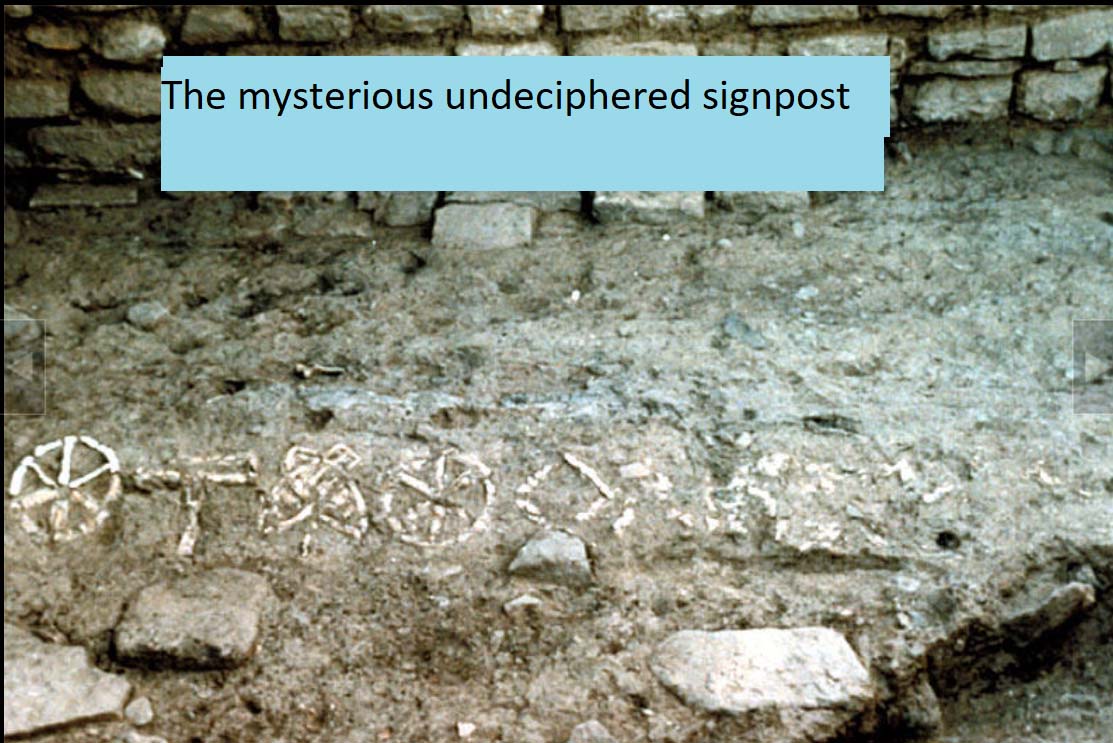
Nowhere is this more vivid,or more haunting than in the Dholavira Signboard. Discovered near the northern gateway of the city, it is believed to be the world’s oldest signboard—ten large symbols fashioned from white gypsum, displayed prominently for all who passed through the gate to see. Scholars believe it may have carried the name of the city, a proclamation of authority, or perhaps a greeting. No one knows. The letters are among the largest Indus script characters ever found—clearly intended to communicate something of importance. And yet, five thousand years later, they remain as silent as the desert wind that sweeps across these ruins. A message composed with deliberate care, displayed with evident purpose,and utterly beyond our comprehension.
Unlike the scripts of Ancient Egypt or Mesopotamia, the Indus script has never been deciphered. Scholars have studied it for decades, proposed theories, drawn comparisons—but the code remains unbroken.
A civilization so advanced in its urban planning, so refined in its execution, and yet, silent to us. We can see what they built. We can admire how they lived. But we do not know what they thought, what they believed, or what stories they told.
Standing amidst the ruins of Dholavira, one becomes acutely aware of this silence. It is not an empty silence. It is a silence filled with questions.
Dholavira does not overwhelm you with grandeur. It does not demand attention through spectacle. Instead, it draws you in quietly, compelling you to reflect, to wonder, and to accept that there are chapters of human history that remain beyond our grasp.
I had set out on this long journey in search of answers.
I returned with something far more enduring, a deeper appreciation of the mysteries that continue to shape our understanding of the past.
(Kulbhushan Kain is an award winning educationist with more than 4 decades of working in schools in India and abroad. He is a prolific writer who loves cricket, travelling and cooking. He can be reached at kulbhushan.kain@gmail.com)