Book Review
 By Manoj Pande
=======
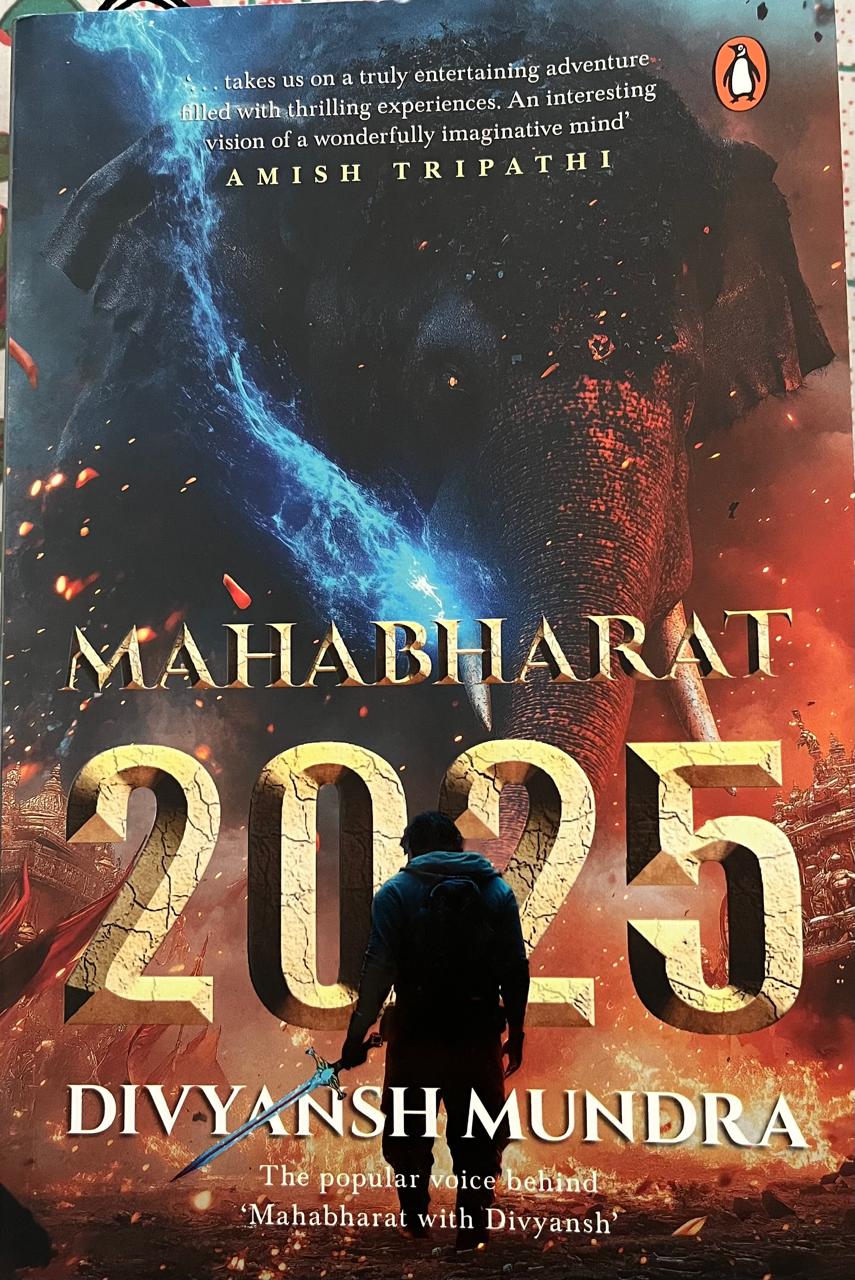
Mahabharat 2025
By Divyansh Mundra
Pages 235
Penguin Random House India 2025
========
Mahabharat – the timeless epic tale of the Pandavas and the Kauravas, is forever fascinating. It has multiple plots and subplots, leading to the final battle at Kurukshetra where great warriors, brothers and cousins were pitched against each other, and in which Lord Krishna as the charioteer of Arjuna, gave the life lesson known all over as the Gita. For years this epic has been an inspiration for many books and movies, that either take a cue from or narrate the story in the context of their times. Divyansh Mundra’s Mahabharat 2025 is yet another.
Set in the present times of the social media and the influencers, the title is somewhat deceptive. There are no Pandavas and Kauravas battling it out in Kurukshetra, yet a host of characters from that epic to carry on their unfinished battles in the present time. Cursed by Shri Krishna to be immortal, the skilled warrior Ashwatthama is supposed to roam the world even today. He, or rather his latest version, plays an important part in the story that moves across various locations – not those where the story of Mahabharat had played out ages ago. However, it does not affect the narrative of the wonderfully imaginative present novel.
Mundra picks up some other characters like Shikhandi, Nakul, Shakuni, a Gandharva and a dog, too, as he paces his novel through the life of a social media influencer Divyansh Ananthar, whose life goes berserk when he learns of his ancestry and that many are out there to end his life, with some on his side.
That the book will not flinch from describing war in its gory detail is clear from the prologue itself when the young boy jumps into the stream and is transported to an ongoing battle in another time. Fast paced and moving from one place to another, the reader can get flummoxed in trying to hang on to the plot in the initial pages. Interspersed with the description of his family that is long gone, one is likely to get confused how suddenly Divyansh realises that his days are numbered and how he gets going with his extraordinary powers.
But no worries. It is mayhem out there. Almost everyone is not what he or she seems, and this makes the plot quite intriguing. The chases never seem to end, but they are very well written and gripping. Many times, the reader wonders what next as the supernatural powers for the different protagonists never seem to cease as the battles continue in places as diverse as Rishikesh and Mansarovar Lake. Therefore, one should not even try and find similarities between THE Mahabharat and this book.
No review of Mahabharata 2025 can cover all the twists and turns. But what can be said to be unique is how some of the present day ‘avtaars’ (for want of a better word to describe them, even though they are not gods) have been depicted. Particularly Shakuni and Nakul. As for myself, I did not know that Nakul was supposed to have been the most handsome of the Pandavas. Naga soldiers and warrior women, too, find their place in the story that picks up pace in the second half.
For reasons best known to the author, some loose ends remain. It would not be correct to say which, as they would take away from the fun of reading the book. However, since many of the characters are well known from the original Mahabharat story, the reader cannot help but wonder why. No doubt the main character is Divyansh but others with supposed links to the Mahabharat also form no mean part of the plot. Their stories are quite intriguing and fascinating and would have been interesting too. This however, is the prerogative of the author.
There seem to be two printing/editing errors to my mind. At page 40, Vikram ‘Sampat’ is printed. It should be ‘Samvat’. Similarly, on page 47, ‘Garhwali’ Himalayas is mentioned. It should be ‘Garhwal’. Garhwali is the dialect spoken in those parts of Uttarakhand.
‘Strange times we find ourselves in,’ his heavy voice captured Divyansh’s attention. ‘Hacking trees that we should be saving. Feeding upon animals whom we should be feeding. Disregarding the world that we should be cherishing.’ He took a pause. ‘Soon, all that mankind takes for granted will cease to exist, and in those moments… we will realize what we have done.’ (Page 123).
A thought for the reader and for all of us.
As he says in the Author’s note, Mundhra aspires to be the greatest storyteller in the world and that he is not ashamed of this ambition. Going by this book, some distance is still to be travelled by him in his endeavour.